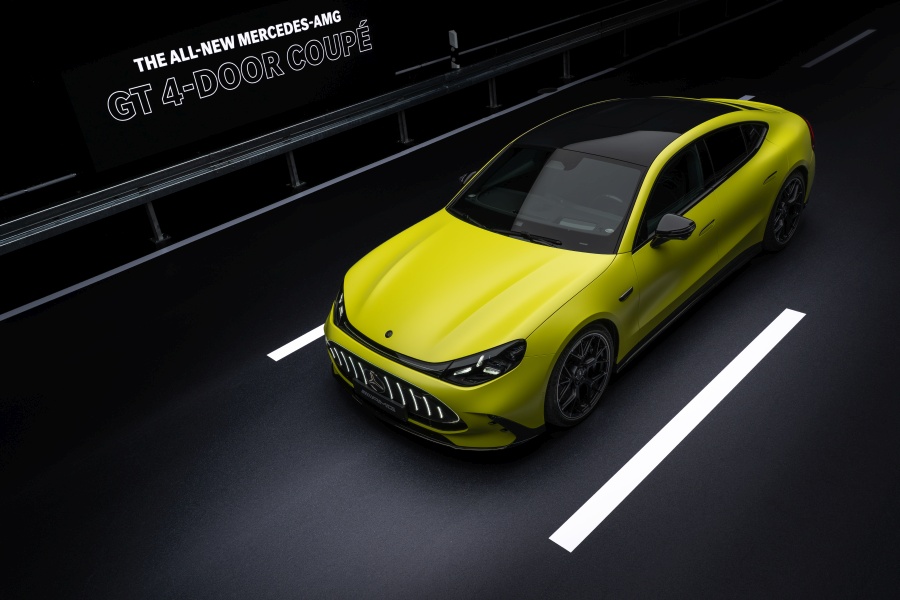
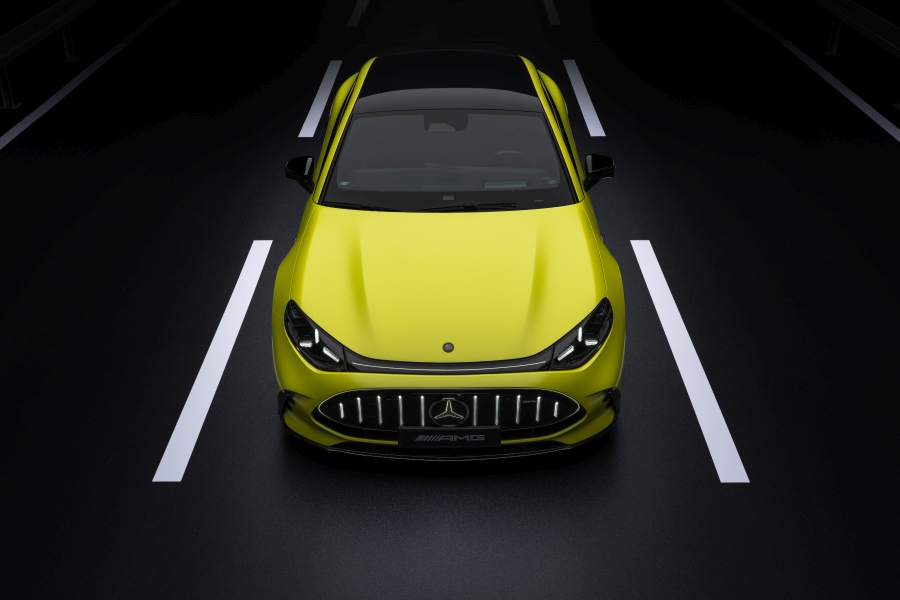
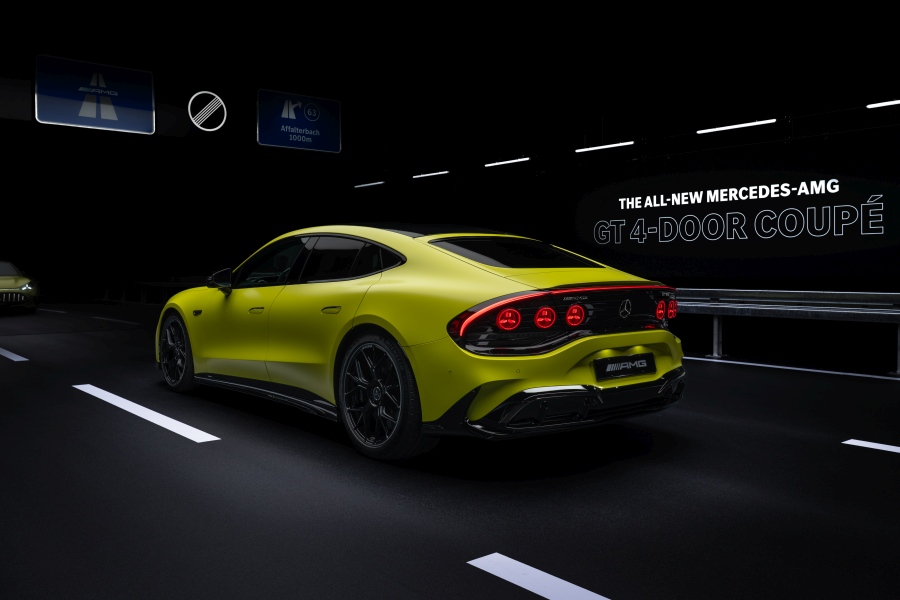
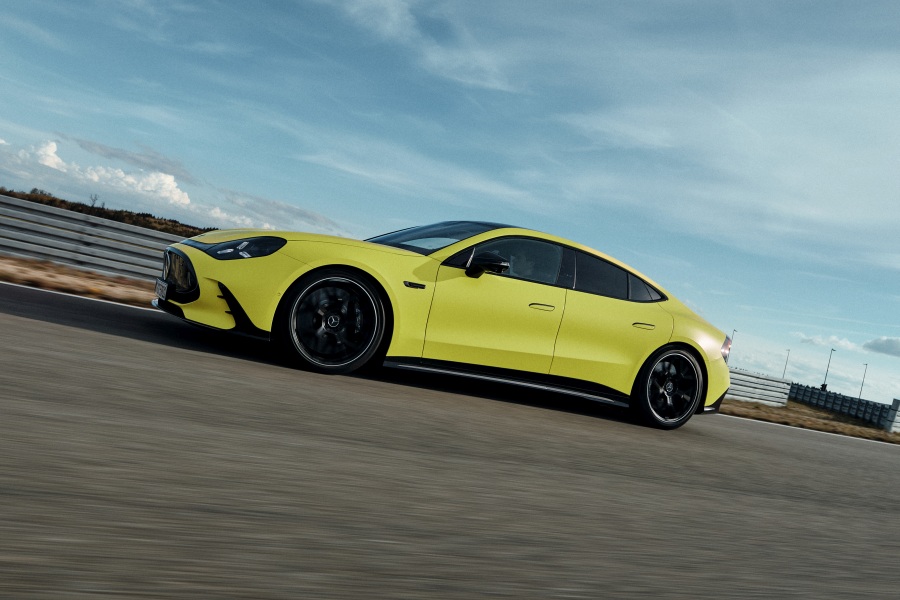
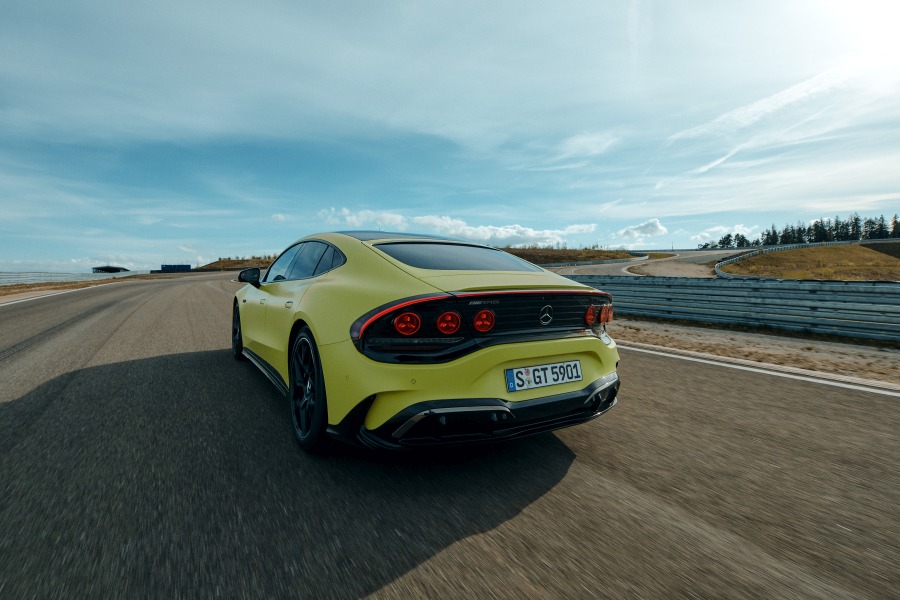
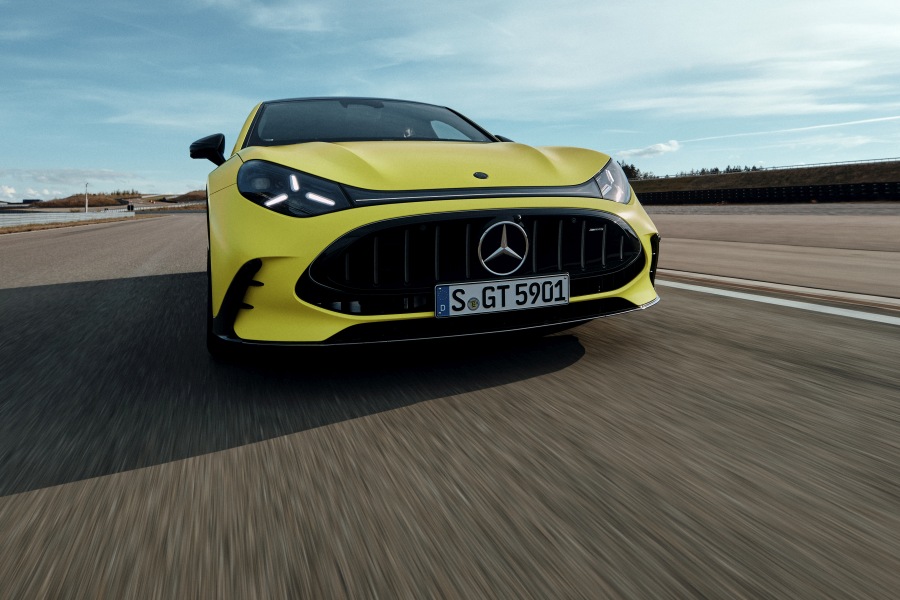
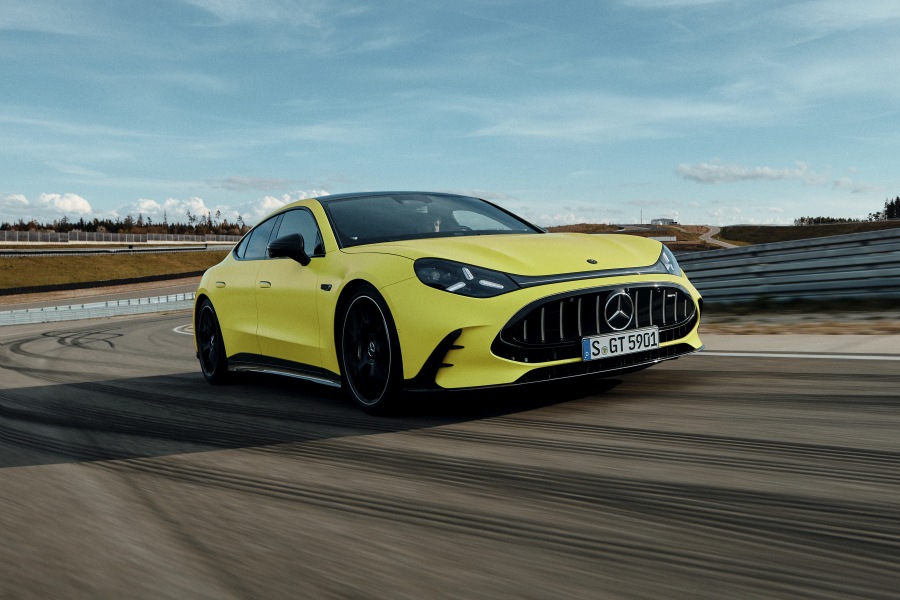
The electric Mercedes-AMG GT 4-Door Coupe replaces the internal combustion engine versions and debuts with two variants featuring three axial-flux motors that produce 816 PS (600 kW) and 1,169 PS (860 kW) respectively. Under the body lies the revolutionary new AMG.EA platform. Here is everything you need to know about it.
Mercedes has made a bold and risky decision by abandoning the combustion-engine Mercedes-AMG GT 4-Door Coupe in favor of a high-performance electric version. This is the first electric AMG model built on the new dedicated AMG.EA electric platform.
Here are the characteristics of this high-tech, high-performance platform.
YASA axial-flux motors
Both versions are powered by three YASA axial-flux motors: two at the rear and one on the front axle. Unlike conventional electric motors, where the electromagnetic flux is perpendicular to the rotation axis, axial-flux motors have electromagnetic flux parallel to the motor’s rotation axis. The main components of the axial motor are designed as thin discs: two rotors surround the stator like a sandwich, on the left and right sides. This arrangement, also known as the H-configuration, allows optimal coupling of the magnetic flux generated by the stator to the rotors.
In addition, YASA motors are incredibly compact. The rear-axle motors are only 8 cm wide, while the front motor is just 9 cm wide. Axial-flux motors also provide higher continuous power and greater torque.
At launch, two versions are available:
- Mercedes-AMG GT 55 4-Door Coupe 4MATIC+ producing 600 kW (816 PS)
- Mercedes-AMG GT 63 4-Door Coupe 4MATIC+ producing 860 kW (1,169 PS)
In both cases, these maximum outputs are available in AMG Launch Control mode when the battery is at 80% charge. However, the AMG.EA platform architecture is designed for outputs exceeding 1,000 kW.
As with other Mercedes models, the front motor acts as a booster and activates only when extra performance or traction is required. It can also be mechanically disconnected from the transmission in other situations. The top GT 63 version accelerates from 0–100 km/h in just 2.1 seconds, reaches 200 km/h in 6.4 seconds, and has a top speed of 300 km/h with the optional Driver package.
Battery with cylindrical cells
For the AMG.EA platform, Mercedes adopted a battery with cylindrical cells instead of the prismatic-cell modules used in MB.EA. This is a solution similar to the one used by BMW for Neue Klasse, because cylindrical cells allow much better cooling. Unlike BMW, however, Mercedes uses smaller-diameter cells: 26 mm compared to BMW’s 46 mm, with a height of 105 mm that enables optimal cooling. There are 2,660 cells grouped into 18 plastic modules welded by laser.
With 800V technology, the battery can charge at up to 600 kW. Why not more? Because 600 kW is the maximum charging power supported by current connectors. Beyond this level, the connector would need water cooling. With a charging power of 600 kW, the NCMA (Nickel/Cobalt/Manganese/Aluminium) battery with a net capacity of 106 kWh (energy density of 298 Wh/kg) charges from 10% to 80% in just 11 minutes.
Semi active suspension
The Mercedes-AMG GT 4-Door Coupé is an imposing GT, measuring 5,094 mm in length, 1,959 mm in width, and only 1,411 mm in height, while the wheelbase is 3,040 mm. Even though the car has a battery integrated into the floor, it is 40 mm lower than the previous internal combustion-engine version.
The large battery and generous dimensions result in an impressive curb weight of 2,460 kg, and Mercedes-AMG has attempted to manage this mass with a sophisticated suspension setup.
The AMG Active Ride Control air suspension with semi-active roll stabilization comes as standard and features three-stage adjustable air springs. An 8.2-liter pressure reservoir allows the body to be raised and lowered quickly, including automatic ride-height adjustment depending on speed, in order to improve driving range.
In addition, the AMG Active Ride Control suspension uses dampers equipped with semi-active interconnected hydraulic elements that replace conventional anti-roll bars. This is a system also used by McLaren, eliminating both locking differentials and anti-roll bars, reducing both suspension weight and body roll.
The front and rear suspension both use a multilink layout, while rear-wheel steering with a steering angle of up to 6 degrees ensures a smaller turning circle. At speeds of up to 80 kph, the rear wheels turn in the opposite direction to the front wheels by up to 6 degrees, while above 80 kph the rear wheels turn in the same direction as the front wheels by an angle of up to 1 degree.
The braking system is a mixed setup, featuring ceramic brake discs at the front axle and steel brake discs at the rear axle.
The Mercedes-AMG GT 4-Door Coupé rides on wheels ranging from 19 to 21 inches, with the 21-inch wheels featuring an optimized aerodynamic design that increases WLTP range by 14 km.
Active aerodynamics
Like the Mercedes-AMG SL, the Mercedes-AMG GT 4-door Coupe features active aerodynamics.
Under the car there are two elements, one at the front and one in the center, which activate at higher speeds to control airflow and generate the Venturi effect, increasing downforce. By accelerating the air flowing beneath the car, they create a low-pressure zone that “glues” the car to the asphalt, improving grip. The front element activates from 120 km/h, while the central element activates from 140 km/h.
A rear spoiler deploys at speeds above 80 km/h and adopts different positions, either steeper or more horizontal, improving stability or reducing aerodynamic drag. At high speeds or during dynamic driving, it extends into its steepest position for maximum downforce and optimum stability. This position can also be activated manually via a button on the steering wheel.
The cooling air management system has been carried over from the Mercedes-AMG SL and GT and further modernized. The vertical louvers behind the radiator grille close or open depending on cooling requirements, for example remaining closed at high speeds. In addition to the AMG GT and SL, the Mercedes-AMG GT 4-door Coupe also features small louvers in the side air intakes next to the radiator grille that help cool the brakes. When cooling demand increases, the louvers open in up to nine stages to channel air to the central battery cooling module and the side radiators.
Pure sports car interior
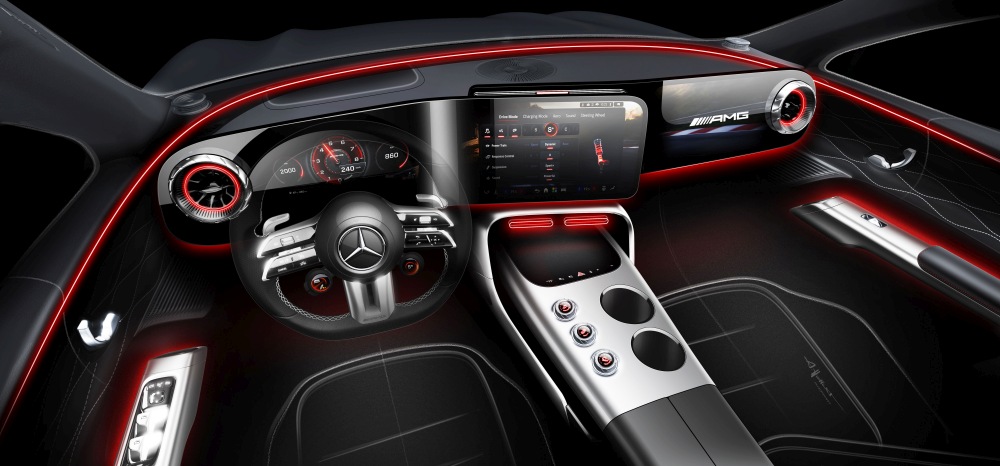
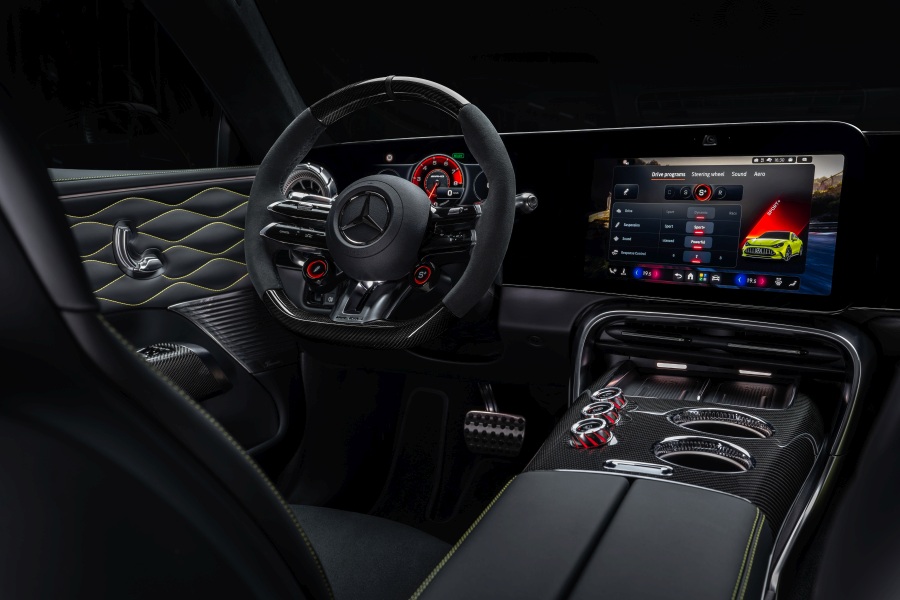
Thanks to the slim and compact battery, the driver feels as if they are sitting in a pure sports car when entering the cabin. The seating position is very low in the excellently contoured seats, while the interior wraps itself around the driver. Even sportier optional AMG Performance seats are also available. The flat-bottom AMG Performance steering wheel is wrapped either in leather or in a superb combination of carbon fiber on the upper and lower sections with microfiber on the sides, and it features paddles for adjusting the energy recuperation levels.
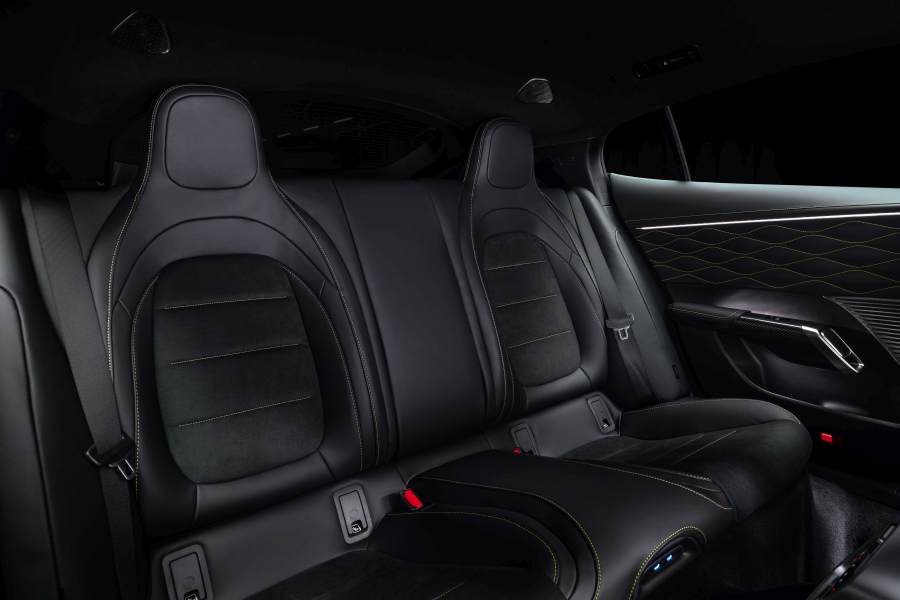
At the rear, the standard configuration includes two individual seats, while an optional three-seat bench is available. In both cases, the backrests can be folded individually. The panoramic glass roof, divided into several segments, can be electronically dimmed. Optionally, at night the roof can be illuminated with glowing AMG crests above the driver and front passenger, as well as motorsport-inspired racing stripes stretching across the entire roof surface.
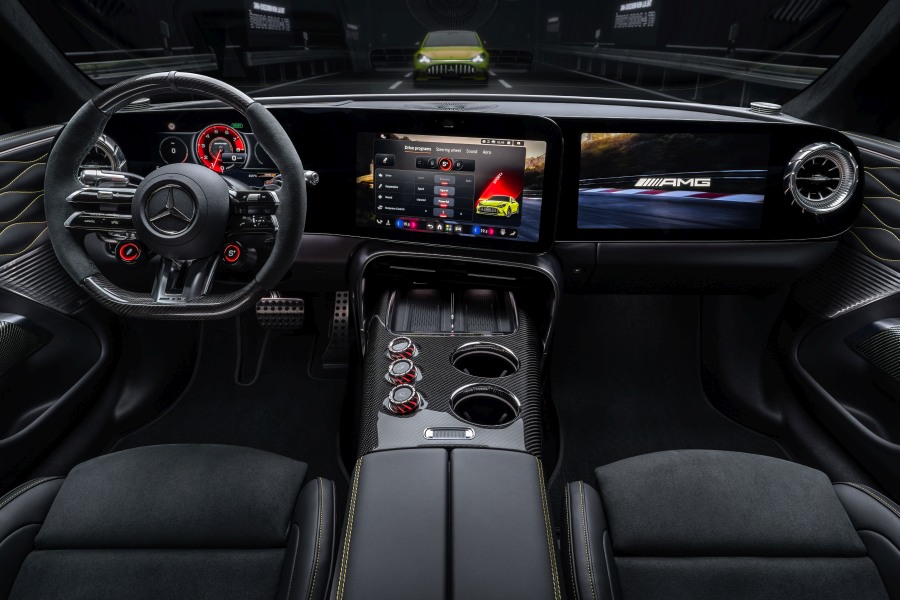
The dashboard includes three displays: a 10.2-inch instrument cluster and a 14-inch multimedia display grouped within the same unit, with the multimedia screen slightly angled toward the driver, plus a separate 14-inch display for the passenger.
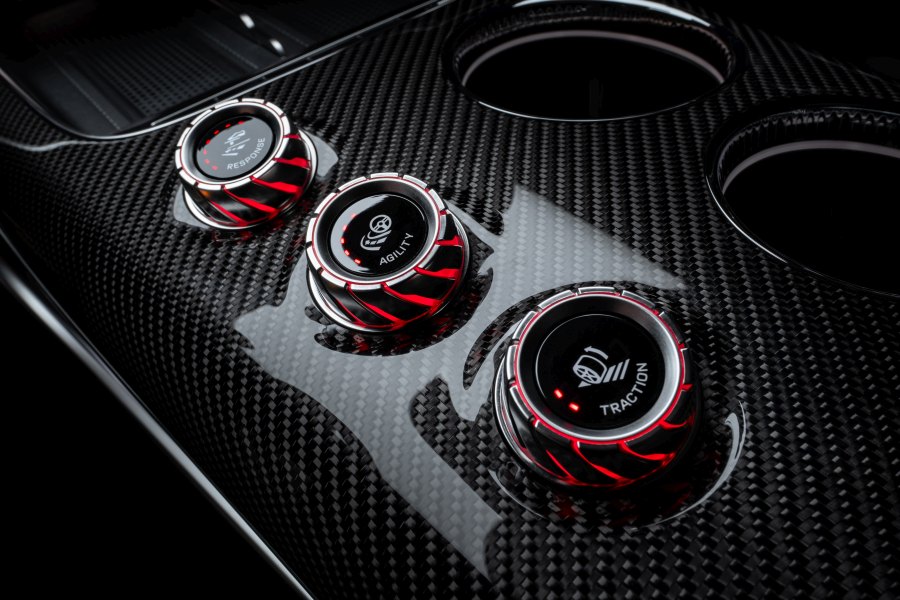
On the high center tunnel, close to the driver, are grouped the three rotary controls for the car’s dynamics:
- Response Control – modifies the response of the electric motors when the accelerator pedal is pressed
- Agility Control – adjusts the car’s agility along the vertical axis and therefore its behavior in corners
- Traction Control – varies the intervention of the traction control system across nine levels
The driver can choose between Comfort, Sport, AMGFORCE Sport+, Race, Slippery, Eco, and Individual driving modes. In Sport, AMGFORCE Sport+, and Race, the Launch Control function is available. Pressing both paddles behind the steering wheel simultaneously also provides a power boost in Comfort, Sport, and AMGFORCE Sport+ modes (up to 10 kW in the AMG 63 and up to 50 kW in the AMG 55).
The special driving mode called AMGFORCE S+ is dedicated to V8 enthusiasts, featuring authentic gearshift sensations and a driver-focused central-tube display design. The patented sound portfolio combines the legendary AMG V8 acoustics with innovative electric technology.
The Mercedes-AMG GT 4-door Coupe will be produced in Hall 32 at the Sindelfingen plant starting in the summer of 2026.
| Model | Mercedes-AMG GT 55 4-door coupe | Mercedes-AMG GT 63 4-door coupe |
|---|---|---|
| Engine | 3, electric | 3, electric |
| Max. output PS(kW) | 600 (816) | 860 (1,169) |
| Continuous power PS (kW) | 375 (510) | 530 (721) |
| Max. torque (Nm) | 1,800 | 2,000 |
| L x w x h (mm) | 5,094 x 1,959 x 1,411 | |
| Wheelbase (mm) | 3.040 | |
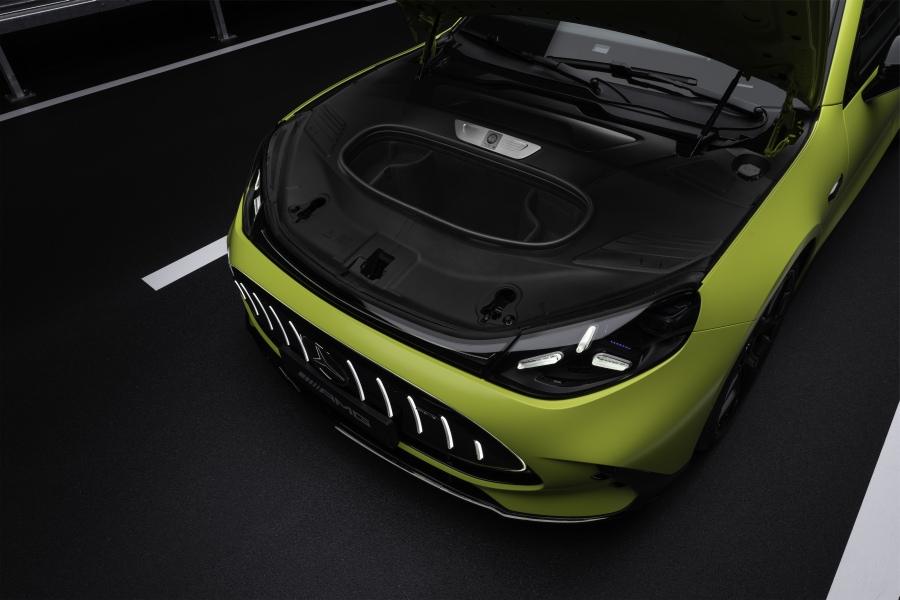
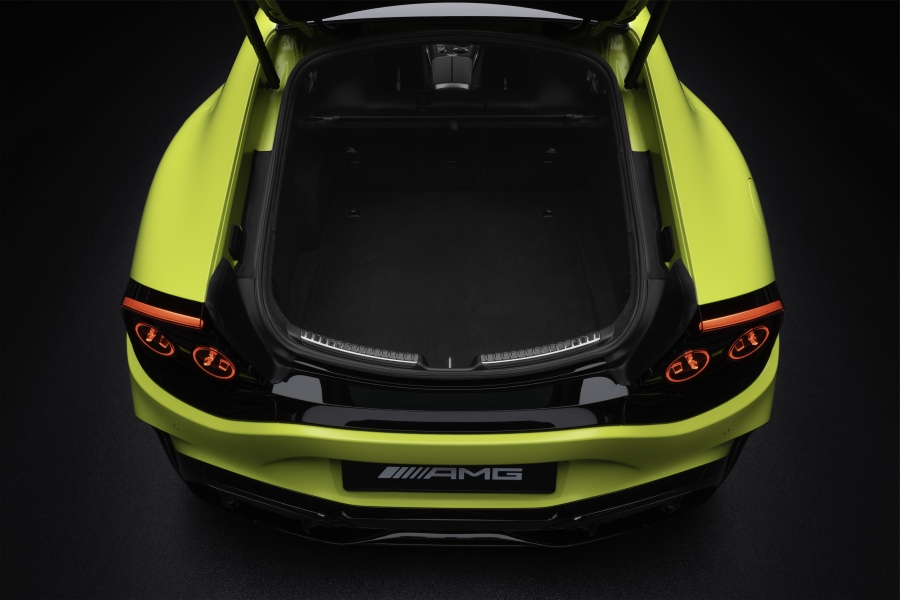
| Boot volume (l) | 62/415 | |
| Kerbweight (kg) | 2,460 | 2,460 |
| Battery capacity net (kWh) | 106 | 106 |
| Charge power DC (kW) | 600 | 600 |
| Charge power AC (kW) | 11 | 11 |
| Energy consumption (kWh/100 km) | 17.8 | 17.9 |
| WLTP range (km) | 700 | 696 |
| Acc 0-100/0-200 kphh (s) | 2.8/9.0 | 2.4/6.8 |
| Top speed (km/h) | 300 | 300 |