BMW 7 Series vs Mercedes S-Class: Who Builds the Best Luxury Limousine in the World?

,
5 0

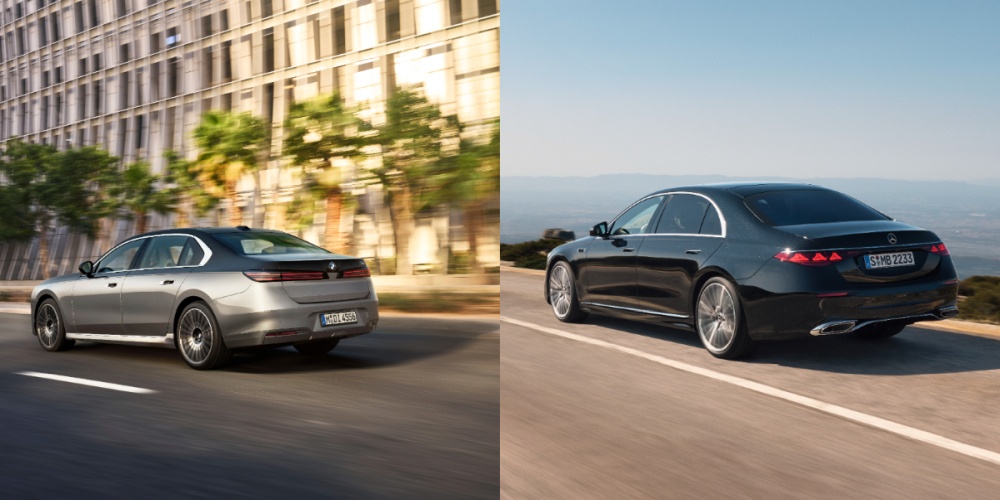
Almost 3 months after the facelift of the Mercedes S-Class, BMW responds with the facelift of the BMW 7 Series. Both facelifts are extensive operations, so we considered it worth making an initial evaluation.

Photo: Mercedes-Benz, BMW

The two German premium limousines are now in their seventh generation, and after the discontinuation of the Audi A8, they remain the only German luxury limousines. The current BMW 7 Series generation (G70) was introduced in July 2022, while the current Mercedes S-Class (W223) was introduced in the fall of 2020. That means the BMW 7 Series is nearly four years old, and the Mercedes S-Class about five and a half years old.

The BMW 7 Series is built on the conventional CLAR platform, which is used for all powertrains – diesel, petrol, PHEV, and electric. In contrast, the facelifted Mercedes S-Class still uses the MRA II platform, and is available with diesel, petrol, and PHEV options, while its electric counterpart, the EQS, is based on the dedicated EVA II electric platform, recently upgraded with 800V technology. It should be noted that the Mercedes S-Class is now offered only in a long-wheelbase version.

Engine lineup

Both luxury limousines use a wide range of engines, but their offerings differ quite a bit. BMW does not offer a V8 engine in Europe, both brands have two PHEV versions in their lineup, and Mercedes offers more diesel and petrol variants—two each, compared to only one from BMW. All conventional diesel and petrol engines feature a new-generation 48V mild hybrid system, with the electric motor integrated into the automatic transmission (8-speed for BMW, 9-speed for Mercedes).

Petrol engines

  • BMW 740 xDrive, inline 6-cylinder, 400 HP / 580 Nm + electric motor 18 HP / 200 Nm
  • Mercedes S 450 4Matic, inline 6-cylinder, 381 HP / 560 Nm + electric motor 23 HP / 205 Nm
  • Mercedes S 500 4Matic, inline 6-cylinder, 449 HP / 600 (640) Nm + electric motor 23 HP / 205 Nm
  • Mercedes S 580 4Matic, V8 flat-plane crankshaft, 537 HP / 750 Nm + electric motor 23 HP / 205 Nm

Diesel engines

  • BMW 740 d xDrive (November 2026), inline 6-cylinder, 286 HP / 670 Nm + electric motor 18 HP / 200 Nm
  • Mercedes S 350 d 4Matic, inline 6-cylinder, 313 HP / 650 Nm + electric motor 23 HP / 205 Nm
  • Mercedes S 450 d 4Matic, inline 6-cylinder, 367 HP / 750 Nm + electric motor 23 HP / 205 Nm

PHEV versions

  • BMW 750e xDrive (November 2026), inline 6-cylinder, 313 HP / 450 Nm + electric motor 197 HP / 280 Nm, total system output 489 HP / 700 Nm, electric range 70–82 km
  • BMW M760e xDrive (November 2026), inline 6-cylinder, 426 HP / 540 Nm + electric motor 197 HP / 280 Nm, electric range 69–80 km
  • Mercedes S 450e, inline 6-cylinder, 326 HP / 540 Nm + electric motor 163 HP / 480 Nm, total system output 435 HP / 680 Nm
  • Mercedes S 580e 4Matic, inline 6-cylinder, 449 HP / 560 Nm + electric motor 163 HP / 480 Nm, total system output 585 HP / 750 Nm
    Electric versions

    The BMW 7 Series has three electric versions that are not available on the S-Class, but they are offered on the new EQS facelift. The BMW i7 comes in three electric versions, all with all-wheel drive, while Mercedes offers two rear-wheel-drive versions and two all-wheel-drive versions. Thanks to its more aerodynamic shape and, except for the base version, a battery that is 10 kWh larger (net), the Mercedes EQS has a greater range—the advantage in favor of Mercedes is impressive, at about 200 km.

    • BMW i7 50 xDrive: two motors, 455 HP / 660 Nm, 112.5 kWh net battery, WLTP range 591–728 km, WLTP consumption 18.1–21.8 kWh/100 km
    • BMW i7 60 xDrive: two motors, 544 HP / 745 Nm, 112.5 kWh net battery, WLTP range 581–727 km, WLTP consumption 18.2–21.9 kWh/100 km
    • BMW i7 M70 xDrive: two motors, 680 HP / 1,100 Nm, 112.5 kWh net battery, WLTP range 566–686 km, WLTP consumption 19.7–22.9 kWh/100 km

    The Mercedes EQS facelift is available as:

    • Mercedes EQS 400: single motor, 367 HP / 505 Nm, 112 kWh net battery, WLTP range 817 km, WLTP consumption 15.7–19.3 kWh/100 km
    • Mercedes EQS 450+: single motor, 408 HP / 505 Nm, 122 kWh net battery, WLTP range 926 km, WLTP consumption 15.4–19.3 kWh/100 km
    • Mercedes EQS 500 4MATIC: two motors, 476 HP / 750 Nm, 122 kWh net battery, WLTP range 876 km, WLTP consumption 16.2–19.5 kWh/100 km
    • Mercedes EQS 580 4MATIC: two motors, 585 HP / 800 Nm, 122 kWh net battery, WLTP range 876 km, WLTP consumption 16.2–19.5 kWh/100 km

    Both models feature adaptive air suspension and all-wheel steering. In the Mercedes, all-wheel steering with a steering angle of 4.5 degrees is standard, while the 10-degree steering angle version and the E-Active Body Control suspension are optional.

    In the BMW, there is an all-wheel steering system with a single steering angle of 3.5 degrees, available optionally either in the Adaptive Chassis Control package or in the Adaptive Chassis Control Professional package, together with active anti-roll bars.

    mercedes S-Class facelift 2026 vs BMW 7 Series facelift 2026

    Interior and Ergonomics

    Both models have substantially revised their interiors and multimedia systems.

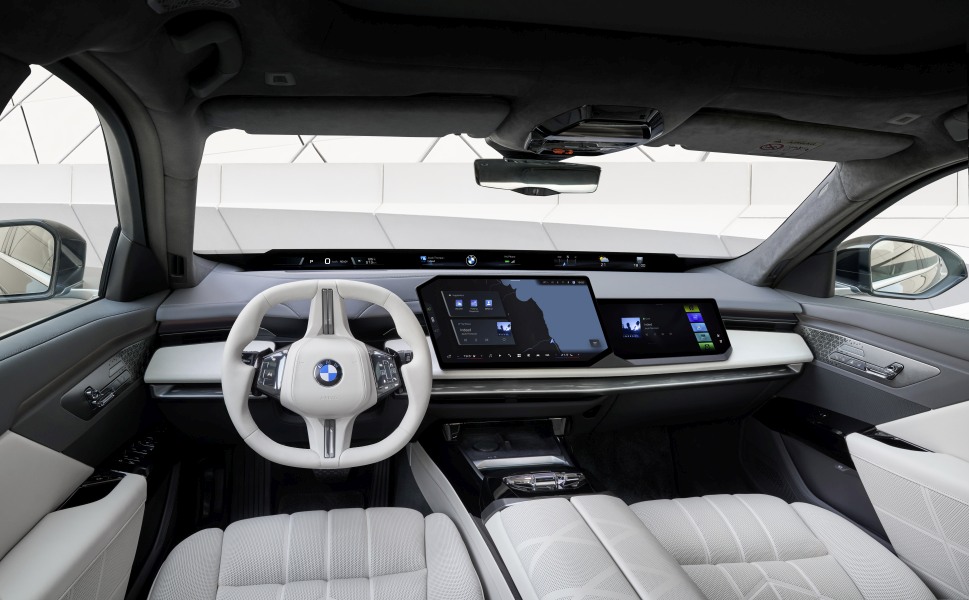
    The Mercedes S-Class drops the portrait-oriented screen and now comes standard with the MBUX Superscreen from the E-Class, featuring two displays—a 14.4-inch central screen and a 12.3-inch passenger display—grouped under a single glass panel. The multimedia system includes an improved Zero Layer function. As before, the 12.3-inch digital instrument cluster is optionally available in 3D.

    The steering wheel remains the same as before the facelift, but Mercedes has returned to physical buttons on the wheel. It now offers rocker switches for the limiter and Distronic, as well as a roller for volume control.

    Mercedes S-Class facelift W223

    For the first time in the S-Class, the navigation system uses Google Maps, and Mercedes is among the first manufacturers to offer Google Cloud’s new Automotive AI Agent for in-vehicle conversational services with Google Maps. Optionally, the MBUX Augmented Reality head-up display is still available, projecting key guidance cues such as arrows, lane recommendations, and points of interest onto the road ahead.

    More than 40 apps can be installed, including audio, video, productivity, and entertainment apps. For the first time, user-specific app folders can be created.

    Customers can choose between two high-end audio systems: Burmester 3D Surround and Burmester High-End 4D Surround (39 speakers, 4 exciters, 1,750W, and Dolby Atmos), with tactile transducers integrated into the seats that vibrate and pulse in sync with the music.

    The new BMW 7 Series adopts the BMW Panoramic iDrive operating concept from the iX3, with a display at the base of the windshield stretching across the entire width of the dashboard, a 17.9-inch hexagonal multimedia display positioned close to the steering wheel, a head-up display, a new steering wheel with two haptic surfaces, and—for the first time in a BMW—a standard 14.6-inch front passenger display. This allows the passenger to watch TV programs, stream video and audio, make video calls, and connect to the internet via a mobile hotspot or Wi-Fi network. As in the iX3, the multimedia system uses the new BMW OS X operating system, while navigation uses HERE maps.

    The BMW 7 Series also features a new optional top-tier audio system from Bowers & Wilkins with 36 speakers, 1,965W, and 4D sound, while an 18-speaker, 665W Bowers & Wilkins system comes as standard.

    BMW 7 Series facelift

    Rear-seat Comfort

    The facelifted Mercedes S-Class can be configured in four ways at the rear:

    • Electrically adjustable seats with backrests reclining up to 37 degrees
    • Rear Comfort Package with ventilated seats and Thermotronic automatic climate control in the rear
    • Rear Comfort Package Plus with massage function, Chauffeur package, Executive seats with backrests adjustable up to 43.5 degrees (on the long-wheelbase version)
    • First Class configuration with two individual rear seats

    Additionally, the MBUX High-End Rear Seat Entertainment System with two 13.1-inch displays is now available, featuring individual detachable remote controls and interior cameras that turn every seat into a meeting space.

    BMW offers standard comfort rear seats, with optional Executive Lounge seating.

    The BMW 7 Series retains the massive 31.3-inch 8K display that folds down from the roof, which in the facelift now includes a camera for hosting online conferences. The display also supports video streaming from Netflix, Prime, and Disney+.

Shoot A Reply

Your email address will not be published.