
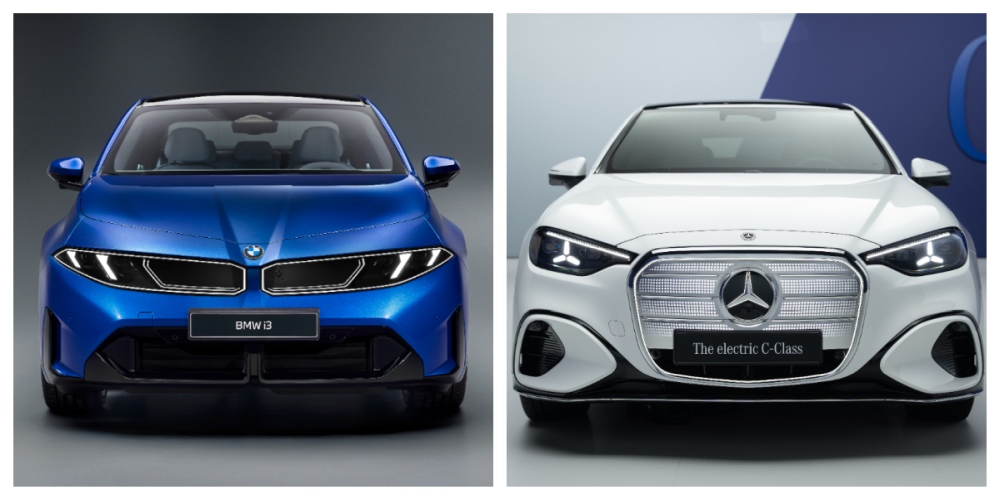
Would you still buy a Tesla Model 3 now that the BMW i3 and Mercedes C-Class EQ exist with 800V technology? For now, we don’t know the prices, but we do know all the technical details and have made an initial comparative evaluation.
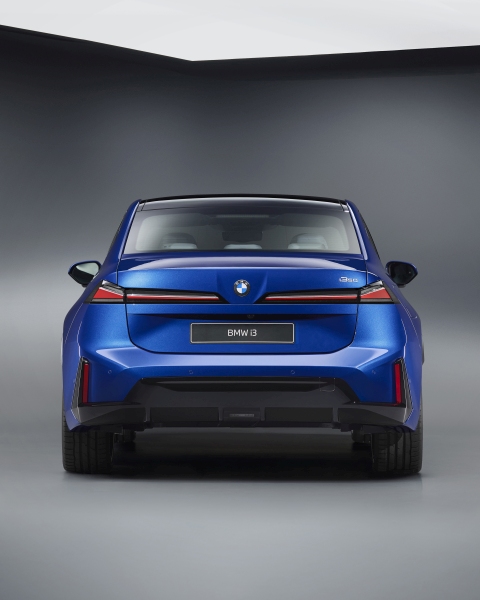
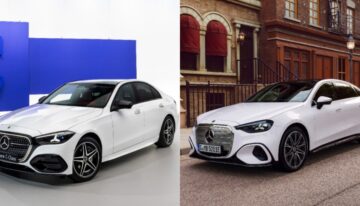
Who copied whom? BMW from Mercedes or the other way around? The new BMW i3 looks almost identical to the upcoming 3 Series we’ve seen, but we can’t show it yet because the embargo only lifts on September 30. But trust us—they share the same design, even though the platforms are different: Neue Klasse architecture for the i3, and CLAR platform for the 3 Series.
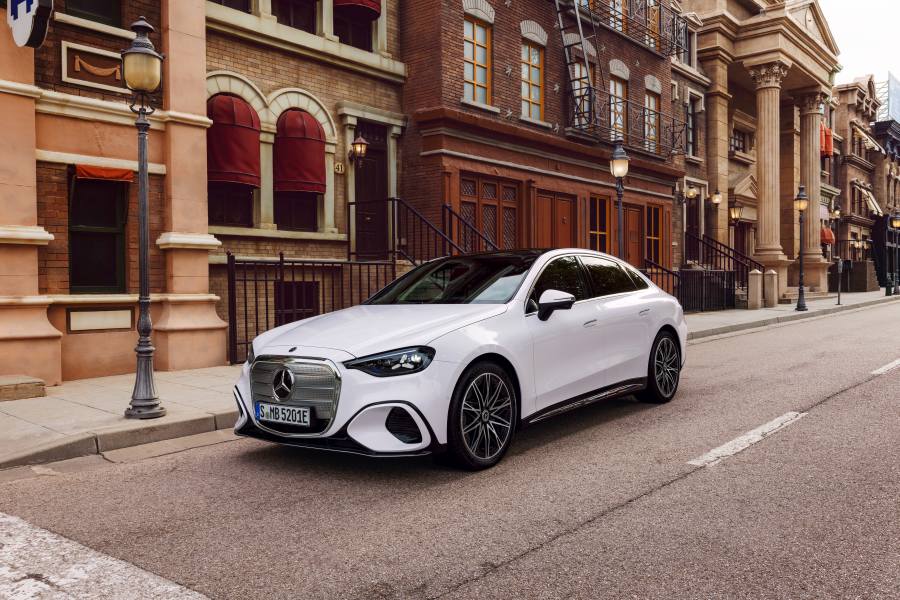
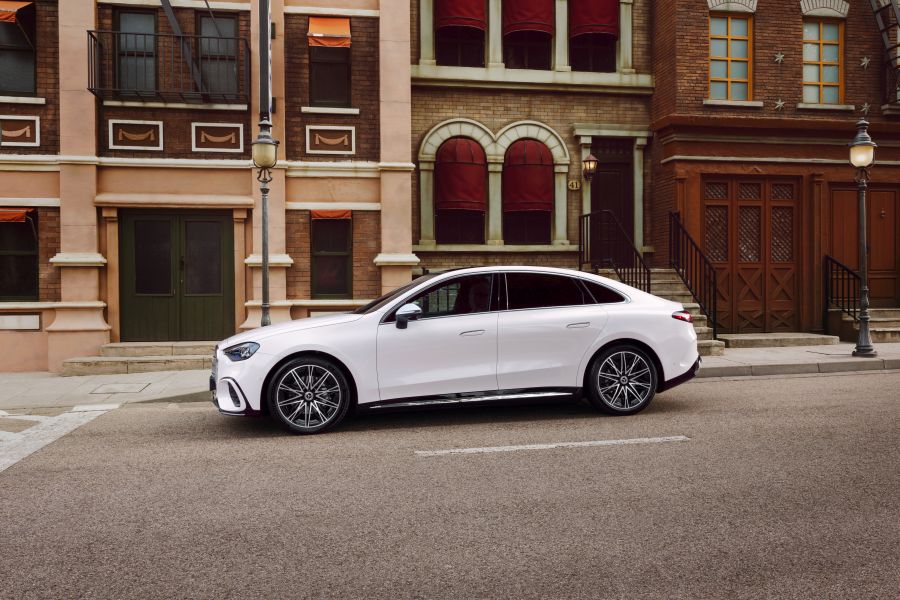
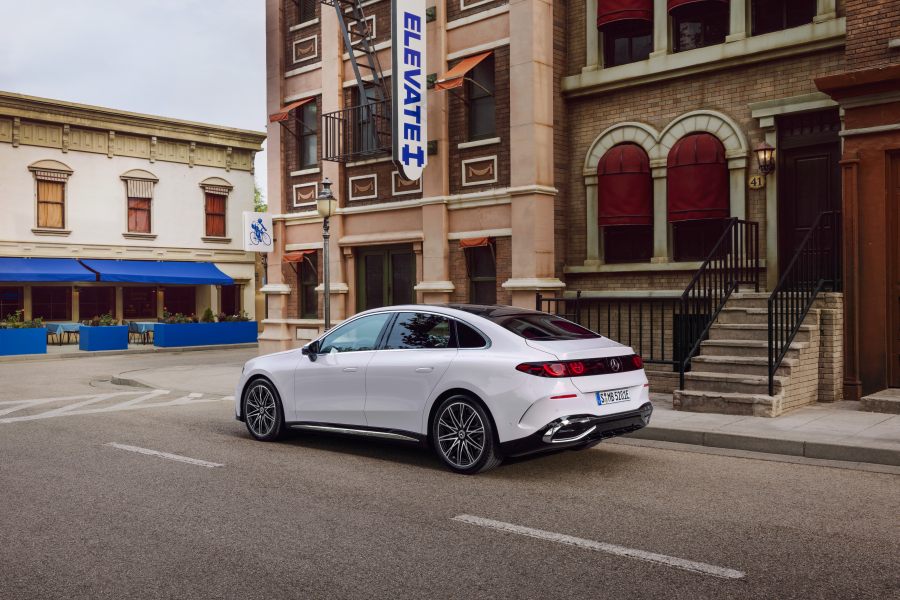
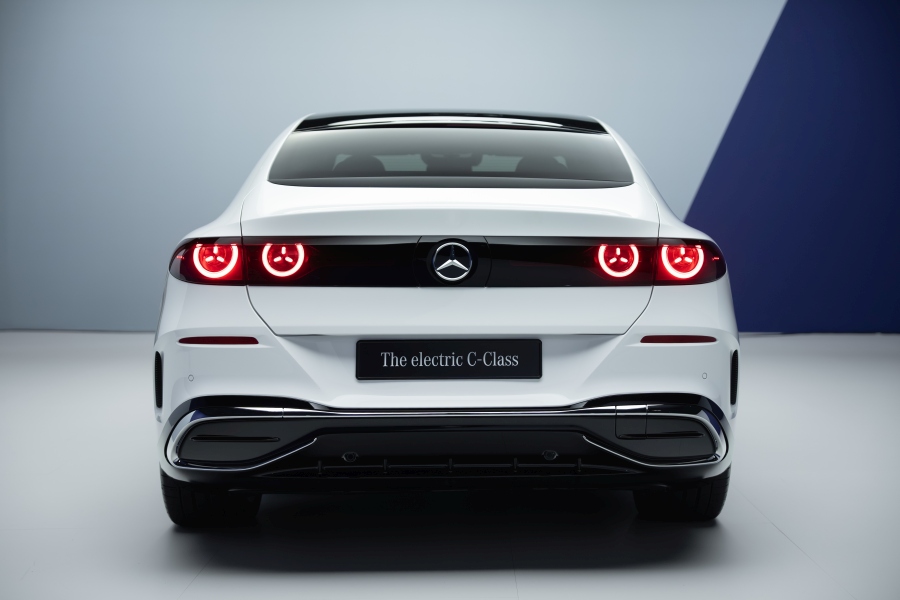
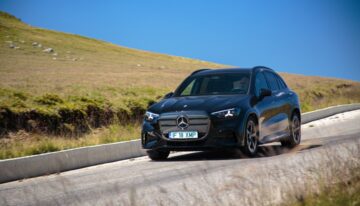
The Mercedes C-Class EQ borrows design elements from the GLC EQ and looks different from the conventional C-Class with combustion engines. However, the latter will undergo a facelift that will bring the two closer visually. Here too, we’re dealing with two different platforms: MB.EA for the C-Class EQ and MRA II for the combustion-engine C-Class.

Dimensions and Size
With a length of 4,883 mm, width of 1,892 mm, and height of 1,503 mm, the Mercedes C-Class EQ is significantly larger than the BMW i3 (4,760 mm length, 1,865 mm width, 1,480 mm height):
- 123 mm longer
- 27 mm wider
- 23 mm taller
The wheelbase of 2,962 mm is also 65 mm longer than the BMW i3’s 2,897 mm.
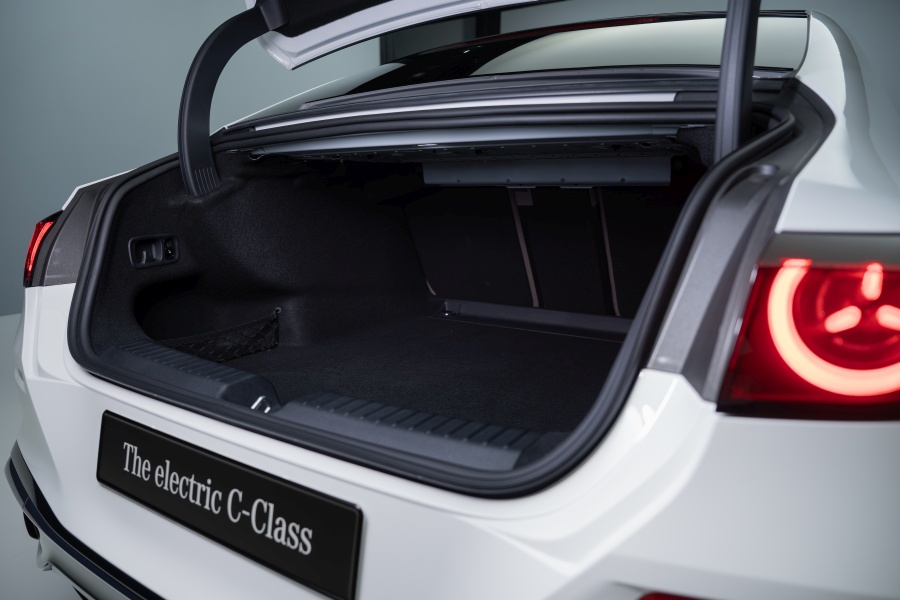
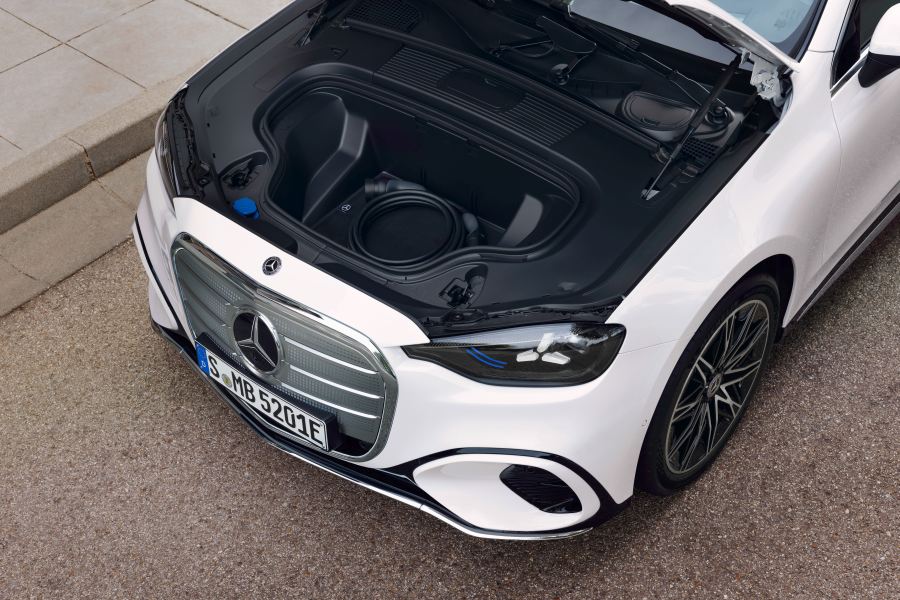
BMW hasn’t yet announced trunk capacity, but like the iX3, it includes a front trunk (frunk). The Mercedes C-Class EQ offers 470 liters (15 liters less than the combustion-engine C-Class) and also features a 101-liter frunk. BMW has a lid for the frunk, while Mercedes does not—it’s essentially integrated under the hood.
Mercedes has announced a drag coefficient (Cd) of 0.22, while BMW has not yet disclosed this figure.
Motors and Batteries
BMW has released relatively limited data about the i3 so far. The most important figure is the official range of 900 km, significantly higher than the 762 km announced for the Mercedes C-Class EQ.
At launch, both models debut in powerful dual-motor, all-wheel-drive versions:
- BMW i3 50 xDrive: 469 HP and 645 Nm
- Mercedes C 400 4Matic: 489 HP and 800 Nm
Mercedes lists a minimum consumption of 14.1 kWh/100 km, while BMW has not yet provided consumption details.
The motors differ significantly:
- BMW uses a separately excited synchronous motor at the rear and an asynchronous motor at the front.
- Mercedes uses permanent magnet synchronous motors on both axles.
BMW features a single-speed gearbox at the rear motor (revving higher, up to 18,000 rpm), while Mercedes uses a two-speed gearbox (ratios 11:1 and 5:1).
The BMW i3’s greater range is mainly due to its larger battery—108.7 kWh net (similar to the iX3), compared to just 94 kWh net for Mercedes.
Surprisingly, despite having a smaller battery, the Mercedes is heavier. We have the data only for GLC 400 4Matic and iX3 for the moment: 2,360 kg for BMW and 2,535 kg for Mercedes.
The new Mercedes C 400 4Matic weighs 2,460 kg, which is 75 kg less than the GLC 400 4Matic. Taking into account the 75 kg difference between the C-Class EQ sedan and the GLC EQ SUV, it follows that the i3 50 xDrive will be about 70–80 kg lighter than the SUV, meaning it will weigh around 2,280 kg—about 180 kg less than the Mercedes C 400 4Matic.
- BMW: 400 kW
- Mercedes: 330 kW
BMW’s advantage comes from its cylindrical cell-to-pack battery design, compared to Mercedes’ prismatic cells arranged in modules.
Mercedes has another drawback: if you want to charge at older 400V stations, you’ll need to buy an optional adapter (costing €654 on the GLC 400 4Matic).
Both models support AC charging at 11 kW and optionally 22 kW. BMW states a charging time of 5.8 hours, while Mercedes has not provided a figure.
Performance
The Mercedes C 400 4Matic accelerates from 0 to 100 km/h in just 4 seconds. However, we expect the BMW i3 50 xDrive to be even quicker, as it has only 20 HP less but is nearly 200 kg lighter.
Chassis
If we evaluate the chassis, we understand why the Mercedes C 400 4Matic is significantly heavier.
The Mercedes C 400 4Matic is optionally available with air suspension and all-wheel steering with a steering angle of 4.5 degrees. All of this adds weight to the car but provides a high level of ride comfort. I haven’t tested the BMW i3, but I have tested the iX3, and BMW’s SUV comes with a fairly firm suspension that contribute to a great dynamics, but does not favor comfort as much as the air suspension found on the GLC 400 4Matic.
In addition, Mercedes’ all-wheel steering reduces the turning radius by 0.9 meters, down to just 11.2 meters.

Interior and Operating System
Both manufacturers have made remarkable progress in terms of operating systems and multimedia systems, with both cars now essentially defined by their software.
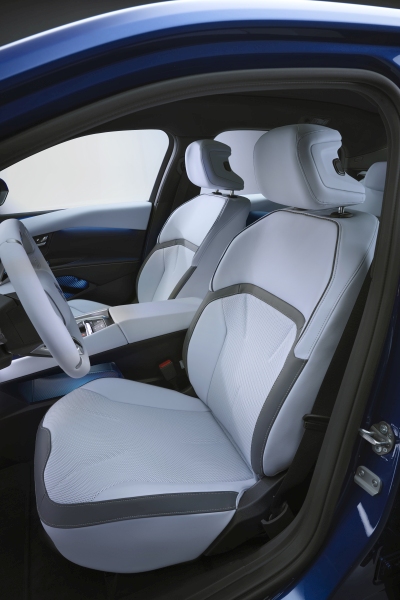
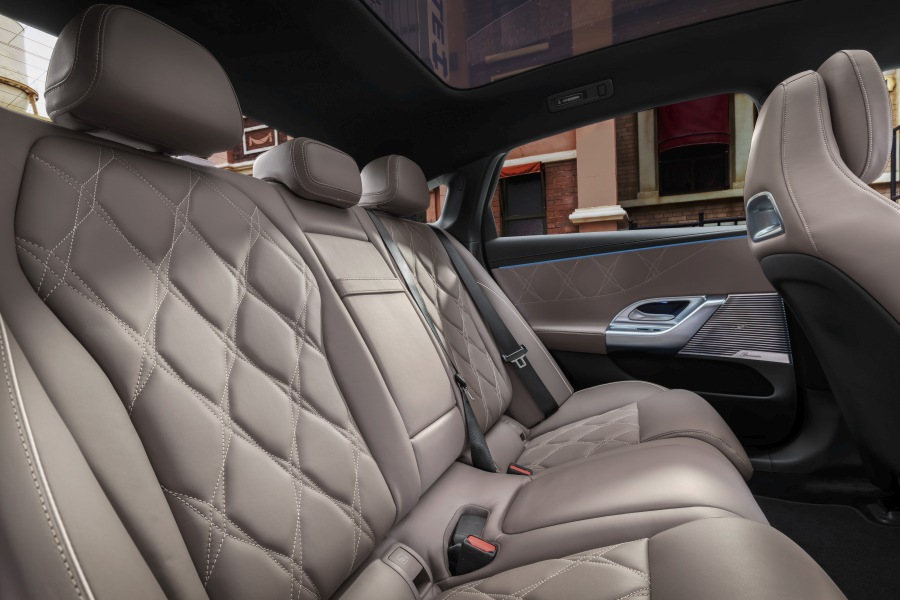
The BMW i3 adopts the ergonomic Panoramic iDrive concept from the iX3, featuring a dashboard-wide display that stretches along the base of the windshield, a 17.9-inch hexagonal display positioned close to the steering wheel, and a new steering wheel with two haptic control pads. Although the panoramic Vision display at the base of the windshield is placed high within the driver’s field of view, BMW still offers an optional head-up display. Various widgets can be moved from the 17.9-inch multimedia display to the windshield base display, while the instrument cluster area is no longer configurable.
The two haptic surfaces on the new steering wheel have controls marked by icons that only illuminate when accessed. However, the icons are small, and some time is needed to get used to operating the two haptic surfaces.
The BMW i3 benefits from four supercomputers, one of which—called “Heart of Joy”—controls the motors, steering, brakes, and energy recuperation, and is 10 times faster than previous control units. Another controls the multimedia system, which is based on the BMW OS X operating system using BMW maps (Here maps).

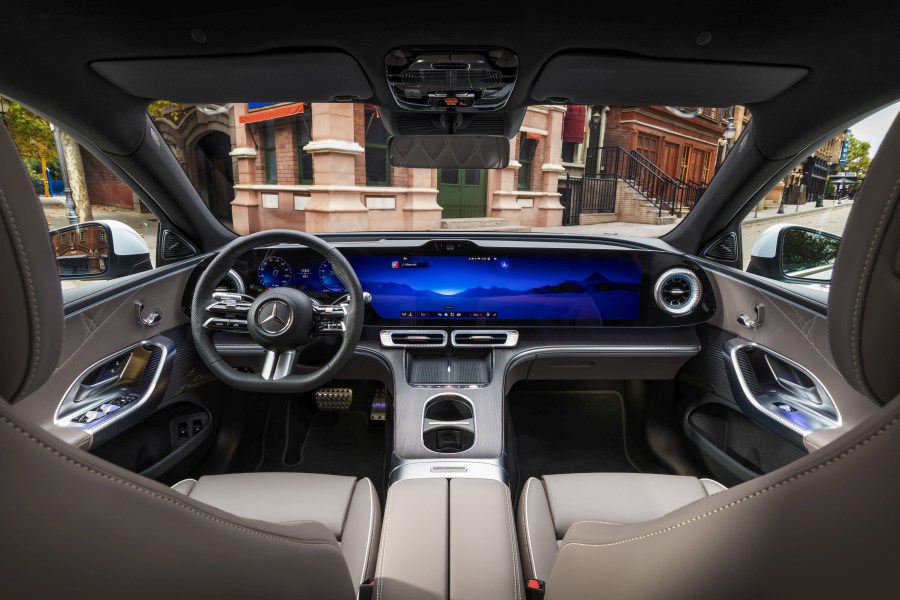
The Mercedes C-Class EQ adopts the concept from the GLC EQ and is available in two versions:
- MBUX Hyperscreen with two displays: a 10.3-inch instrument cluster and a 14-inch multimedia display, plus an optional 14-inch front passenger display included in the Advanced Plus package.
- MBUX Hyperscreen with a single display spanning the entire width of the dashboard, with a diagonal of 99.1 cm and a resolution of 10 million pixels.
The multimedia system is based on the new MB.OS operating system, which uses Google services for navigation (optimized for electric routes), as well as Google Gemini AI, Microsoft Bing, and ChatGPT. Additionally, 40 third-party apps for audio/video streaming and gaming can be downloaded.
The steering wheel is largely the same as in other Mercedes models, except that the two small touch-sensitive pads have been replaced with a physical switch for adaptive cruise control and a physical rotary knob for audio volume. The downside is that it no longer offers as many functions: previously, you could change the instrument cluster graphics using the left touchpad and navigate multimedia menus using the right one.
Prices
Prices have not yet been announced. Production of the Mercedes C-Class EQ will begin in Kecskemét, Hungary, in the second half of 2026, while production of the BMW i3 will start in August 2026 at the fully retooled Munich plant.
The motors for the Mercedes C-Class EQ are produced in Sebeș, Romania, while the rear motor for BMW is produced in Steyr, Austria, and the battery and control unit are manufactured at the Landshut plant in Germany.
However, we can estimate pricing by comparing the iX3 50 xDrive with the GLC 400 4Matic. The BMW iX3 50 xDrive starts at €70,900, while the Mercedes GLC 400 4Matic starts at €71,281.
Considering that for the combustion-engine versions (X3/3 Series and GLC/C-Class), SUVs are about €5,000 more expensive than sedans, we expect a price of around €65,000 for both, with BMW having an advantage of a few hundred euros.
Both manufacturers have also announced cheaper single-motor versions: the i3 40 sDrive from BMW and a similar version from Mercedes. There will also be sportier variants: an M Performance version (BMW i3 M60 xDrive), a full M version with over 1,000 HP, and an AMG version of the C-Class based on the AMG.EA platform with cylindrical batteries and axial-flux motors from Yasa. However, we will have to wait a bit longer for these.
| Technical data | Mercedes C 400 4Matic | BMW i3 50 xDrive |
|---|---|---|
| Motors | 2, one rear, one front | 2, one rear, one front |
| Max. output (PS) | 489 | 469 |
| Max. torque (Nm) | 800 | 645 |
| Traction | awd | awd |
| Gearbox | 2 gears rear, 1 gear front | 1 gear rear, 1 gear front |
| L x w x h (mm) | 4,883 x 1,892 x 1,503 | 4,760 x 1,865 x 1,480 |
| Wheelbase | 2,962 | 2,897 |
| Curb weight/payload (kg) | 2,460 | na |
| Boot volume (l) | 101/470 | na |
| Battery capacity net (kWh) | 94 | 108.7 |
| AC charging (kW) | 11/22 | 11/22 |
| AC charging time (h) | na | na |
| DC charging (kW) | up to 330 | up to 400 |
| DC charging time 10-80% (minutes) | 22 | 21 |
| Performances | ||
| Acc. 0-100 kph | 4 | na |
| Top speed (kph) | 210 | na |
| Energy consumption (kWh/100 km) | 14.1 | na |
| WLTP Range (km) | 762 | 900 |









That’s a really interesting point about the 800V charging – it definitely changes the game when you’re thinking about range anxiety.
The 800V allows high charging power. 400 kW for BMW and 330 kW for Mercedes. BMW benefit by the cylindrical cells, like Tesla has, which allows better coooling and higher charging power.