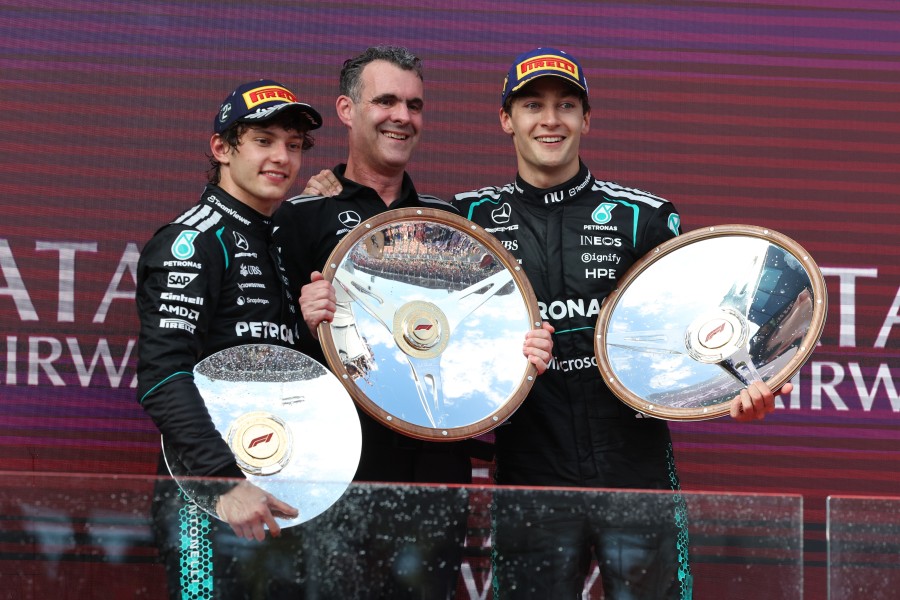
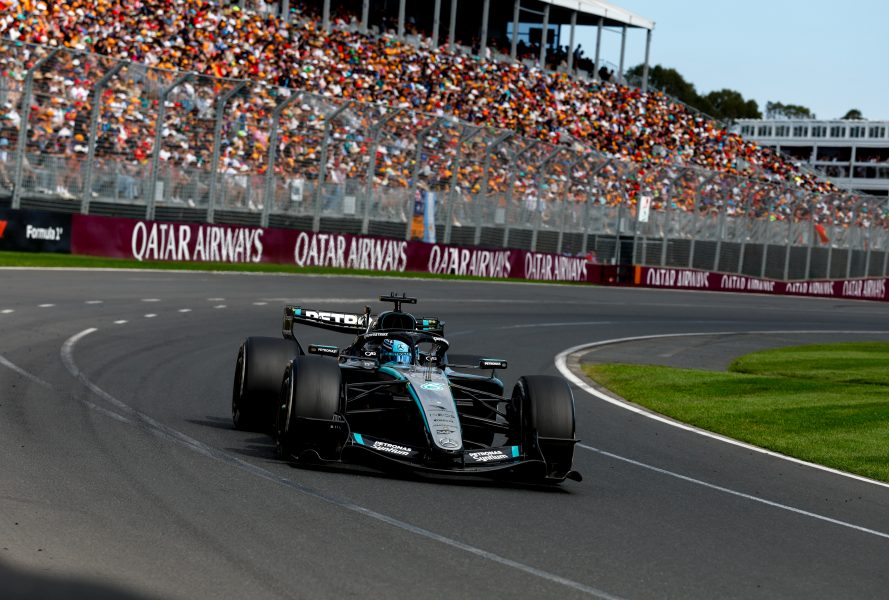
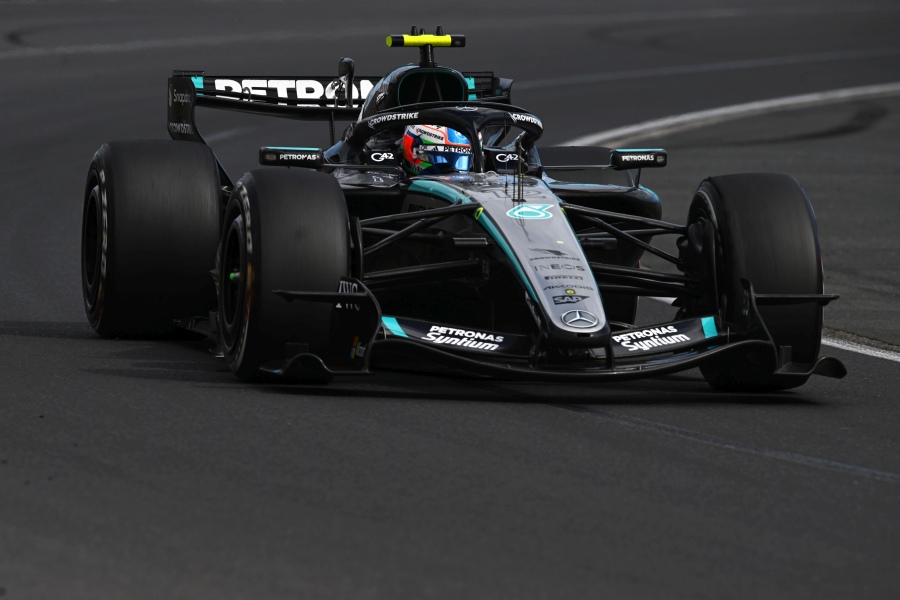
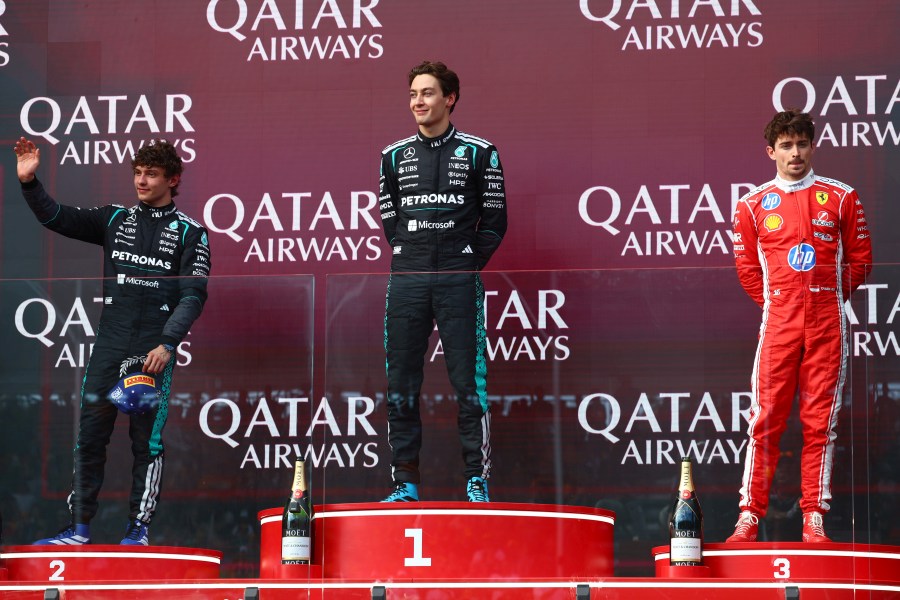
Mercedes crushed the competition, securing a 1–2 finish in qualifying and then a clear one-two victory in the Australian Grand Prix.
The new hybrid era in F1 has completely reshuffled the hierarchy. Mercedes has fully leveraged its experience with high-performance hybrid systems and currently has the fastest car on the grid.
In qualifying, Mercedes took first and second place with an advantage of almost 0.8 seconds over the rest of the field. Ferrari, Red Bull, and McLaren each had different explanations for Mercedes’ dominance, but the general conclusion is that Mercedes has the best energy management.
George Russell and Andrea Kimi Antonelli occupied the front row of the grid, with Russell faster by 0.3 seconds. Antonelli achieved this despite the fact that his car had been nearly destroyed in a crash just hours before qualifying and had been hastily repaired.
Russell was:
-
0.785 s faster than Red Bull
-
0.809 s faster than Ferrari
-
0.862 s faster than McLaren
Ferrari team principal Frédéric Vasseur said that Russell was “driving in another league.”
Why Mercedes is so fast
Each team has its own explanation:
-
McLaren says Mercedes is superior in energy management.
-
Ferrari believes the advantage comes from the Mercedes engine, which operates with a higher compression ratio.
-
Red Bull says it loses time across the entire circuit but believes the gap is recoverable.
Max Verstappen had bad luck: he went off track right at the start of qualifying due to a wheel lock caused by the settings of the energy recovery system.
Ferrari’s problems
Ferrari believes its engine is about 15 horsepower weaker than Mercedes’. Starting in June, the FIA will begin measuring engine compression both cold and hot. However, this is unlikely to change much, because Mercedes will still maintain the highest allowed compression ratio of 16:1.
Ferrari also lost time due to suboptimal tire preparation during qualifying.
The McLaren situation
McLaren uses the same Mercedes engine but does not manage energy as efficiently. Team principal Andrea Stella says the team is still in the learning phase and is analyzing GPS data to understand how Mercedes uses battery energy.
There are three main ways the battery is charged:
-
During braking
-
When the car is coasting (running without throttle)
-
When the driver lifts off the throttle
The Mercedes speed paradox
Interestingly, Mercedes is not the fastest on the straights.
For example:
-
Russell ranked only 15th in top speed on the start–finish straight, with 301.3 km/h.
-
Liam Lawson in the Racing Bulls was 17 km/h faster.
Despite this, Mercedes gained time consistently in every sector thanks to its smart energy management.
The race
In the race, Mercedes also finished first and second, followed by the two Ferraris, though the dominance was not as overwhelming as in qualifying. Ferrari team principal Frédéric Vasseur said: “Ultimately, we were slower than the Mercedes. Just not as dramatically as in qualifying.”
Charles Leclerc finished less than 13 seconds behind Antonelli.
Ferrari might have been able to fight for the win, but Mercedes executed a better strategy. When the VSC (Virtual Safety Car) was deployed, Mercedes called both cars into the pits and then made no further tire changes, successfully completing 46 laps on the second set of tires.
Chief strategist Rosie Wait explained: “We weren’t sure if the second set of tires would last 46 laps. Then we examined the first set and saw that it might work.”
Here is the final classification of Australia F1 Grand Prix.
| Driver | Team | Time/delay |
|---|---|---|
| 1. George Russell | Mercedes | 1:23:06.801 h |
| 2. Andrea Kimi Antonelli | Mercedes | +2.974s |
| 3. Charles Leclerc | Ferrari | +15.519s |
| 4. Lewis Hamilton | Ferrari | +16.144s |
| 5. Lando Norris | McLaren | +51.741s |
| 6. Max Verstappen | Red Bull | +54.617s |
| 7. Oliver Bearman | Haas | + 1 round |
| 8. Arvin Lindblad | Racing Bulls | + 1 round |
| 9. Gabriel Bortoleto | Audi | + 1 round |
| 10. Pierre Gasly | Alpine | + 1 round |
| 11. Esteban Ocon | Haas | + 1 round |
| 12. Alexander Albon | Williams | + 1 round |
| 13. Liam Lawson | Racing Bulls | + 1 round |
| 14. Franco Colapinto | Alpine | + 2 rounds |
| 15. Carlos Sainz | Williams | + 2 rounds |
| 16. Sergio Perez | Cadillac | + 3 rounds |
| 17. Lance Stroll | Aston Martin | + 15 rounds |
| 18. Fernando Alonso | Aston Martin | abandon |
| 19. Valtteri Bottas | Cadillac | abandon |
| 20. Isack Hajar | Red Bull | abandon |
| 21. Oscar Piastri | McLaren | not started |
| 22. Nico Hülkenberg | Audi | not started |