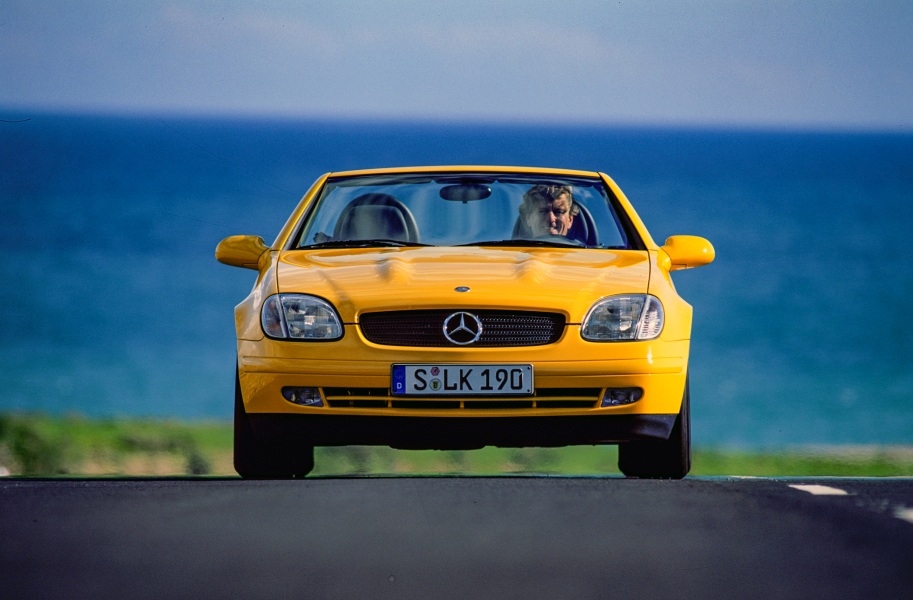
The Mercedes SLK R170, the first compact roadster in Mercedes’ history, has turned 30. Mercedes’ answer to the BMW Z3 and Porsche Boxster stood out from its rivals thanks to its steel “vario-roof,” which could open or close in just 25 seconds.
The mid-1990s were marked by the launch of some emotional car models. The success of the Mazda MX-5, launched in 1989, convinced premium manufacturers to enter this segment.
The first was the BMW Z3, launched into production in September 1995. It was also BMW’s first model produced outside Germany, at the new plant in Spartanburg, South Carolina, USA – today the largest BMW factory in the world, producing the X3, X4, X5, X6, and X7.
Then, in April 1996, the Mercedes SLK R170 debuted, followed a few months later by the Porsche Boxster. In August 1999, the German “four aces” were completed by the Audi TT Roadster.
The SLK R170 was built on a shortened platform of the Mercedes-Benz C-Class (W202) and measured only 3,995 mm in length, making it about half a meter shorter than the Mercedes-Benz SL R129.
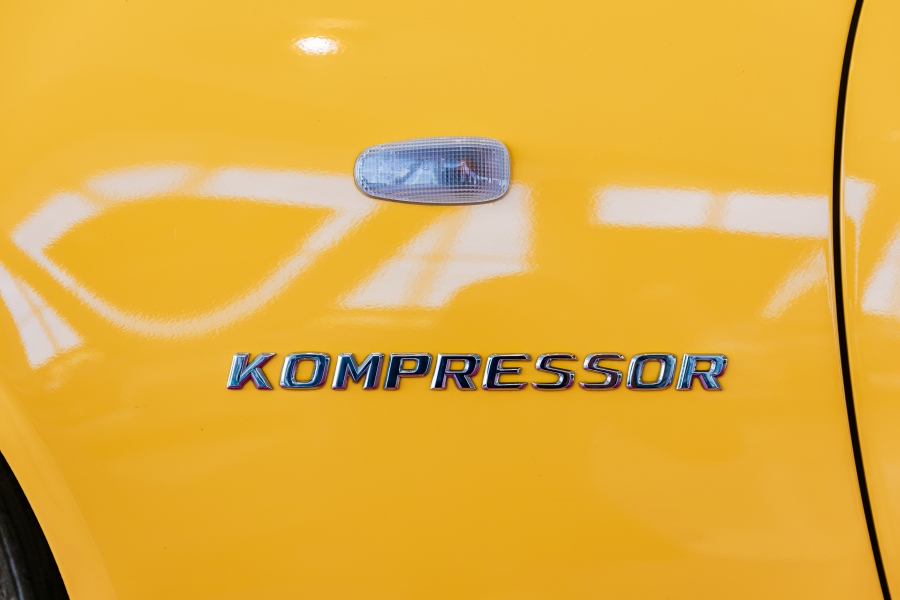
A total of 311,222 units were sold between April 1996 and 2004. The SLK was available in versions such as SLK 200, SLK 200 Kompressor, SLK 230 Kompressor, SLK 320, and SLK 32 AMG. The best-selling version was the SLK 230 Kompressor, which featured a 2.3-liter supercharged inline-four engine producing 193 PS. With a low weight of just 1,325 kg (the base SLK 200 weighed only 1,260 kg), the SLK 230 Kompressor could accelerate from 0 to 100 km/h in 7.6 seconds and reach a top speed of 231 km/h.
The SLK 200 Kompressor was similar, using a 2.0-liter engine derived from the 2.3-liter unit, with a shorter stroke and the same mechanical supercharger. This version was developed for countries where legislation imposed high taxes on engines larger than 2 liters.
The use of a mechanical supercharger was reminiscent of Mercedes models from the 1920s. Its main advantage was the absence of turbo lag, as the compressor was directly driven by the crankshaft and engaged immediately when the engine started. The downside was slightly higher fuel consumption compared to a naturally aspirated engine of similar power.
The top models, SLK 320 and SLK 32 AMG, used a 3.2-liter V6 engine – naturally aspirated in the SLK 320 and supercharged in the SLK 32 AMG—producing 218 PS and 354 PS, respectively.
Using the C-Class (W202) platform, the SLK R170 featured a sophisticated suspension with double wishbones at the front and a multi-link rear axle. For a better driving behavior, the suspension was lowered with 20 mm compared with the C-Class. The braking system, however, was borrowed from the Mercedes-Benz E-Class (W210).
The steel vario-roof folded fully automatically via a button on the center console in just 25 seconds, offering better winter protection and improved sound insulation compared to competitors’ soft tops. When properly maintained, it proved impressively reliable over the years.
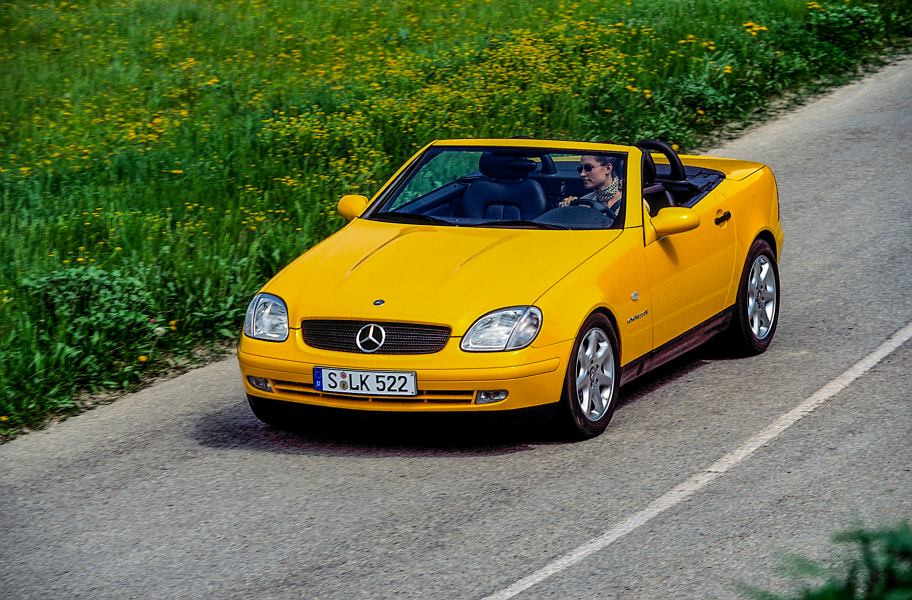
The car shown in these photos is finished in the original launch color from 30 years ago, Yellowstone (color code 685). In 2000, a facelift introduced new interior colors such as merlin blue, magma red, and lotus yellow.



Mercedes SLK R171
The second generation, Mercedes SLK R171, debuted in March 2004 at the Geneva Motor Show and was characterized by a Formula 1-inspired front end. The roof mechanism was revised and could open in 22 seconds – 3 seconds faster. A facelift followed in 2008.
In the R171, the 2.0 and 2.3-liter supercharged engines were replaced by a 1.8-liter unit producing 163 and 184 PS. New V6 versions were introduced: SLK 280 (2005–2008, 3.0L/231 PS), replaced after the facelift by SLK 300 (2009–2011, 3.0L/231 PS), and SLK 350 (2004–2008, 3.5L/272 PS), updated to 306 PS after the facelift. The SLK 55 AMG featured a new 5.4-liter V8 engine producing 360 PS.

Mercedes SLK R172
The third and final generation, Mercedes SLK R172, debuted in 2011 and had the longest production run, lasting until 2020. A facelift in 2015 brought a name change to SLC.
It was the only generation also offered with a diesel engine – the SLK 250 CDI, powered by a 2.1-liter turbodiesel producing 204 PS.
At launch, the R172 came in SLK 200 (184 PS) and SLK 250 (204 PS) versions, both turbocharged instead of using a mechanical supercharger, along with the SLK 350 featuring the same 3.5-liter V6 (306 PS) from the R171. The SLK 55 AMG used an updated 5.5-liter V8 producing 422 PS.
After the facelift, two new versions were introduced: the base SLC 180 with a 1.6-liter engine producing 156 PS, and the SLC 200 with a 2.0-liter engine producing 184 PS. Both came standard with a 6-speed manual transmission and an optional 9-speed automatic, which was standard on the rest of the range, including SLC 260 (2.0L/211 PS) and SLC 300 (2.0L/245 PS). The new AMG SLC 43 featured a 3.0-liter twin-turbo V6 producing 390 PS.