In an effort to boost sales of the EQS, Mercedes-Benz is introducing steer-by-wire steering on the Mercedes EQS, which will be offered as an option alongside the classic electromechanical steering system.
Photo: Mercedes-Benz
The new steer-by-wire system will be available during the year as an option for all powertrain versions of the Mercedes EQS, in combination with rear-axle steering featuring a steering angle of 10 degrees.
Mercedes thus becomes the third manufacturer in the world, after Lexus and Tesla, to offer steer-by-wire steering.
The new steering system is extremely direct, so turning the wheel from one end to the other requires only 170 degrees – less than half a full rotation (180 degrees). By comparison, a normal car requires between 2 and 2.5 turns of the steering wheel, meaning between 720 and 900 degrees.
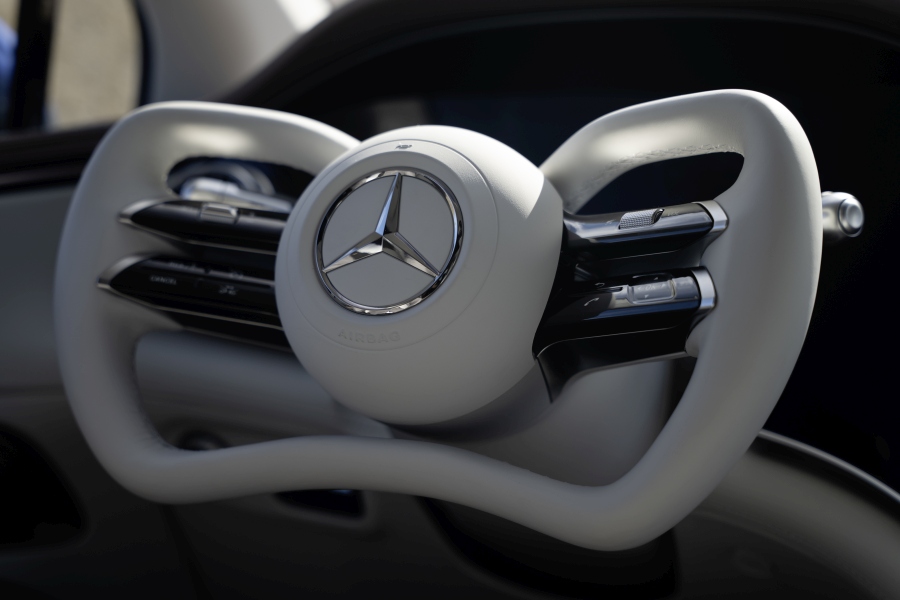
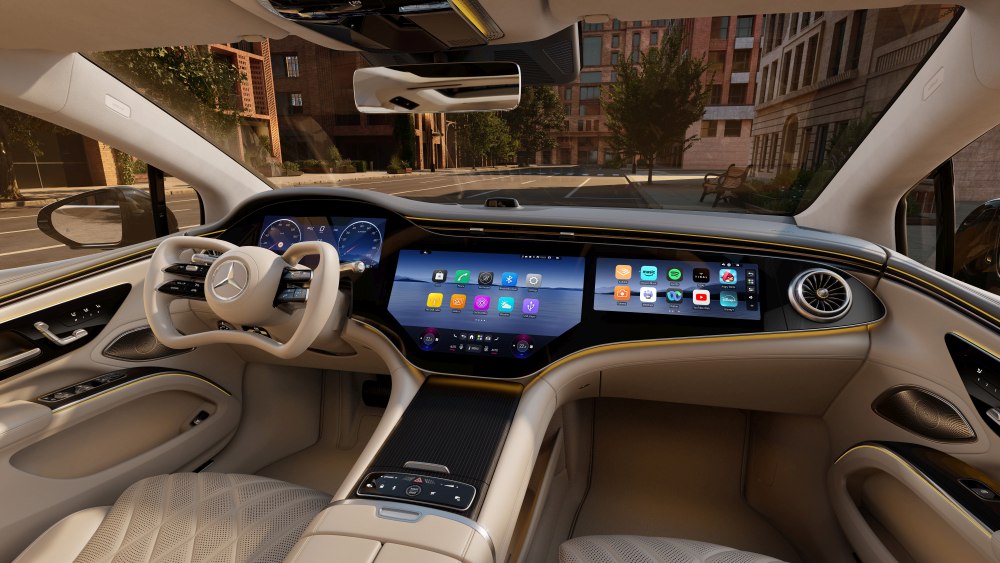
Because less than half a turn is needed, Mercedes has also redesigned the steering wheel, which now resembles an aircraft yoke – flattened and very compact. As a result, Mercedes had to develop a new airbag structure, which is still integrated into the steering wheel hub but can no longer rely on a closed circular rim. Instead, an internal support and folding architecture controls how the airbag deploys.
The new flattened steering wheel improves visibility of the instrument cluster and makes getting in and out of the car easier.
Another major advantage is that the driver no longer feels any vibrations in the steering wheel caused by potholes or uneven road surfaces, since there is no longer a mechanical connection between the steering wheel and the wheels. Tire-road contact is instead calculated on a model-by-model basis using the restoring forces of the steered wheels.
For safety, there is a redundant system architecture, along with high-precision sensors and powerful control units. This means there are essentially two signal paths, ensuring that steering capability is always maintained. Even in the unlikely event of a complete failure, lateral control remains possible thanks to rear-axle steering and targeted, wheel-specific braking interventions via ESP.
How does the Mercedes EQS drive with the new drive-by-wire system?
Journalists from the British magazine Autocar tested it and concluded that, with drive-by-wire steering, the EQS – measuring 5.2 meters in length and 1.9 meters in width – feels almost as maneuverable as a small car.
However, it takes some time to get used to the new steering system, because reducing the steering range to just 170 degrees means that steering responses at low speeds are inevitably much quicker, and reactions feel more abrupt.
That’s why Autocar recommends driving in a very relaxed, smoother style, which allows better use of the significantly improved agility.
Getting used to the new yoke-style steering wheel also takes time. You have two main options: either keep your hands in the traditional “9 and 3 o’clock” position, or grip the horizontal bars like motorcycle handlebars—both requiring an adjustment period.
Mercedes has not yet announced the price of the steer-by-wire system, but it will likely not be cheap and will initially be available only on higher-end models, where it makes more sense.