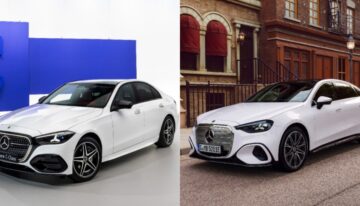
The misguided Luxury First and Electric Only policies, combined with external market conditions – shrinking profit margins and sales in China, plus U.S. import tariffs – have pushed Mercedes into a corner. Can Ola Källenius bring Mercedes back onto the path to success?
Between 2016 and 2018, Mercedes became the world’s number one premium brand. During Dieter Zetsche’s tenure, Mercedes had set the goal of becoming the leading premium brand by 2018. They achieved this two years earlier, becoming global No. 1 as early as 2016 – a crown they retained through 2018. What times those were!
In 2016, 2017, and 2018, Mercedes reached all-time sales records:
-
2,083,888 units in 2016
-
2,289,344 in 2017
-
2,310,185 units in 2018
In 2018, the gap between Mercedes and BMW reached its highest level in modern times: nearly 185,000 more units than BMW.
And last year, sales dropped to an incredibly low level: only 1,800,800 units. Where did over 500,000 customers disappear? We will attempt to analyze this below. The 9% drop in sales compared to 2024, considering the external context, is not dramatic in itself. However, the halving of profit—from €10.4 billion to €5.33 billion—is a major alarm signal.
How did this happen? As usual, the causes are not singular but rather a combination of strategic and geopolitical factors. Let’s analyze them one by one.
The “Electric Only” Strategy
From a technical standpoint, dedicated electric platforms are the ideal solution for building a no-compromise EV. But Mercedes started down this path too early, in 2020. By comparison, BMW launched its Neue Klasse architecture only in 2025, five years later. Thus, between 2020 and 2025, by offering multiple types of powertrains on the same platform, BMW was better able to control and adjust volumes for each propulsion type.
Beyond starting too early, Mercedes launched its “Electric Only” strategy in the business and luxury classes with the EQE, EQS, and their derivatives—precisely the segments where it proved that customers with above-average financial means are not willing to pay for electric propulsion the same way they would for combustion engines.
As a result, the formula—low volumes, high prices, top technology—did not work. The top technology was present in terms of aerodynamics (record drag coefficient) and chassis systems (adaptive air suspension and rear-axle steering with up to 10 degrees steering angle), but not in charging performance, which is crucial for luxury EV customers. With lower charging power than the Kia EV9, the EQE and EQS fell short in a very important area.
Wealthy customers also did not particularly appreciate the aerodynamic design of what was meant to be the electric equivalent of the S-Class. Asian customers were dissatisfied with the narrow access to the rear seats. And customers around the world criticized materials that were inferior compared to the S-Class.
Thus began the decline, especially for the EQS, though the EQE has not been selling particularly well either. Mercedes was forced to offer huge discounts, which it tried to disguise as free option packages.
Even these discounts did not bring the expected jump in sales, although the planned volumes were never very high. Still, actual sales were even lower than initially projected.
Because the EVA2 platform was developed strictly as Electric Only, it did not allow for any synergies with other powertrain systems, and Mercedes now has no way to amortize the hundreds of millions of euros invested in this platform.
For this reason, Källenius made several radical decisions—there was no other solution. Mercedes abandoned the development of the MB.EA Large derivative of the MB.EA platform, which was supposed to underpin the next generations of the EQE and EQS. Instead, the EVA2 platform will be retained, upgraded from 400 to 800 volts, and will serve as the basis only for the successor to the EQS, which will look almost identical to an S-Class.
The MB.EA Medium platform, inaugurated with the new GLC EQ in autumn 2025 at the Munich Motor Show, will underpin the future C-Class EQ, E-Class EQ, and GLE EQ. The latter two models will replace the EQE and EQE SUV.
“Luxury First” Strategy
Another major mistake was focusing only on luxury models at the expense of the compact range. While BMW kept the 1 Series and 2 Series Active Tourer, Mercedes announced it would discontinue the A-Class and B-Class.