Brabus has unveiled a 2+2-seat super GT called the Brabus Bodo, produced in a strictly limited series of just 77 units in memory of Brabus founder Bodo Buschmann. It is powered by a 5.2-liter twin-turbo V12 engine delivering 1,000 PS and 1,200 Nm, enabling it to sprint from 0 to 100 kph in 3 seconds and reach a top speed of 360 kph.
Presented during FuoriConcorso on the shores of Lake Como on May 16–17, 2026, the Brabus Bodo is a tribute to brand founder Bodo Buschmann, who passed away in 2018.
Bodo Buschmann had long envisioned such a coupe but never had the chance to bring it to life. For this reason, his son Constantin Buschmann, who took over the company after his father’s death in 2018, wanted to honor his legacy and finally realize this idea. And of course, this super GT could bear only one name: BODO.
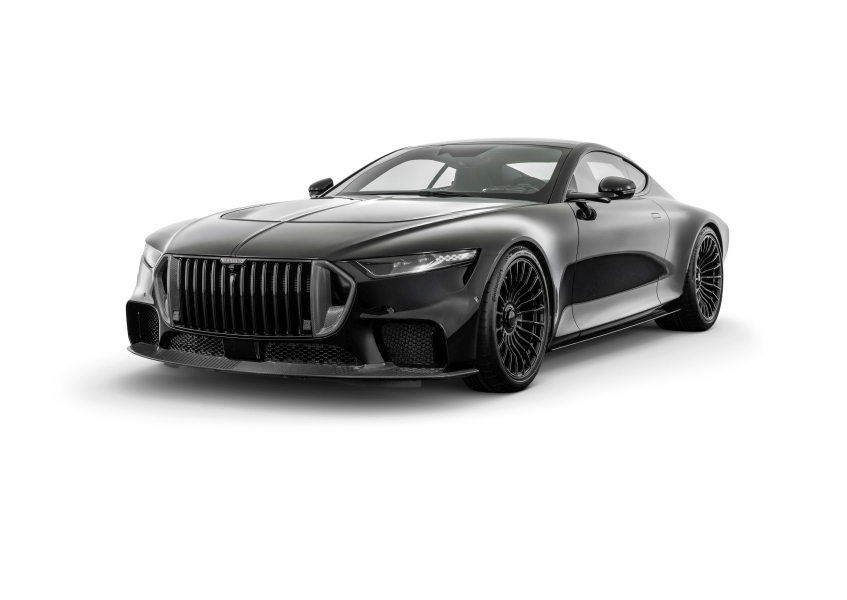
Although Brabus is primarily renowned for tuning Mercedes models and creating special Mercedes-based vehicles, this model is not based on a Mercedes. Its development did not begin entirely from scratch, as several elements from the Aston Martin Vanquish were adopted, especially noticeable in the interior. Nevertheless, the Brabus Bodo has its own unique and distinct personality. The front end is more imposing, featuring an aggressive radiator grille with 13 vertical slats and the Brabus logo in the center, flanked by large air intakes designed to channel cool air toward the V12 engine.

Additional large air intakes are integrated into the front spoiler to supply cool air to the water and oil radiators as well as the front brakes. The fins in the front spoiler are designed to generate downforce on the front axle at high speeds.
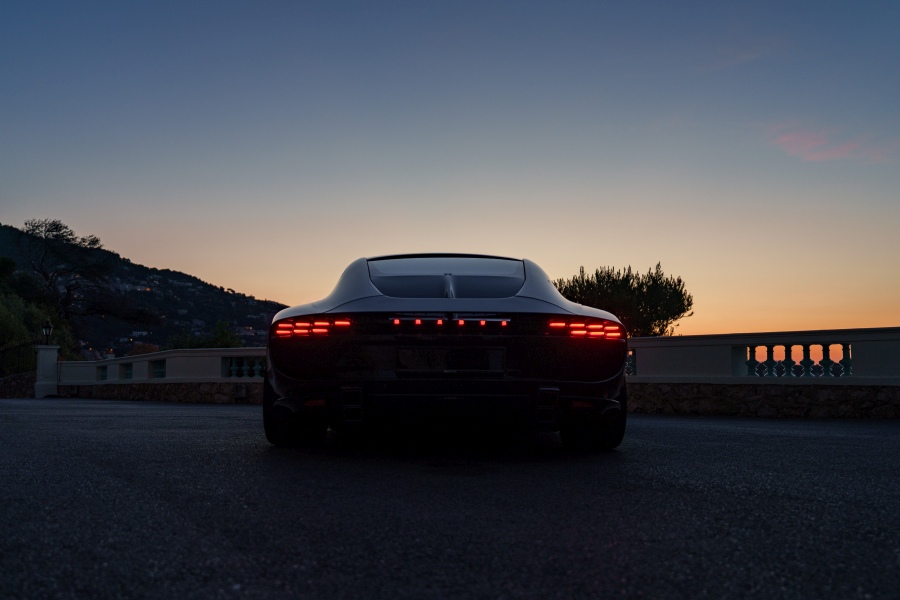
Measuring 5.06 meters in length, 2.02 meters in width, and only 1.30 meters in height, the Brabus Bodo has a sleek silhouette ending in an elongated rear section inspired to some extent by the 2005 Maybach Exelero concept. At the rear, the taillights stand out with seven LEDs each, framing the illuminated Brabus lettering. The taillights are surrounded by an exposed carbon-fiber element that also incorporates the rear license plate area.
The rear diffuser, also made from carbon fiber, provides additional downforce on the rear axle while also highlighting the four rectangular exhaust pipes, stacked two by two, made from titanium using 3D manufacturing technology.
Even greater rear downforce is generated by the electrically operated rear wing. At higher speeds, it deploys automatically and adjusts its position according to aerodynamic requirements, while under heavy braking above 140 km/h, the wing moves into a vertical position, acting as an air brake.
The interior clearly brings the Aston Martin Vanquish to mind, as the Brabus Bodo features a multimedia system, steering wheel, center console, and gear selector similar to those of the British super coupe. However, the round air vents differ from the rectangular ones in the Vanquish, as does the shape of the dashboard surface, while the Brabus Bodo stands out through its extensive exposed carbon-fiber inserts across the dashboard. Carbon fiber has also been used for the instrument binnacle and the long gearshift paddles.
The seats appear similar to those in the Vanquish, but Brabus has upholstered them with new leather and materials.

Highly modified V12 engine from Aston Martin
The Brabus Bodo uses the bi-turbo V12 engine from the Aston Martin Vanquish, which has been substantially modified to produce 1,000 PS and 1,200 Nm, compared with 835 PS and 1,000 Nm in the Aston Martin. The power increase was achieved through the installation of two new turbochargers, a RAM-AIR box, and improved cooling. Power is sent to the rear wheels through an 8-speed automatic transmission with a torque converter, while the driver can also shift manually using the massive paddle shifters behind the steering wheel. An electronically controlled locking rear differential, capable of up to 100% lock-up, ensures efficient delivery of the enormous torque output.