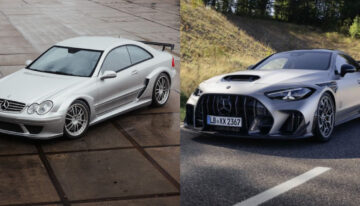
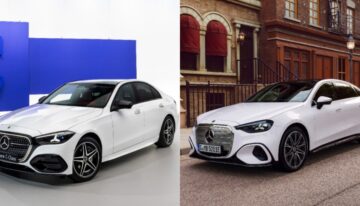
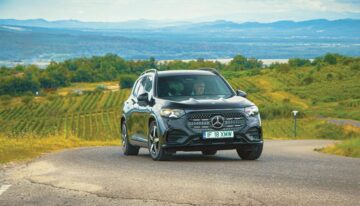
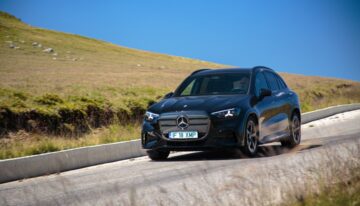
There’s a very specific feeling you get when you shut the door of a Mercedes-Benz. It’s a solid, vault-like thud that seems to whisper that you’re safe from the rest of the world. If you’re white-knuckling it through a sudden lake-effect snow squall on I-81 or trying to stay calm in the aggressive, bumper-to-bumper grind of a Scranton rush hour, that feeling isn’t just luxury, it’s a psychological safety net. We’ve been told for decades that the three-pointed star is the gold standard of engineering, a fortress on wheels designed to think faster than the person behind the wheel.
Photo: Deposit Photo
But let’s be blunt: physics doesn’t read brochures. Even with a car that has more computing power than the Apollo moon missions, Pennsylvania roads are a brutal, unpredictable mess. We have deer that treat Route 611 like a track meet, potholes that can swallow a tire whole, and weather that flips from “sunny” to “survival mode” in ten miles. Your Mercedes is brilliant, yes. But it isn’t a god. And when the silicon and sensors meet the reality of a distracted driver in a ten-ton semi-truck, the conversation changes from “features” to “survival.”
The “Invisible Co-Pilot”: What’s Really Happening Under the Hood?
Most people buy a Mercedes for the leather and the status, but the real magic is the “Intelligent Drive” system — a suite of tech that’s essentially trying to prevent you from being human. We get tired. We get distracted by a text. We blink at the wrong time. The car doesn’t.
Pre-Safe® and the Science of Reflexes
The Pre-Safe® system is probably the closest thing to a biological reflex ever put into a machine. If the car’s sensors detect an unavoidable skid or a sudden, panicked stomp on the brakes, it starts “pre-loading” the cabin. It’s fascinating and a bit eerie: the seatbelts tighten, the windows roll up to provide better support for the side-curtain airbags, and the front passenger seat adjusts to a position that’s safer for impact.
Then there’s the Pre-Safe® Sound. This is the kind of detail only Mercedes obsesses over. When a crash is imminent, the speakers emit a burst of “pink noise.” It’s designed to trigger a muscle in your ear that momentarily dampens your hearing, protecting you from the deafening pressure of an airbag going off. It’s brilliant, invisible, and potentially the difference between walking away and dealing with permanent tinnitus.
Active Brake Assist: The Intersection Lifesaver
Intersections in Pennsylvania are essentially high-stakes gambling zones. Whether it’s a red-light runner in downtown Scranton or someone failing to yield on a rural highway, T-bone collisions are where things get deadly. The Active Brake Assist with Cross-Traffic Function doesn’t just look forward; it scans the periphery with radar that can see through fog better than any human eye. If it sees a car coming at you from the side, it can slam on the brakes before your foot even moves. It’s a literal life-saver, but not a substitute for a focused driver.
Why Pennsylvania Roads Break Even the Best Tech
We love our state, but let’s be honest: our infrastructure is a nightmare for sensors. Modern safety systems rely on “seeing” the road. But what happens when the lane markings on a backroad in Lackawanna County are so faded they’ve basically disappeared? Or when road salt and slush from a PA winter coat your radar sensors in a layer of grime?
Suddenly, your “intelligent” car is flying blind.
This is the gap where accidents happen. You can have the best Distronic Plus system in the world, but if a distracted driver in a rusted-out pickup truck hydroplanes into your lane, technology can only do so much to soften the blow. In those seconds after the dust settles, you realize that while the car protected your body, you’re now wide open to a different kind of disaster: the legal and financial aftermath.
This is exactly why knowing what drivers should do after a serious crash is as vital as any safety feature. The minutes following a wreck are a blur of adrenaline and shock. People say things they shouldn’t. They forget to document the road conditions. They don’t realize that in Pennsylvania, the evidence starts disappearing the moment the tow trucks arrive.
The Nightmare of High-Tech Repairs and Diminished Value
Here’s something the dealership won’t tell you: crashing a Mercedes is exponentially more complicated than crashing a “normal” car. You aren’t just looking at bodywork. If you take a hit to the front end, you’ve likely damaged thousands of dollars’ worth of sensors and cameras.
Repairing these cars requires surgical precision. If a shop doesn’t recalibrate your radar sensors to within a fraction of a millimeter, your emergency braking might not work next time. Or worse, it might “ghost brake” at highway speeds. Then there’s the issue of “diminished value.” Even if your car is fixed perfectly, its resale value takes a massive hit the second an accident shows up in its history. Standard insurance companies hate paying for this. They want to give you the bare minimum and move on.
You need a heavyweight to push back. That’s why Munley Law has such a massive presence in PA. They aren’t just “lawyers”; they are specialists who understand that a Mercedes owner has more to lose. They know how to fight for the true cost of repairs and the loss of value that comes with owning a high-end machine.
The Legal “Black Box” in Your Dashboard
Every modern Benz has a “black box” — an Event Data Recorder (EDR). In the five seconds before a crash, it logs everything: how fast you were going, how hard you hit the brakes, and whether you were turning the wheel.
If someone hits you and then tells the police you were the one speeding, that EDR is your best friend. But you can’t just download that data to your phone. You need an experienced Scranton car accident lawyer who knows how to freeze that data before it’s overwritten and use it as a weapon in court. Munley Law has built a reputation on this kind of technical deep-dive, turning a car’s internal data into a winning argument.
The Bottom Line: Total Protection
We don’t drive Mercedes-Benz vehicles just for status. We drive them because we want the best protection money can buy for our families. But true safety is a three-part strategy.
First, you have the engineering — the crumple zones and the silicon. Second, you have the driver — staying vigilant despite the tech. And third, you have the “after-crash” plan. In a state like Pennsylvania, with its complex “modified comparative negligence” laws, you can’t afford to wing it after a serious collision. You need an advocate who is as sophisticated as the car you drive.
Lean into those heated seats and trust your Pre-Safe® systems. But remember: technology protects your heart rate in the moment of impact, but an elite legal team protects your life after the sirens fade. Stay safe, stay focused, and keep a pro in your corner.