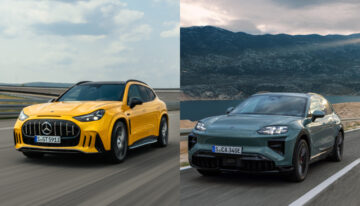
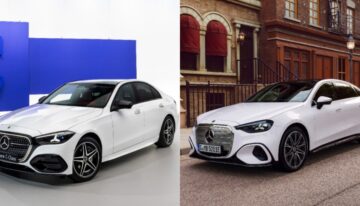
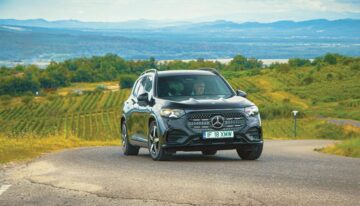
The new electric era at Mercedes begins — with exceptional efficiency, extremely high charging power, and incredible range. And on top of all that, the new Mercedes CLA is still a true Mercedes. We tested the Mercedes CLA 250+, featuring a 272 PS rear-mounted motor and a large 85 kWh battery.
Photo: Christian Bart
Before the electric era, the German dream was to build a house, have two children, and own a Mercedes. But in the new electric age, that dream has somewhat faded, as electric Mercedes models like the EQA, EQE, or EQS no longer hold the same appeal as the combustion-engine C-Class or E-Class — especially those legendary diesel versions known for easily surpassing a million kilometers.
Sales figures confirm this: in the first nine months of 2025, electric Mercedes models accounted for only 9% of total sales. That’s as low as it gets — and far from the goal set at the October 2020 conference, when Mercedes predicted that by 2030, half of its production would be electric vehicles.
The inventor of the automobile realized that a revolution was needed — just like in 1886, when Karl Benz presented the Benz Patent Motorwagen. That revolution is called MMA and MB.EA: two completely new platforms. The first, MMA, is a multi-powertrain platform designed as “electric first,” intended for the compact range (CLA / CLA Shooting Brake / GLA / GLB), while MB.EA is a dedicated electric platform for the new GLC EQ and the future electric C-Class and E-Class.
For now, though, our focus is on the new Mercedes CLA, in the CLA 250+ version — equipped with a 272 PS rear motor and a large 85 kWh net battery.
Tesla Killer?
All the technical data points directly toward the Tesla Model 3 — from size and range to charging speed. While the combustion-engine CLA was based on front-wheel drive, the new electric CLA was designed with rear-wheel drive, precisely to deliver Tesla Model 3–like dynamics.
At 4,723 mm long, 1,855 mm wide, and 1,468 mm high, the new CLA is only 3 mm longer, 5 mm wider, and 27 mm taller than the Model 3. However, its wheelbase of 2,790 mm is 85 mm shorter. So, the overall footprint is nearly identical, though the Model 3 has a slightly longer wheelbase.
This difference is noticeable inside: the Mercedes offers a bit less knee room in the rear, and access is trickier because of the sloping roofline. Still, the cabin feels airy thanks to the standard panoramic roof with thermal protection.
The rear bench is positioned rather low, so your knees sit in air, and the seat cushion is relatively short. Nevertheless, space is decent, and the backrest and cushion are both comfortable and well-shaped.
The trunk volume has decreased from 460 to 405 liters, but the electric version compensates with a spacious frunk (front trunk) offering 101 liters — enough for charging cables or a travel bag. By comparison, the Model 3 provides 425 liters in the rear and 88 liters in the front.
But enough with the measurements — it’s time to hit the road.