The fifth-generation Audi A6 Allroad Quattro takes aim directly at the Mercedes E-Class T-Model All-Terrain in an exclusive premium segment where BMW currently has no competitor.
Today, SUVs are the trend, but those who do not want a large and heavy vehicle and prefer more refined driving dynamics can choose premium raised-ride station wagons. These models are lighter, have a lower center of gravity, and benefit from all the technologies found in equivalent SUVs.
Dimensions and Space: Mercedes E-Class All-Terrain Is More Spacious
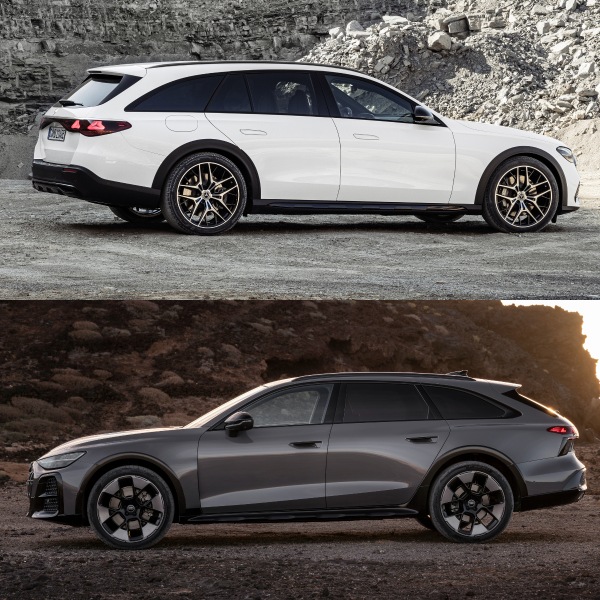
The Audi A6 Allroad Quattro has now reached its fifth generation, while the Mercedes E-Class All-Terrain is in its second generation. The new A6 Allroad Quattro differentiates itself more clearly from the A6 Avant, featuring a distinct body design. The rear track has been widened by 70 mm, while the overall width has increased by 111 mm.
With a length of 5,016 mm, a width of 1,986 mm (2,099 mm including mirrors), and a height of 1,508 mm, the Audi A6 Allroad Quattro is 66 mm longer, 97 mm wider, and 11 mm taller than the Mercedes E-Class All-Terrain, which measures 4,950 mm in length, 1,889 mm in width, and 1,497 mm in height.
Surprisingly, despite being shorter overall, the Mercedes E-Class All-Terrain has a longer wheelbase: 2,961 mm compared with 2,923 mm for the Audi A6 Allroad.
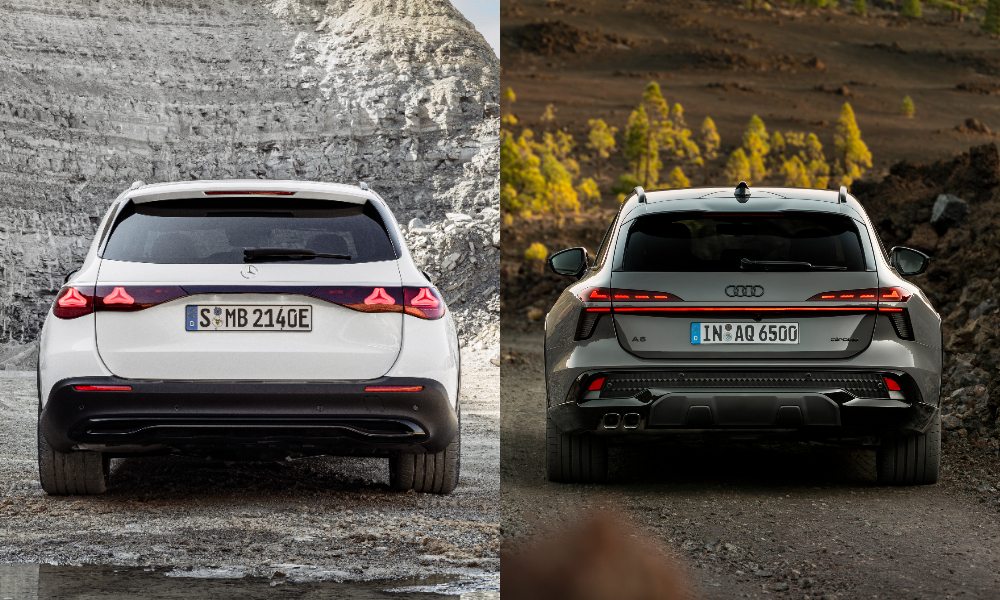
In addition to its very generous rear-seat space, the Mercedes E-Class All-Terrain is a true house on wheels, offering a huge luggage compartment ranging from 615 liters to 1,830 liters with the standard 40:20:40 split-folding rear seats folded down. By comparison, the Audi’s cargo capacity ranges from 466 to 1,497 liters, as its tailgate is more steeply sloped than the Mercedes’.
The PHEV version offers an even smaller luggage compartment due to the battery located beneath the floor, with capacity ranging from 404 to 1,423 liters. The Mercedes PHEV also has a slightly reduced cargo area because its battery is likewise mounted under the luggage compartment floor, but it still offers more space, ranging from 460 to 1,675 liters.
The Audi A6 Allroad Quattro can be configured with wheels ranging from 19 to 21 inches, while the Mercedes comes standard with 18-inch wheels and can be optionally equipped with wheels up to 20 inches in size.
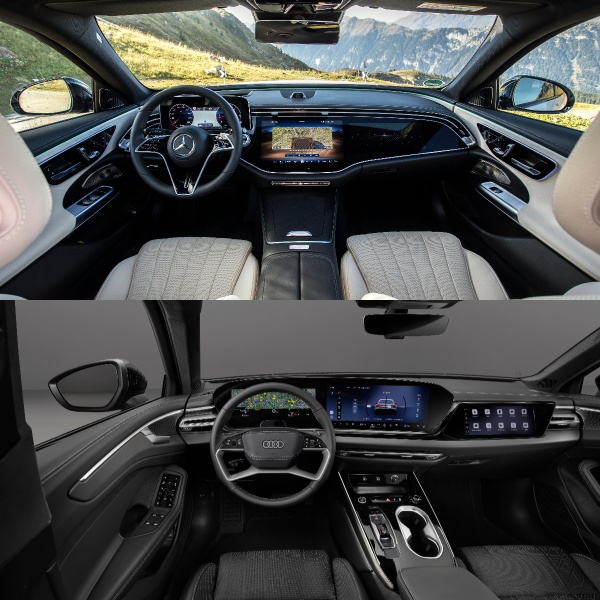
The Mercedes E-Class was the first non-EQ model to receive the new MBUX Superscreen dashboard, which includes a 12.3-inch digital instrument cluster, a 14.4-inch central infotainment display, and an optional 12.3-inch passenger display (€1,773). Buyers can also opt for a 3D instrument cluster (€1,178). The head-up display costs an additional €1,297.
By comparison, the Audi A6 Allroad dashboard follows the layout used across the Audi A6 family, featuring three displays: an 11.9-inch digital instrument cluster, a 14.5-inch MMI infotainment touchscreen, and an optional 10.9-inch front passenger display.
The instrument cluster can be configured in three modes: classic gauges, navigation mode, and an assistance systems display. The infotainment system includes a voice assistant powered by ChatGPT, although neither model’s navigation system is based on Google services.
Engines and Suspension
Both models come standard with adaptive air suspension and all-wheel drive. Although Mercedes offers numerous models with rear-axle steering, the E-Class All-Terrain is not available with this feature, not even as an option. Audi, on the other hand, offers all-wheel steering: at speeds of up to 60 km/h, the rear wheels can turn by up to 5 degrees in the opposite direction to the front wheels, reducing the turning circle by up to one meter. At higher speeds, the rear wheels turn by up to 2 degrees in the same direction as the front wheels.
The adaptive air suspensions also allow the ride height to be adjusted depending on the selected driving mode and vehicle speed.
In the case of the Mercedes E-Class All-Terrain, ground clearance varies between 121 mm and 156 mm. In Comfort mode above 120 km/h and in Sport mode, the vehicle lowers by around 15 mm to the minimum ground clearance of 121 mm. In Comfort mode below 120 km/h, ground clearance is 136 mm, while in All-Terrain mode it rises by 20 mm to 156 mm.
Audi does not provide exact ground-clearance figures but promises a wider adjustment range of 55 mm. In the “balanced,” “comfort,” and “efficiency” modes, ground clearance is 34 mm higher than in the A6 Avant. In the “offroad” and “offroad+” modes, the suspension raises by a further 15 mm, while in “dynamic” mode it lowers by 20 mm compared with the normal level.
In addition, regardless of the selected driving mode, the suspension lowers automatically at speeds above 120 km/h.
There is also a Lift mode that raises the suspension by an additional 20 mm at speeds of up to 35 km/h.
The Audi A6 Allroad Quattro is initially available with two powertrains:
- 3.0-liter V6 TDI diesel producing 220 kW (299 PS) and 580 Nm, featuring a slightly different mild-hybrid system from its rivals. The 48V mild-hybrid system includes a belt-driven starter-generator, a powertrain generator delivering up to 18 kW (24 PS) and enabling up to 25 kW of regenerative braking, as well as an electrically powered compressor. The electric compressor eliminates turbo lag until the turbocharger reaches operating speed.
- Plug-in hybrid (PHEV) combining a 2.0 TFSI turbocharged petrol engine with 252 PS and a 105 kW (143 PS) electric motor. The system delivers a combined output of 270 kW (367 PS) and 500 Nm of torque. The 25.9 kWh gross (20.9 kWh net) battery provides a WLTP electric range of 95 km, but it can only be charged at AC stations with up to 11 kW, requiring approximately two and a half hours for a full charge.
The Mercedes E-Class All-Terrain is available in four versions:
- E 220 d 4Matic T-Model All-Terrain with a 2.0-liter diesel engine producing 145 kW (197 PS) and 440 Nm.
- E 450 4Matic T-Model All-Terrain with a 3.0-liter inline six-cylinder petrol engine producing 280 kW (381 PS), featuring a 48V mild-hybrid system with a 17 kW (23 PS) electric motor integrated into the 9-speed automatic transmission.
- E 450 d 4Matic T-Model All-Terrain with a 3.0-liter inline six-cylinder diesel engine producing 270 kW (367 PS), also equipped with a 48V mild-hybrid system and a 17 kW (23 PS) electric motor integrated into the 9-speed automatic transmission.
- Diesel-electric plug-in hybrid (PHEV) combining the 2.0-liter diesel engine with 145 kW (197 PS) and 440 Nm and a 95 kW (129 PS) electric motor powered by a 25.4 kWh gross (19.5 kWh net) battery. This setup provides a WLTP electric range of 96 km. Mercedes has an advantage because its battery can also be charged at DC fast chargers with up to 60 kW (optional for €595), in addition to 11 kW AC charging, whereas the Audi can only be charged at AC stations with a maximum of 11 kW.
Prices
Mercedes is more expensive than Audi. Comparing the six-cylinder diesel versions directly, the new Audi A6 Allroad V6 TDI 220 kW starts at €77,250, while the Mercedes E 450 d 4Matic T-Model All-Terrain costs €86,418. The price difference is almost €10,000, although Mercedes does offer 68 PS more power.
By contrast, the plug-in hybrid versions are priced very similarly: €80,250 for the Audi and €81,277 for the Mercedes E 300 de 4Matic T-Model All-Terrain.
The four-cylinder diesel Mercedes E 220 d 4Matic All-Terrain, which has no Audi equivalent, costs €73,601, while the inline six-cylinder petrol version, which also has no direct Audi counterpart, starts at €85,109.