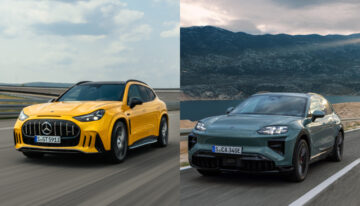
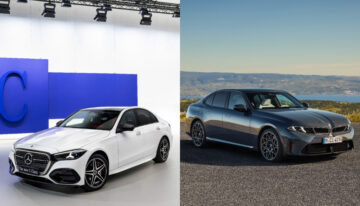
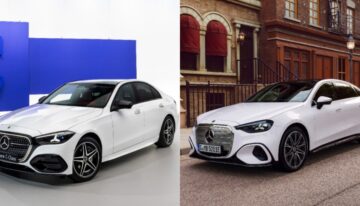
Mercedes offers the new Mercedes CLA in two propulsion versions: the fully electric Mercedes CLA EQ and the Mercedes CLA mild hybrid. Which has the better price and which is better equipped? We explain in the following analysis.
After the unsuccessful experiment with the EQE/EQS models—which had a completely different design compared to the traditional E-Class and S-Class sedans—Mercedes decided to unify the design of electric, combustion, hybrid, and plug-in-hybrid models.
Thus, the Mercedes CLA EQ and CLA hybrid share a similar design and, in this case, even a similar multi-propulsion platform, MMA (Mercedes Modular Architecture), developed as “electric first” rather than “electric only.”
This means that the MMA platform was developed primarily for electric propulsion but can also accommodate conventional powertrains.
Which is cheaper: electric or combustion?
The Mercedes CLA EQ is available with 58- and 85-kWh batteries combined with either one or two electric motors.
The cheapest model, the Mercedes CLA EQ with a 58-kWh LFP battery and a 224-PS rear electric motor, starts at 49,521 euros. With the smaller 58-kWh battery, the WLTP range is a decent 541 km.
The Mercedes CLA mild hybrid is available in five versions, two of which have 4Matic all-wheel drive. The cheapest model, the Mercedes CLA 180 with a 1.5-liter turbo engine producing 136 PS driving the front wheels and a 30-PS electric motor integrated into the new 8-speed automatic transmission, starts at 46,243 euros.
This means the combustion model is only 3,300 euros cheaper, even though the electric version accelerates from 0 to 100 kph in 7.5 seconds compared to 8.8 seconds for the combustion model. With a 51-liter tank and a WLTP consumption of 4.9 l/100 km, the combustion model should theoretically have almost double the range.
Moving up the range, the Mercedes CLA 250+ electric with the larger 85-kWh battery and a 272-PS rear electric motor starts at 55,859 euros and offers an impressive WLTP range of up to 792 km.
The next two hybrid models, the Mercedes CLA 200 and CLA 220, also feature 1.5-liter engines producing 163 and 190 PS respectively, supported by the same 30-PS electric motor integrated into the 8-speed automatic transmission. The CLA 200 starts at 48,956 euros, and the CLA 220 at 52,026 euros.
This means the CLA 200 is almost 7,000 euros cheaper than the electric CLA 250+, but it has 109 PS less; the CLA 220 is 3,800 euros cheaper and has 82 PS less.
The CLA 250+ accelerates from 0 to 100 kph in 6.7 seconds—1.3 seconds faster than the CLA 200 and 0.5 seconds faster than the CLA 220.
Finally, the top electric model, the Mercedes CLA 350 4Matic, comes with the same large 85-kWh battery and two electric motors producing a total of 354 PS, and starts at 60,381 euros. In the CLA 350 4Matic, in addition to the 272-PS rear motor, there is an extra 109-PS front electric motor that operates intermittently when more power or traction is needed.
In comparison, the top combustion model, the Mercedes CLA 220 4Matic, has a 1.5-liter turbo engine with 190 PS combined with the same 30-PS electric motor integrated into the gearbox and all-wheel drive that can send up to 50% of the torque to the rear axle. The top CLA 220 4Matic costs 54,228 euros, over 6,000 euros cheaper than the electric CLA 350 4Matic.
However, 0–100 kph acceleration takes 7.1 seconds, while the electric model reaches 100 kph much faster—just 4.9 seconds, meaning it is 2.2 seconds quicker.
Which is better equipped: electric or gasoline?
Is the higher price of the electric model compensated by superior standard equipment? Compared to the previous generation, the new Mercedes CLA is better equipped as standard in both the electric and combustion versions.
Like the Mercedes CLA EQ, the Mercedes CLA mild hybrid comes with a rich standard equipment list. The panoramic sunroof is standard, as well as 10.25-inch displays for the digital instrument cluster and a 14-inch display for the multimedia system. Standard equipment also includes LED High Performance headlights with Adaptive Highbeam Assist, Thermatic automatic climate control, a leather-wrapped multifunction steering wheel, the MBUX navigation system, the USB package with four USB-C ports, heated front seats, and an almost complete set of driver assistance systems plus a reversing camera.
Three packages can be configured for both versions:
Advanced Plus (1,469.65 euros),
Premium with Digital Extras (3,230.85 euros), and
Premium Plus with Digital Extras (5,432.35 euros).
The electric version has only two extra features: the illuminated grille and logo, and the heat pump—the latter being more commonly found in electric models. Therefore, the price differences do not change significantly. A heat pump is not offered even as an option for the combustion version. In general, a heat pump costs around 1,200 euros. If we take this into account, the price difference between electric and gasoline shrinks slightly.
Which one consumes less?
Looking at official WLTP consumption, the Mercedes CLA 250+ uses 12.5 kWh/100 km, while the Mercedes CLA 220 uses 5 l/100 km (WLTP emissions: 113 g/km CO₂).
Purely theoretically, with a gasoline price of 1.8 euros per liter and fast DC charging at 0.6 euros per kWh, and using the consumption figures of 5 l/100 km for the CLA 220 and 12.3 kWh/100 km for the CLA 250+, the cost is 9 euros per 100 km for the gasoline model and 7.38 euros per 100 km for the electric model. Thus, the electric model costs 1.62 euros less per 100 km. The 3,800-euro difference between the CLA 220 gasoline and CLA 250+ electric would be recouped only after about 234,000 km.
In reality, however, three things must be considered:
-
Real-world consumption is completely different. In our test of the Mercedes CLA 250+, we recorded 14.5 kWh/100 km. The gasoline model is not yet available for testing, but it is hard to imagine it consuming less than 6 l/100 km considering its 190-PS output, even with the support of an electric motor.
-
Maintenance costs for the electric model are slightly lower, as servicing is cheaper.
-
Taxes and fees are lower for electric cars in most countries.
Therefore, in real life, the price difference between electric and gasoline could be recouped sooner—before 200,000 km.