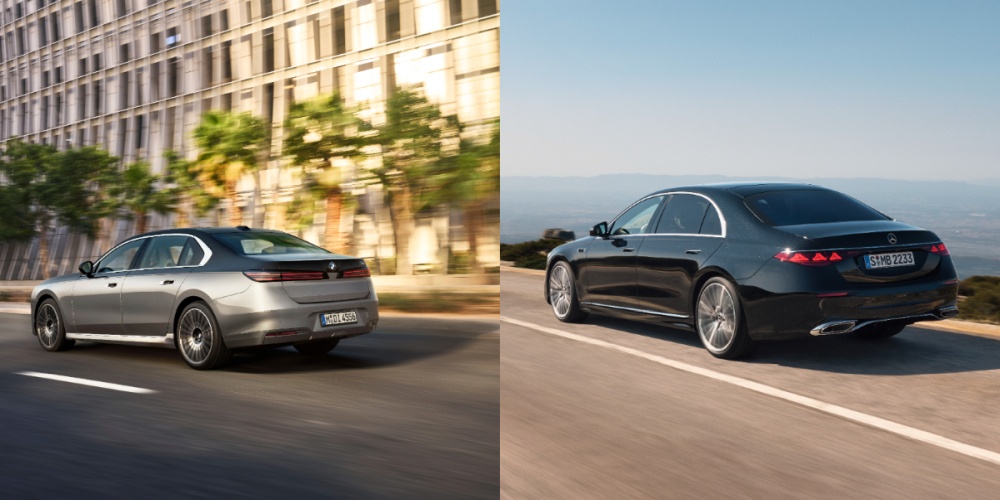
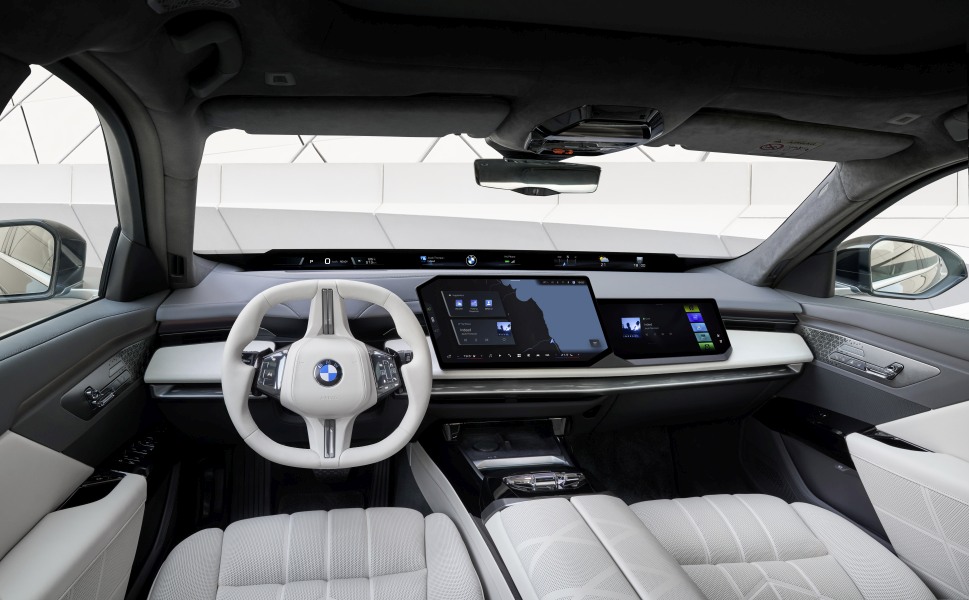
Almost 3 months after the facelift of the Mercedes S-Class, BMW responds with the facelift of the BMW 7 Series. Both facelifts are extensive operations, so we considered it worth making an initial evaluation.
Photo: Mercedes-Benz, BMW
The two German premium limousines are now in their seventh generation, and after the discontinuation of the Audi A8, they remain the only German luxury limousines. The current BMW 7 Series generation (G70) was introduced in July 2022, while the current Mercedes S-Class (W223) was introduced in the fall of 2020. That means the BMW 7 Series is nearly four years old, and the Mercedes S-Class about five and a half years old.
The BMW 7 Series is built on the conventional CLAR platform, which is used for all powertrains – diesel, petrol, PHEV, and electric. In contrast, the facelifted Mercedes S-Class still uses the MRA II platform, and is available with diesel, petrol, and PHEV options, while its electric counterpart, the EQS, is based on the dedicated EVA II electric platform, recently upgraded with 800V technology. It should be noted that the Mercedes S-Class is now offered only in a long-wheelbase version.
Engine lineup
Both luxury limousines use a wide range of engines, but their offerings differ quite a bit. BMW does not offer a V8 engine in Europe, both brands have two PHEV versions in their lineup, and Mercedes offers more diesel and petrol variants—two each, compared to only one from BMW. All conventional diesel and petrol engines feature a new-generation 48V mild hybrid system, with the electric motor integrated into the automatic transmission (8-speed for BMW, 9-speed for Mercedes).
Petrol engines
- BMW 740 xDrive, inline 6-cylinder, 400 HP / 580 Nm + electric motor 18 HP / 200 Nm
- Mercedes S 450 4Matic, inline 6-cylinder, 381 HP / 560 Nm + electric motor 23 HP / 205 Nm
- Mercedes S 500 4Matic, inline 6-cylinder, 449 HP / 600 (640) Nm + electric motor 23 HP / 205 Nm
- Mercedes S 580 4Matic, V8 flat-plane crankshaft, 537 HP / 750 Nm + electric motor 23 HP / 205 Nm
Diesel engines
- BMW 740 d xDrive (November 2026), inline 6-cylinder, 286 HP / 670 Nm + electric motor 18 HP / 200 Nm
- Mercedes S 350 d 4Matic, inline 6-cylinder, 313 HP / 650 Nm + electric motor 23 HP / 205 Nm
- Mercedes S 450 d 4Matic, inline 6-cylinder, 367 HP / 750 Nm + electric motor 23 HP / 205 Nm
PHEV versions
- BMW 750e xDrive (November 2026), inline 6-cylinder, 313 HP / 450 Nm + electric motor 197 HP / 280 Nm, total system output 489 HP / 700 Nm, electric range 70–82 km
- BMW M760e xDrive (November 2026), inline 6-cylinder, 426 HP / 540 Nm + electric motor 197 HP / 280 Nm, electric range 69–80 km
- Mercedes S 450e, inline 6-cylinder, 326 HP / 540 Nm + electric motor 163 HP / 480 Nm, total system output 435 HP / 680 Nm
- Mercedes S 580e 4Matic, inline 6-cylinder, 449 HP / 560 Nm + electric motor 163 HP / 480 Nm, total system output 585 HP / 750 Nm