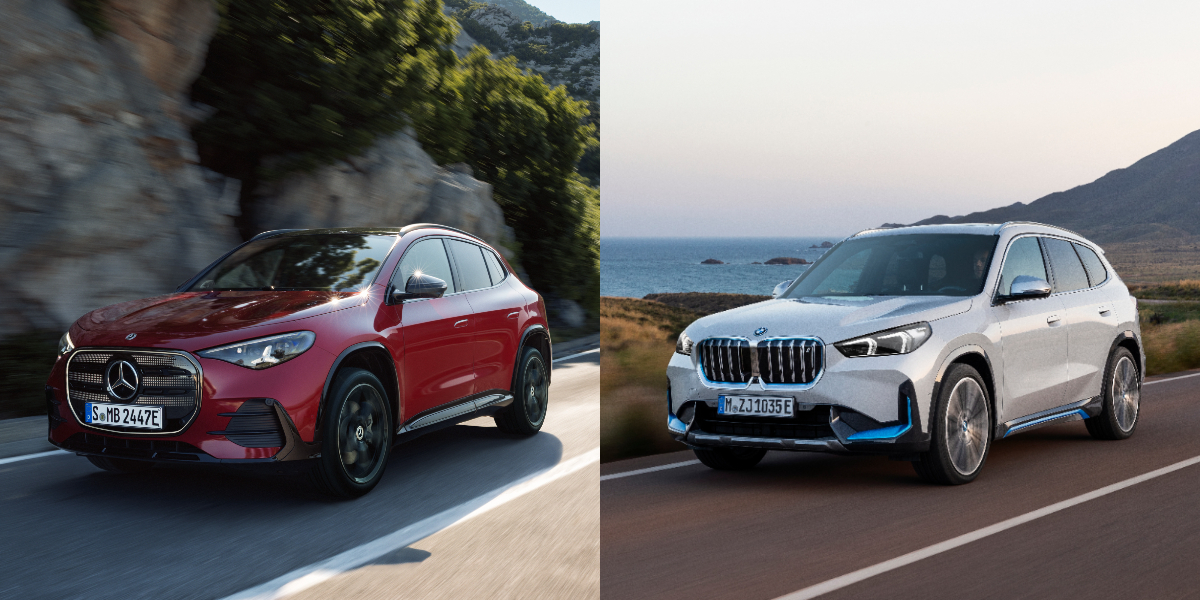
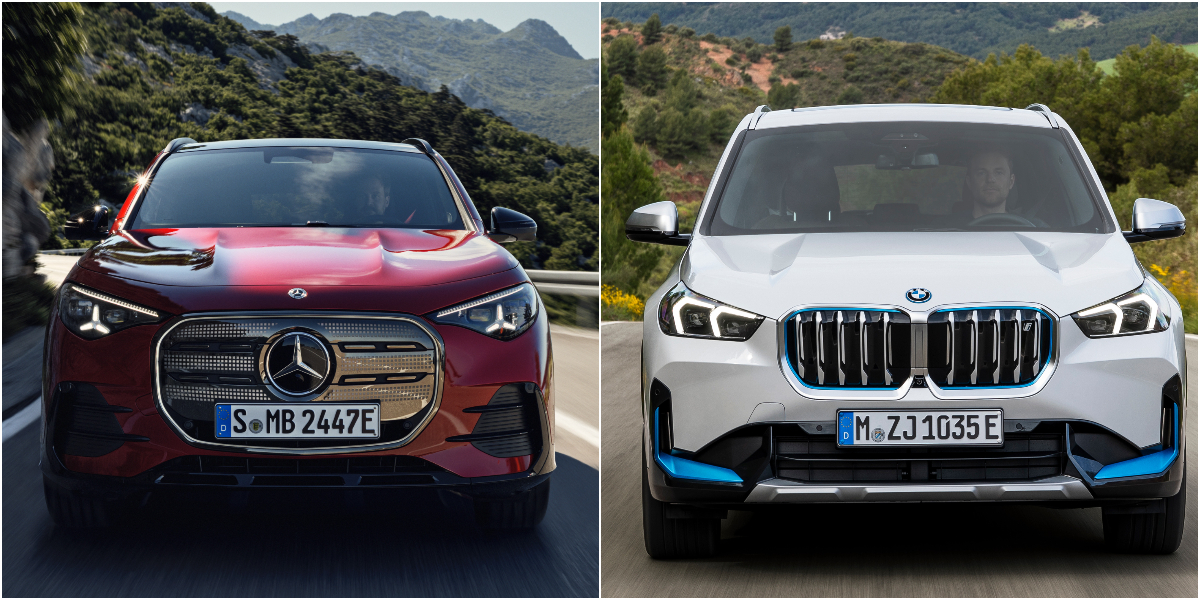
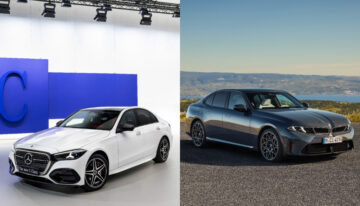
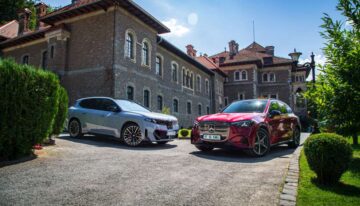
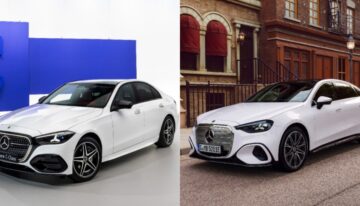
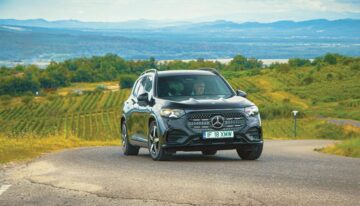
Mercedes has just unveiled the third-generation Mercedes GLA, which will compete directly with the BMW X1, originally launched in the summer of 2022 and recently updated with a minor facelift.
The new Mercedes GLA and BMW X1 share many similarities. Both are built on multi-energy platforms—MMA for Mercedes and UKL2 for BMW. However, while the BMW X1 is available with every type of powertrain—mild-hybrid petrol, mild-hybrid diesel, plug-in hybrid, and fully electric—offering no fewer than 13 different drivetrain variants, the new Mercedes GLA has debuted exclusively as an electric model. At the beginning of 2027, Mercedes will add two mild-hybrid petrol powertrains, each available with either rear-wheel drive or all-wheel drive, but no diesel.
Dimensions and practicality
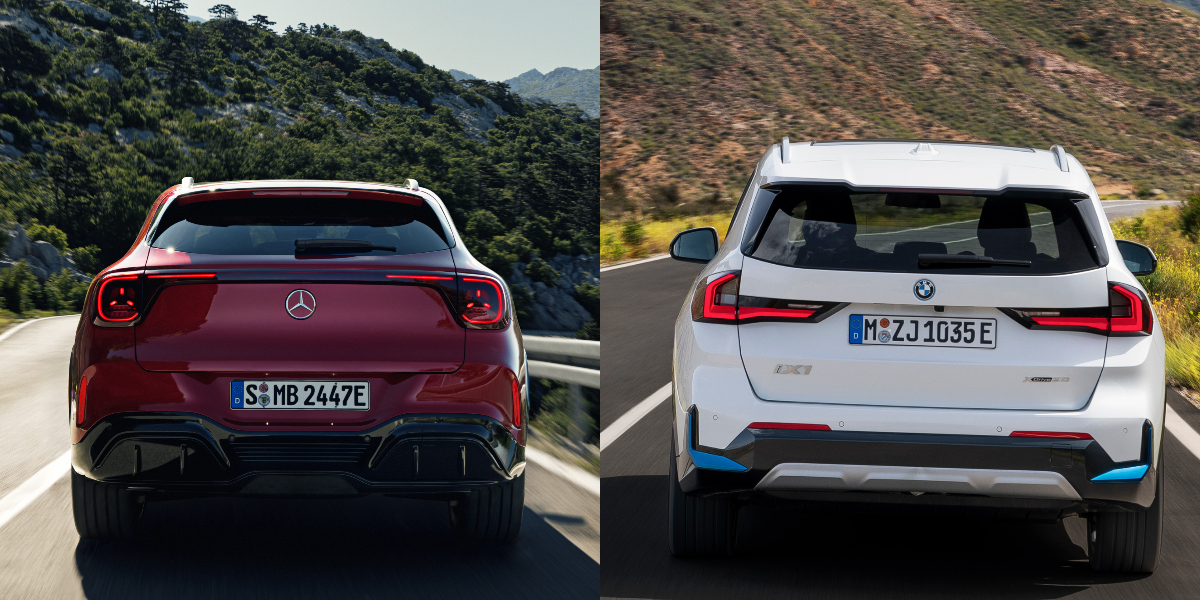
Measuring 4,500 mm in length, 1,845 mm in width and 1,616 mm in height, the BMW X1 is 65 mm shorter, 28 mm narrower and 12 mm taller than the Mercedes GLA, which measures 4,565 mm long, 1,873 mm wide and 1,604 mm high.
Although the BMW X1 is only 65 mm shorter overall, its 2,692 mm wheelbase is almost 100 mm shorter than the Mercedes GLA’s generous 2,790 mm wheelbase. We will have to wait for our first driving test to see whether this translates into noticeably better rear legroom.
BMW, however, offers a significantly larger luggage compartment. Mild-hybrid versions provide 540 litres of cargo space, expandable to 1,600 litres with the rear seats folded. The electric versions offer between 490 and 1,495 litres.
By comparison, the electric Mercedes GLA (the only version revealed so far) has a smaller luggage compartment, ranging from 410 to 1,400 litres. However, thanks to its newer design, the GLA features a spacious 107-litre front trunk (frunk) for storing charging cables, partially compensating for the smaller rear cargo area.
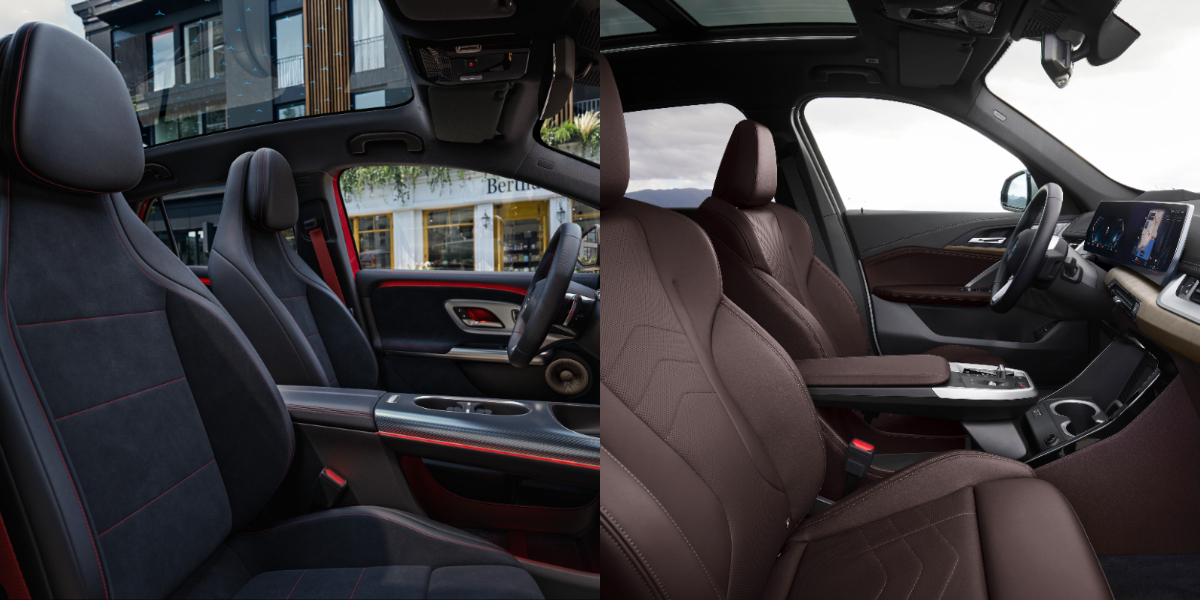
Mercedes also impresses with its optional Sky Control panoramic roof, featuring seven individually dimmable glass sections and integrating 172 illuminated stars.
Powertrains and batteries
As mentioned earlier, Mercedes has limited its compact model range to electric and mild-hybrid petrol powertrains. As with the CLA and GLB, the GLA launches first as an EV, while the mild-hybrid petrol versions will arrive in early 2027.
At launch, the Mercedes GLA is available in three electric versions:
- Mercedes GLA 200 – 224 PS electric motor, 58 kWh LFP battery, from €48,599.60
- Mercedes GLA 250+ – 272 PS electric motor, 85 kWh NMC battery, from €54,978
- Mercedes GLA 350 4MATIC – dual-motor all-wheel drive, 354 PS, 85 kWh net battery, from €58,107.70
The BMW iX1, meanwhile, is available in only two electric versions, as BMW also offers two plug-in hybrid variants.
- BMW iX1 eDrive20 – 204 PS electric motor, 65.2 kWh NMC battery, from €49,400
- BMW iX1 xDrive30 – dual-motor all-wheel drive, 313 PS, 65 kWh net battery, from €56,600
While BMW’s new iX3 introduces more advanced EV technology than the Mercedes GLC Electric—with cylindrical battery cells arranged using the cell-to-pack concept and a pack-to-open-body battery structure that improves body rigidity while reducing weight—the BMW iX1 cannot match the technology found in the new Mercedes GLA.
The Mercedes uses an 800-volt electrical architecture, enabling DC charging speeds of 200 kW for the entry-level version and up to 320 kW for the GLA 250+ and GLA 350 4MATIC. BMW relies on a 400-volt system with a maximum charging power of just 130 kW.
Although BMW’s battery is around 20 kWh smaller than the top Mercedes GLA versions, it still requires about 29 minutes for a DC fast charge. Mercedes, despite its much larger battery, completes the same process in just 22 minutes.
The Mercedes GLA also offers significantly greater driving range. The GLA 250+ and GLA 350 4MATIC, equipped with the 85 kWh battery, promise WLTP ranges of 657 km and 643 km, respectively, compared with 516 km for the BMW iX1 eDrive20 and 468 km for the BMW iX1 xDrive30.
Different multimedia systems
BMW updated the iX1’s infotainment system in November 2023. It can optionally run the latest BMW Operating System 9, which can be enhanced through the BMW ConnectedDrive Store, where customers can download third-party applications for audio and video streaming, news and gaming. BMW Digital Premium also includes enhanced navigation, although BMW continues to rely on its own HERE maps rather than Google services.
Like all of Mercedes’ latest models, the new GLA features the MB.OS operating system, built around Google services. It integrates Google Maps navigation, the Google virtual assistant, and artificial intelligence powered by ChatGPT, Microsoft Bing and Google Gemini. The multimedia system provides access to more than 40 third-party applications, ranging from audio and video streaming to gaming. These include YouTube, Sony Pictures Entertainment’s RIDEVU, Disney+ with Dolby Atmos support, and upcoming services such as DAZN and AirPlay Video.
Another innovation is the MBUX Navigation Surround system, which creates a real-time 3D visualization of the vehicle’s surroundings, including pedestrians, cyclists, cars and motorcycles, while combining this with navigation guidance and driver assistance information displayed in the instrument cluster. Tesla has offered a similar visualization of surrounding traffic for years, although without integrating it with augmented-reality navigation.
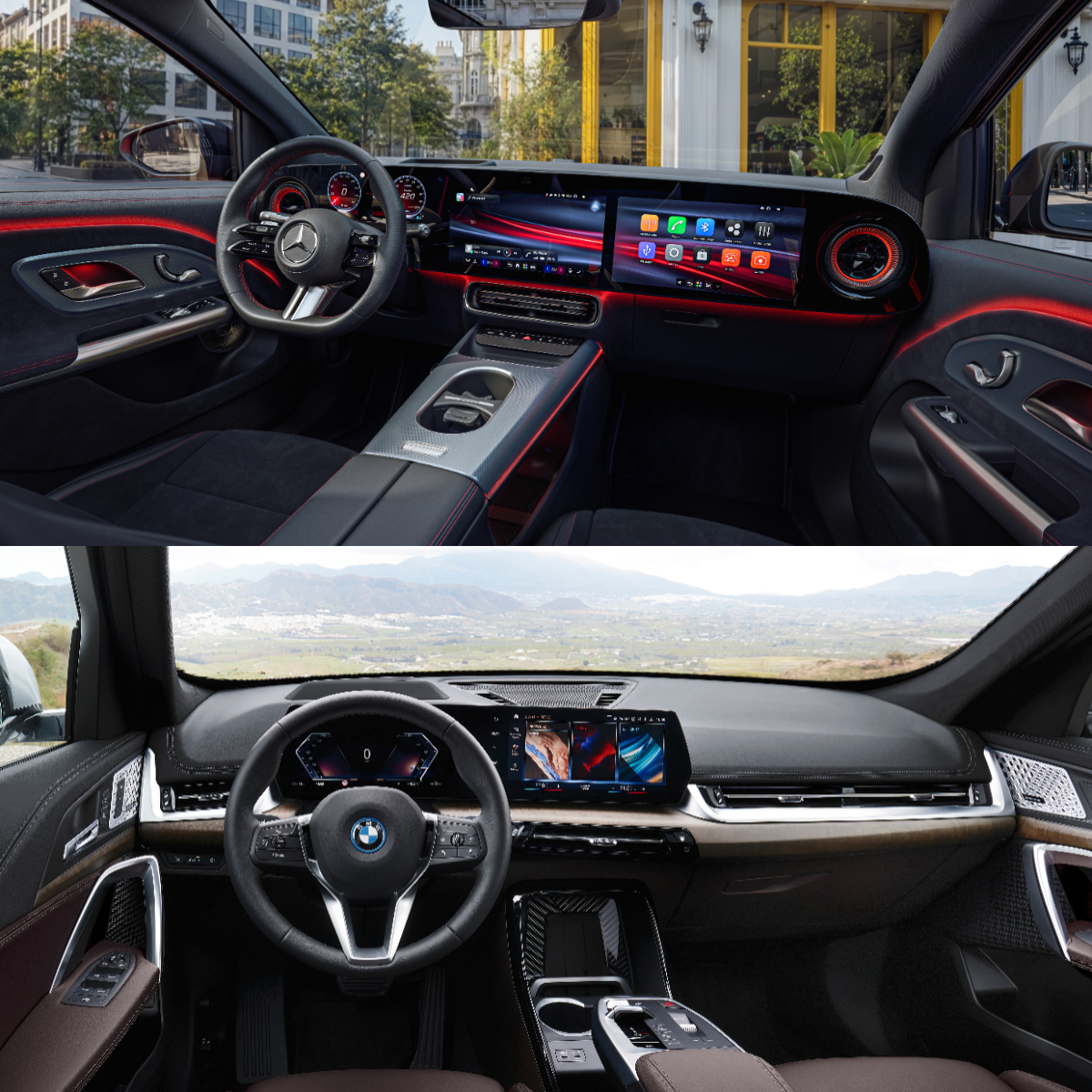
The Mercedes GLA comes standard with two displays: a 10.25-inch digital instrument cluster, which now offers fewer customization modes than before, and a 14-inch central touchscreen. An optional passenger display is available; otherwise, the passenger side features a glossy black panel decorated with illuminated star graphics.
The BMW iX1 with Operating System 9 features a curved display integrating a 10.25-inch digital instrument cluster and a 10.7-inch infotainment touchscreen.
Pricing
The two models are priced very similarly.
The electric Mercedes GLA starts at €48,599.60 in GLA 200 specification, while the BMW iX1 starts at €49,400 as the iX1 eDrive20. Here, BMW holds a slight advantage thanks to its marginally larger battery, which delivers a WLTP range of 516 km compared with 447 km for the Mercedes. However, the Mercedes offers 20 PS more power and reaches 100 km/h 0.5 seconds quicker, taking 8.1 seconds versus 8.6 seconds for the BMW.
The top versions of the Mercedes GLA are positioned even more competitively. The GLA 350 4MATIC, producing 354 PS, starts at €58,107.70, compared with €56,600 for the BMW iX1 xDrive30. For an additional €1,500, the Mercedes offers 41 PS more power, a battery that is 20 kWh larger, and a WLTP driving range of 643 km instead of 468 km. Overall, Mercedes delivers considerably more value for only a modest price premium.
| Technical data | Mercedes CLA 200 | Mercedes CLA 250+ | Mercedes CLA 350 4Matic | BMW iX1 eDrive20 | BMW iX1 xDrive30 |
|---|---|---|---|---|---|
| Engine | 1, rear | 1, rear | 2, one rear, one front | 1, front | 2, one rear, one front |
| Max output (PS) | 224 | 272 | 354 | 204 | 313 |
| Max torque (Nm) | 335 | 335 | 515 | 250 | 494 |
| Traction | rear | rear | awd | fwd | awd |
| Gearbox | 2 gears rear | 2 gears rear | 2 gears rear, one gear front | 1 gear front | 1 gear front, 1 gear rear |
| L x w x h (mm) | 4,565x1,873x1,604 | 4,565x1,873x1,604 | 4,565x1,873x1,604 | 4,500 x 1,845 x 1,616 | 4,500 x 1,845 x 1,616 |
| Wheelbase (mm) | 2,790 | 2,790 | 2,790 | 2,692 | 2,692 |
| Curb weight/payload (kg) | 2,145/480 | 2,155/480 | 2,235/480 | 1,940 | 2,085/na |
| Boot volume (l) | 410-1,400/107 | 410-1,400/107 | 410-1,400/107 | 490-1,495 | 490-1,495 |
| Battery capacity net (kWh) | 58 | 85 | 85 | 65.2 | 65.2 |
| AC charging (kW) | 11/22 | 11/22 | 11 | 11/22 | 11/22 |
| AC charging time (h) | 6.5/3.5 | 9.0/4.75 | 9.0/4.75 | 6.5/nc | 6.5/na |
| DC charging (kW) | 200 | 320 | 320 | 130 | 130 |
| DC charging time 10-80% (minutes) | 20 | 22 | 22 | 29 | 29 |
| Performances | |||||
| 0-100 kph (s) | 8.1 | 7.3 | 5.4 | 8.6 | 5.6 |
| Top speed (kph) | 210 | 210 | 210 | 170 | 180 |
| Energy cons. ( kWh/100 km) | 14.8-17.0 | 15.1-17.3 | 15.1-17.6 | 14.2 | 15.6 |
| Range (km) | 394-447 | 577-657 | 555-643 | 516 | 468 |
| Price (euro with VAT) | 48,599.60 | 54,978 | 58,107.70 | 49,400 | 56,600 |