Chicago freight does not give driver-assistance technology ideal conditions. Trucks move between congested expressways, warehouse districts, rail terminals, industrial streets, and customer yards where cars, pedestrians, forklifts, and other commercial vehicles may enter the driver’s working space with little warning.
Winter makes that environment even harder. Snow reduces lane visibility, slush covers cameras and lights, salt spray collects around sensors, and changing road surfaces affect stopping distance. These are exactly the conditions in which modern safety systems can be valuable—but also the conditions that expose their limits.
For a professional driver, the important question is not whether the truck has advanced technology. It is whether the driver understands what the systems monitor, when they can intervene, and when the information they provide may be incomplete.
Where Modern Truck Technology Helps Most
Current Mercedes-Benz heavy trucks can combine radar, cameras, automated braking, lane monitoring, and side-area detection. Each system addresses a different part of the driver’s workload.
Forward monitoring can warn when the truck is closing too quickly on traffic and may begin braking when a collision risk develops. This is especially useful on Chicago-area expressways, where traffic can move at highway speed and then slow suddenly near an interchange, construction zone, or backed-up exit.
Side monitoring can help when a car remains beside the trailer or when a cyclist or pedestrian enters the area near the cab during a turn. Camera-based mirror systems can also provide a wider view around the truck and trailer than a conventional mirror in certain situations.
The work behind cdl-a jobs increasingly includes understanding these systems as part of the vehicle rather than treating them as optional accessories. A driver needs to recognize alerts, know what can trigger them, and notice when a system reports that its performance is restricted.
Technology can add another layer of awareness. It does not remove the need to control following distance, anticipate traffic, or avoid a lane change that has become too risky.
Chicago Winter Can Limit What the Truck Sees
A camera cannot provide a clear image through a layer of dirty slush. Lane-monitoring systems may have difficulty when pavement markings are hidden by snow, worn away, or confused by construction. Radar may continue operating in poor visibility, but damaged, blocked, or incorrectly calibrated equipment can still reduce performance.
That means winter preparation must include more than checking tires and washer fluid. Drivers should inspect camera lenses, radar covers, lights, mirrors, and exterior warning systems before entering traffic. During a long shift, another inspection may be necessary after driving through heavy spray or snowfall.
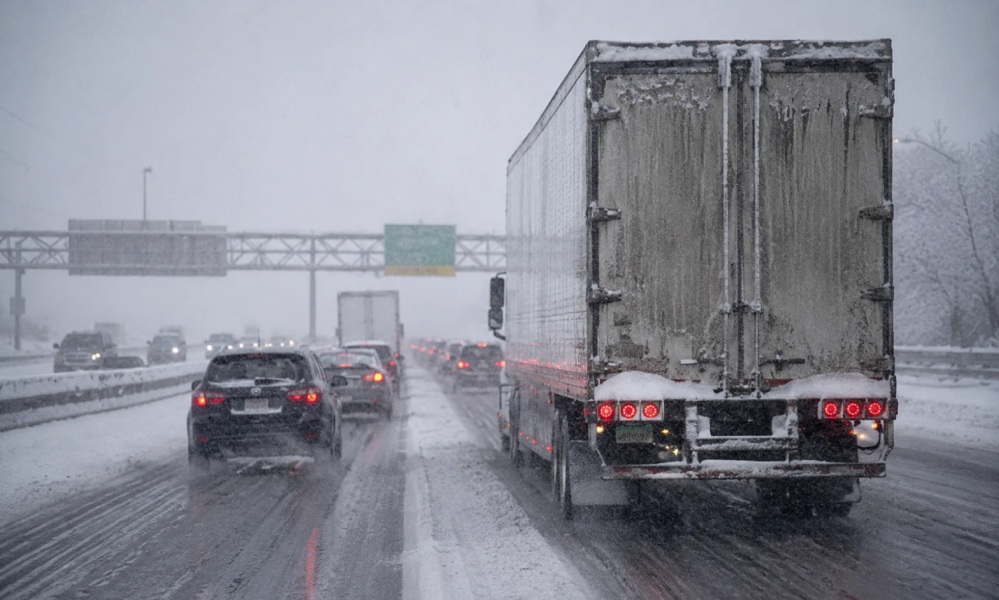
Dashboard messages also matter. A warning that a safety function is unavailable should change how the truck is operated. The driver may need to increase following distance, reduce speed, delay a maneuver, or stop and clean the affected area.
The system has not necessarily failed completely. It may simply be unable to provide the same level of support. The driver must understand that distinction instead of assuming the technology is either fully active or completely useless.
Driver Assistance Cannot Judge the Entire Situation
Automated braking responds to what is happening ahead of the truck, but it does not know everything surrounding the load. A sudden intervention may prevent a collision while also creating forces that affect the trailer and cargo.
The driver must therefore think beyond the immediate traffic event. Was the stop severe enough to justify checking the load? Did the trailer strike a pothole or curb during the maneuver? Has the route changed from smooth highway pavement to rough industrial streets?
Technology can react to a hazard. It cannot inspect the consequences afterward.
This is one reason professional judgment remains important even in highly equipped trucks. The driver connects information from the road, the vehicle, the trailer, the cargo, the weather, and the delivery schedule. No single sensor sees all of those factors at once.
Flatbed Work Makes the Boundary Clear
The difference between assistance and responsibility is especially visible inflatbed driver jobs around Chicago. Cameras can help the driver see traffic beside an open trailer, while collision systems can monitor vehicles ahead. Neither can confirm that a chain remains properly tensioned or that a strap has not been damaged.
Flatbed freight requires direct inspection of chains, straps, binders, anchor points, edge protection, dunnage, and tarps. Rough roads, emergency braking, vibration, and sharp turns can all justify another securement check.
Chicago conditions make those inspections more demanding. Hardware may be wet, frozen, or covered in road grime. Drivers may need to work in gloves, strong wind, snow, or restricted customer yards. A dashboard system cannot feel whether a binder has loosened or notice that a tarp has begun rubbing against a sharp edge.
The truck may help protect the driver on the road, but the load remains the driver’s responsibility.
A Smarter Truck Still Needs an Informed Driver
Safety technology is most effective when the driver understands both its strengths and its boundaries. Automated braking can respond quickly. Side monitoring can reveal a vehicle hidden beside the trailer. Cameras can improve visibility during turns and backing.
None of those systems decides what speed is appropriate for slush, whether a lane change is necessary, or whether the cargo should be inspected after a hard stop.
In Chicago freight work, the best results come from combining technology with disciplined driving, regular equipment checks, and an accurate understanding of what the truck can – and cannot – see.