The Mercedes-AMG GT 4-Door Coupé has a new rival alongside the Porsche Taycan. It is called the Jaguar Type 01, features three electric motors, produces 1,030 PS, offers a WLTP range of 720 km and accelerates from 0 to 100 kph in just 3.2 seconds.
Jaguar was once a brand on the verge of disappearing. Its last completely new model, the I-Pace crossover, was unveiled in 2018, while between June 2024 and December 2025 all its combustion-engined models – the XE, XF, E-Pace and F-Pace – were discontinued without successors.
The British brand, owned by India’s Tata Group, decided to transform itself into an all-electric marque. In December 2024, it unveiled at Miami Art Week the concept of a high-performance electric coupé called the Type 00.
The concept has now evolved into the production Jaguar Type 01, with one major change: it is no longer a two-door coupé, but a four-door GT with a long bonnet and low roofline, positioned as a direct rival to the new Mercedes-AMG GT 4-Door Coupé.
Dimensions and weight
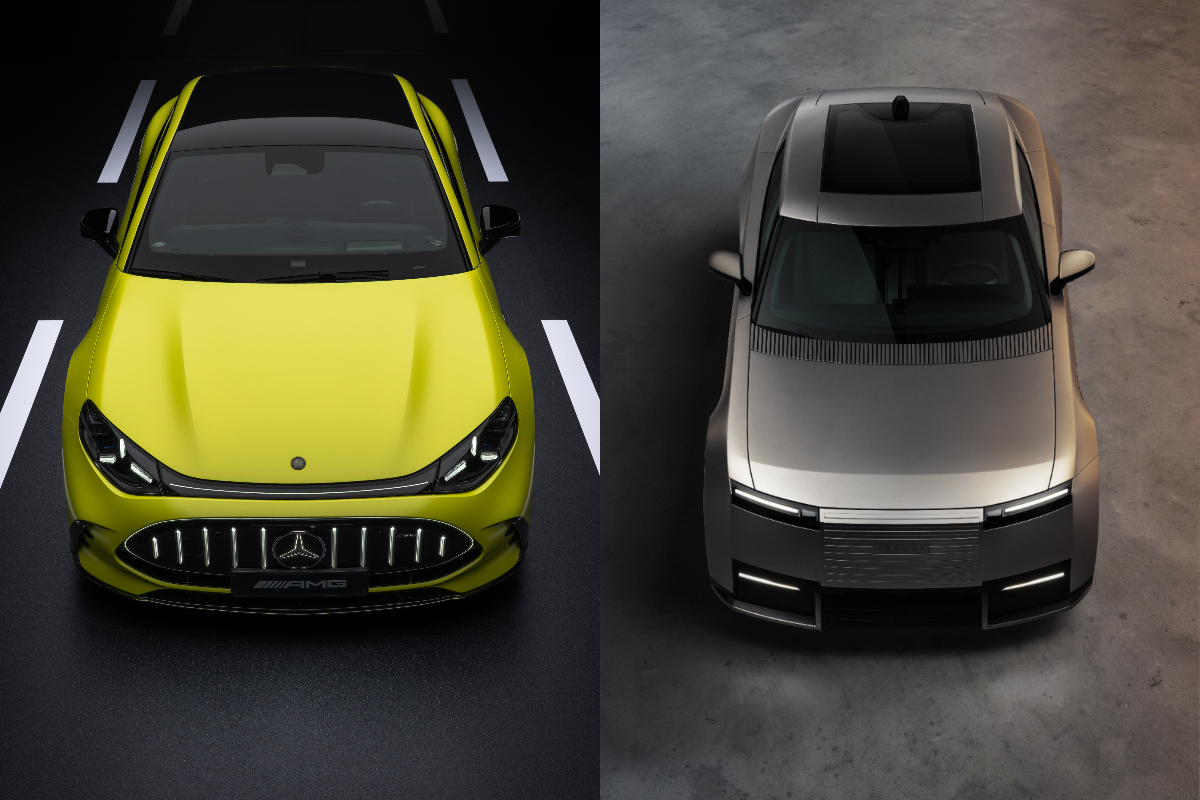
Measuring 5,235 mm in length, 2,021 mm in width and 1,403 mm in height, the Jaguar Type 01 is 141 mm longer, 62 mm wider and 8 mm lower than the Mercedes-AMG GT 4-Door Coupé, which measures 5,094 mm in length, 1,959 mm in width and 1,411 mm in height.
At the same time, its 3,200 mm wheelbase is 160 mm longer than that of the AMG GT. The distance between the front axle and the front door mounting point is 898 mm, recalling the proportions of the legendary E-Type.
Dedicated electric platforms
Both models are built on dedicated electric architectures: AMG.EA for Mercedes-AMG and JEA (Jaguar Electric Architecture) for Jaguar.
With an aluminium body and an impressive torsional rigidity of 51.7 kNm/degree, worthy of a supercar, the Type 01 promises supercar-like structural qualities. However, its very high weight will inevitably limit its cornering dynamics.
Despite its larger dimensions and larger battery – 118 kWh net compared with 106 kWh net for the Mercedes – the Jaguar Type 01 weighs no less than 2,700 kg, compared with 2,460 kg for the top versions of the Mercedes-AMG GT 4-Door Coupé.
The 0–100 kph sprint takes 3.2 seconds, but this is slower than the top versions of the AMG GT 4-Door Coupé, which promise 2.4 seconds for the AMG GT 63 and 2.8 seconds for the AMG GT 55.
Both models use a three-motor configuration, with one motor at the front and two at the rear. Mercedes does not disclose the individual output of its motors, but the AMG GT 55 produces 816 PS and 1,800 Nm, while the AMG GT 63 develops 1,169 PS and 2,000 Nm. Both versions use axial-flux motors supplied by Mercedes-AMG subsidiary YASA.
The Jaguar Type 01 uses permanent-magnet synchronous motors with radial flux. The front motor produces 353 PS, while each of the two rear motors develops 421 PS, giving a combined output of 1,030 PS and 1,365 Nm.
Different chassis configurations
The Jaguar Type 01 uses a double-wishbone front suspension and a fully independent multilink rear axle. The air suspension features two valves – one for compression and one for rebound – and is combined with rear-wheel steering.
At low speeds, the rear wheels turn in the opposite direction to the front wheels by up to six degrees, reducing the turning circle to 11.5 metres. At higher speeds, the rear wheels turn in the same direction as the front wheels.
The driver can select five driving modes: Jaguar (balanced), Dynamic, Efficient, Ice & Snow and Individual. In Dynamic mode, up to 87% of the available power is sent to the rear axle.
The Type 01 comes standard with 23-inch wheels, but customers seeking greater comfort can opt for smaller 21-inch wheels at no additional cost. The wheels are fitted with Pirelli P Zero tyres developed specifically for this model. Jaguar claims a maximum lateral acceleration of 0.94 g.
The Mercedes-AMG GT 4-Door Coupé features air suspension with semi-active roll stabilization and three-stage adjustable air springs. An 8.2-litre pressure reservoir allows the body to be raised and lowered quickly, including automatic ride-height adjustment depending on speed to improve efficiency and driving range.
In addition, the AMG Active Ride Control suspension uses dampers equipped with semi-active interconnected hydraulic elements that replace conventional anti-roll bars.
Both the front and rear suspension use a multilink layout, while rear-wheel steering with a steering angle of up to six degrees helps reduce the turning circle. At speeds of up to 80 kph, the rear wheels turn in the opposite direction to the front wheels by up to six degrees. Above 80 kph, they turn in the same direction as the front wheels by up to one degree.
The driver can choose between Comfort, Sport, AMGFORCE Sport+, Race, Slippery, Eco and Individual driving modes. Launch Control is available in Sport, AMGFORCE Sport+ and Race modes. Pulling both steering-wheel paddles simultaneously also provides a temporary power boost in Comfort, Sport and AMGFORCE Sport+ modes – up to 10 kW in the AMG 63 and up to 50 kW in the AMG 55.
The Mercedes-AMG GT 4-Door Coupé rides on wheels ranging from 19 to 21 inches. The 21-inch wheels feature an optimized aerodynamic design that increases the WLTP range by 14 km.
Active aerodynamics on both, but more sophisticated on the Mercedes-AMG
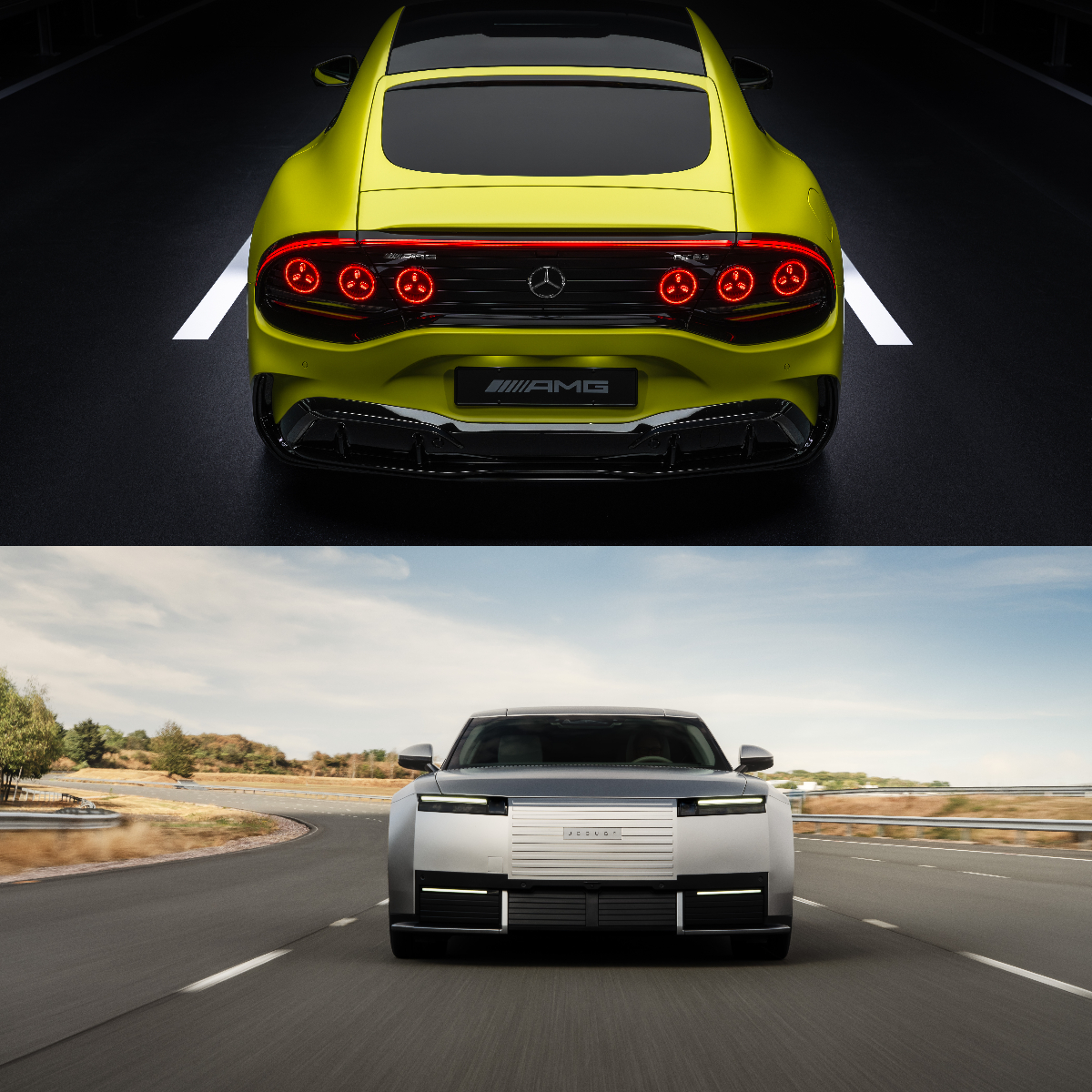
The Type 01 features active flaps in the front grille that open when additional cooling is required for the battery, powertrain or brakes. It also has a three-stage rear spoiler that extends according to vehicle speed. Above 155 km/h, it can generate up to 75 kg of downforce.
The AMG GT 4-Door Coupé has two aerodynamic elements underneath the car – one at the front and one in the centre – which activate at higher speeds to control airflow and generate the Venturi effect, increasing downforce. By accelerating the air flowing underneath the car, they create a low-pressure zone that effectively “glues” the car to the road, improving grip. The front element activates from 120 km/h, while the central element comes into operation from 140 km/h.
A rear spoiler deploys at speeds above 80 km/h and adopts different positions, either steeper or more horizontal, to improve stability or reduce aerodynamic drag. At high speeds or during dynamic driving, it moves into its steepest position for maximum downforce and optimum stability. This position can also be activated manually via a button on the steering wheel.
Jaguar says it conducted more than 7,000 tests in the wind tunnel, but the final drag coefficient is 0.23 – an excellent figure, although 0.01 higher than that of the Mercedes-AMG GT 4-Door Coupé.
The Mercedes-AMG GT 4-Door Coupé charges faster
Built on an 800-volt architecture and equipped with a battery featuring cylindrical cells, which offer more efficient cooling than the prismatic cells grouped into modules, the Mercedes-AMG GT 4-Door Coupé offers a class-leading charging power of up to 600 kW, compared with just 350 kW for the Jaguar, which also uses 800-volt technology.
As a result, the Jaguar needs 13 minutes to add enough energy for 321 km of range, while the Mercedes-AMG requires just 10 minutes to add enough energy for 460 km.
Despite its larger 118 kWh battery, the Jaguar Type 01 offers only a marginally longer range than the Mercedes-AMG: 720 km compared with 700 km for the AMG GT 55 and 696 km for the AMG GT 63.
Different interior philosophies
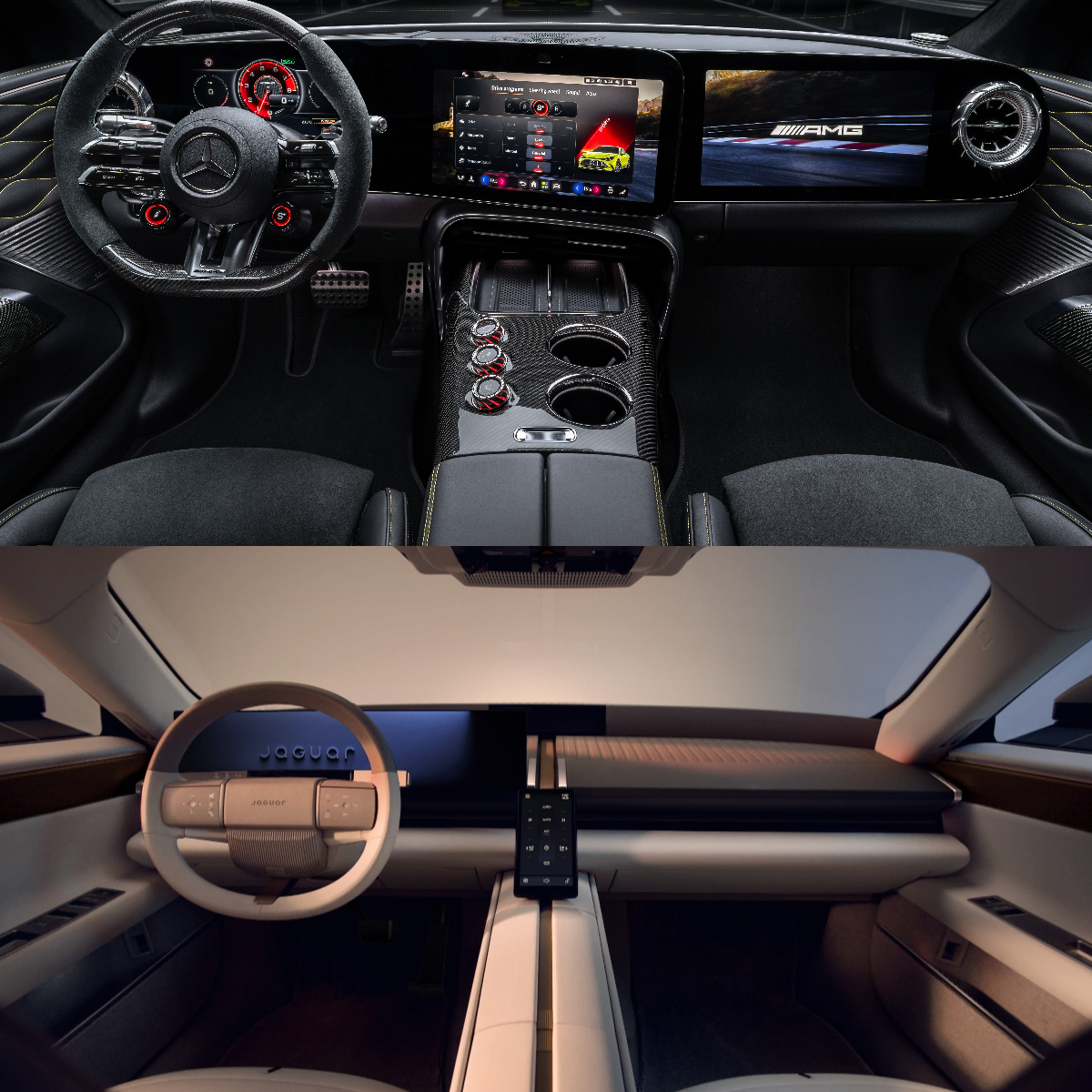
The Mercedes-AMG GT 4-Door Coupé has a strongly sporting interior, while the Jaguar Type 01 emphasizes the brand’s traditional sense of elegance.
In the Mercedes-AMG GT, the dashboard is dominated by three displays: a 10.2-inch screen for the digital instrument cluster with AMG-specific menus, a 14-inch driver-oriented multimedia display and a 14-inch display for the front passenger. Like other Mercedes models, the infotainment system uses the new MB.OS operating system based on Google services.
The Jaguar Type 01, meanwhile, is dominated by a 24-inch curved-glass OLED touchscreen that integrates the digital instrument cluster and infotainment system. A second 7-inch portrait-oriented display, similar in format to a smartphone, is positioned between the front seats. Rear passengers get another 7-inch display integrated into the centre console, through which they can control comfort functions.
The infotainment system can be updated over the air, while the Navigation Pro system calculates routes taking charging stops into account. The Jaguar app displays charging stations, their charging power and whether they are currently available.
Both models have a high centre tunnel, but the Jaguar has no physical buttons, while the Mercedes-AMG groups three rotary controls on the raised centre console: Response Control, Agility Control and Traction Control.
In the Mercedes-AMG, the seating position is very low and the excellently contoured seats wrap around the occupants, with the interior itself oriented towards the driver. Even sportier optional AMG Performance seats are available. The flat-bottom AMG Performance steering wheel is available either in leather or in a superb combination of carbon fibre on the upper and lower sections and microfiber on the sides. It also features paddles for adjusting the energy recuperation levels.
In the Jaguar Type 01, the front seats feature 12-way electric adjustment and offer heating, ventilation and massage functions, including a “hot stone” mode, also available on the Mercedes.
The two individual rear seats, separated by the centre tunnel, also feature heating and ventilation. However, access to the rear seats is not particularly easy because of the car’s low body height.
The price has not yet been announced, but the Jaguar Type 01 is expected to cost around €165,000. By comparison, the Mercedes-AMG GT 4-Door Coupé costs €154,700 in the GT 55 version with 816 PS and €196,350 in the GT 63 version with 1,169 PS. Both versions feature three electric motors.