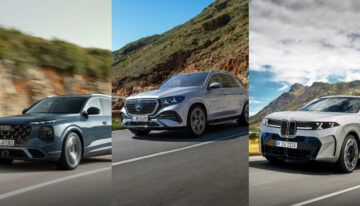
Citing Mercedes insiders, Automotive News reports that the upcoming Mercedes G-Class Baby could be built at the company’s plant in Kecskemét, Hungary, rather than in Rastatt, Germany, in order to reduce production costs.
Computer picture: Marian Cilibeanu (https://www.instagram.com/marianvalentincilibeanu/)
As early as autumn 2020, Mercedes-Benz CEO Ola Källenius announced that the G-Class lineup would be expanded in the coming years. At the Munich Motor Show in autumn 2023, Källenius revealed for the first time that Mercedes would introduce a smaller G-Class model, referring to it as the “Little G.”
The new Mercedes G-Class Baby is expected to debut in 2027.
Now, Automotive News, citing internal Mercedes sources, reports that the new Baby G-Class could be produced in Kecskemét, Hungary, instead of Rastatt, Germany.
Both plants currently manufacture Mercedes’ new compact model range based on the multi-energy MMA platform: the CLA, CLA Shooting Brake, and GLB, all of which are available with either mild-hybrid gasoline or fully electric powertrains.
In January 2026, Mercedes also announced that production of the A-Class would be moved from Rastatt to Kecskemét. The A-Class is the only remaining compact Mercedes model based on the previous-generation MFA II platform.
Two years ago, Mercedes announced plans to discontinue both the A-Class and the B-Class. The B-Class has indeed been phased out, but at the Munich Motor Show in autumn 2025, CEO Ola Källenius confirmed that the A-Class would remain in production until 2028.
More recently, Mercedes announced that the A-Class will receive an all-new generation in 2028 as part of an effort to recover some of the sales volume it has lost over the past five years.
By shifting production to the Kecskemét plant, Mercedes hopes to reduce manufacturing costs and offer the Baby G-Class at a competitive price. The company’s cost-cutting strategy targets a 10% reduction in production costs between 2024 and 2027, and a 20% reduction by 2030.
Initially, the Baby G-Class was planned as an electric-only model. However, the disappointing sales of its larger sibling, the G 580 with EQ Technology, prompted Mercedes to reconsider that strategy.
Although there have been numerous rumors suggesting that the Baby G-Class would not use the MMA architecture found in the new CLA and GLB because it cannot accommodate a separate ladder-frame chassis, it now appears that Mercedes’ top priority is achieving a competitive price rather than delivering the exceptional off-road capability of the larger G-Class.
The decision to build the model in Kecskemét is therefore a strong indication that the Baby G-Class will indeed be based on the multi-energy MMA platform, which supports both mild-hybrid gasoline and fully electric powertrains.
The decision to cut costs and prioritize affordability is understandable given the growing competition from Chinese manufacturers. However, the Baby G-Class could face a challenge because its traditional rivals are preparing models with significantly better off-road credentials.
Toyota has launched the new compact Land Cruiser under the FJ Cruiser name. It retains the traditional Land Cruiser formula, featuring a separate ladder-frame chassis and four-wheel drive with a low-range transfer case. The FJ Cruiser will be sold globally, although not in Europe for the time being.
Land Rover has also announced a smaller Defender for 2027. However, it is expected to use a unibody construction, as even the current Defender no longer features a traditional ladder-frame chassis.
Ineos has unveiled the prototype of a smaller off-roader than the Grenadier, called the Fusilier, which was originally planned with both an electric powertrain and a range-extender version. The project has been delayed because Ineos is also trying to optimize costs and is considering manufacturing the model in China, although no final decision has yet been made.
Before leaving his position, Markus Schäfer, Mercedes’ former Chief Technology Officer, had stated that the Baby G-Class would not use the MMA platform. Instead, it would be based on a derivative of the G-Class architecture with a separate ladder-frame chassis and suspension components borrowed from the GLC. However, it now appears that this solution proved too expensive and was not approved by his successor, Jörg Burzer.
Today, the least expensive G-Class starts at around €128,000. A Baby G-Class based on a derivative ladder-frame architecture would likely cost only €30,000-40,000 less, resulting in a starting price of approximately €88,000-98,000, which would still be far too expensive for its intended market positioning.
A well-equipped Toyota Land Cruiser 250 costs around €80,000, while the more compact FJ Cruiser is expected to start below €60,000.
For this reason, it appears Mercedes has little choice but to use the MMA platform to keep costs under control—even if that means sacrificing the off-road capability that has made the larger G-Class legendary.