Something subtle has been changing in the luxury vehicle market, and it is not coming from automakers.
It is coming from how people actually use the vehicles after they buy them.
A growing number of high-end Mercedes Sprinter conversions in the United States are no longer being used primarily for travel or recreation. Instead, they are being commissioned and designed as fully functional mobile work environments.
Not weekend campers. Not vacation rigs. But rolling offices, production spaces, and business operating systems that happen to have wheels.
This shift is reshaping the custom van industry in real time.
And it is forcing builders, designers, and even OEM platform strategies to adapt faster than most traditional automotive categories.
The Sprinter stopped being a “van” for many buyers
The Mercedes Sprinter was originally designed as a commercial platform. Cargo transport, fleet logistics, utility applications.
But over the last decade, it has evolved into something else entirely in the premium market: a blank canvas for high-end mobility design.
Luxury conversion builders now treat the Sprinter less like a vehicle and more like a structural shell for interior architecture.
Inside these builds, the layout often resembles a compact executive office more than a recreational vehicle:
- Dedicated workstation zones
- High-speed connectivity systems
- Sound-insulated meeting spaces
- Lighting designed for video calls and content production
- Power systems capable of running laptops, monitors, and appliances off-grid
What makes this shift notable is not just the customization, but the intention behind it.
Many of these builds are no longer tied to leisure travel patterns at all.
They are tied to work.
Why the “mobile office van” trend is accelerating now
This shift did not come from automotive marketing. It came from structural changes in how high-income professionals work.
Remote and hybrid work normalized location independence for many industries. At the same time, business owners, consultants, creators, and executives began rethinking how much time they actually needed to spend in fixed office environments.
That opened the door for a category that sits between travel and infrastructure: mobile workspaces.
According to the RV Industry Association, demand for RV usage and ownership has remained elevated in recent years, particularly among younger and remote-work-adjacent demographics seeking flexible mobility solutions.
But in the luxury segment, this is not about camping or vacationing in the traditional sense.
It is about extending work environments beyond geography.
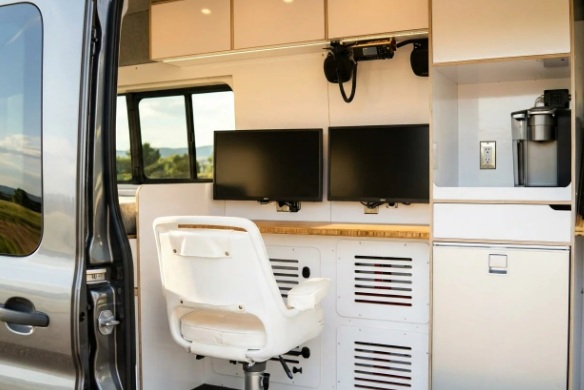
What a $150K to $300K “mobile office van” actually includes
Once you move into high-end Mercedes Sprinter conversions, the price is not driven by the base vehicle alone.
It is driven by systems integration.
A professional-grade mobile office build typically includes:
- Advanced lithium power systems with inverter infrastructure
- Starlink or equivalent satellite connectivity integration
- Climate control systems optimized for long-duration occupancy
- Custom cabinetry designed around workflow ergonomics
- Acoustic treatment for meetings and calls
- Modular seating or lounge configurations for multi-use space
At the highest end, these vehicles are engineered to function independently for extended periods without external infrastructure.
That is a fundamentally different product than a recreational camper.
It is closer to a distributed office system.
Why Mercedes Sprinter became the dominant platform
Even though multiple platforms exist in the conversion market, the Mercedes Sprinter has become the most widely used base for premium builds.
The reason is not branding alone. It is architecture.
The Sprinter offers:
- A tall, adaptable interior volume
- Strong long-distance reliability reputation
- Diesel efficiency suited for extended travel
- Wide availability of aftermarket upfit ecosystems
- Compatibility with high-end fabrication systems
This has allowed an entire ecosystem of builders to form around it, from large-scale conversion companies to boutique fabrication shops.
Even though the Revel is a branded model, it represents a broader point: OEM platforms are now acting as foundations for secondary industries built entirely on customization.
The builders shaping the mobile office category
As demand for mobile work vehicles grows, custom builders are increasingly being asked to solve problems that go beyond travel comfort.
They are designing for productivity.
Companies like Outside Van originally built reputation in the expedition and adventure segment, focusing on durability and off-grid capability for clients operating in remote environments.
Storyteller Overland helped bring more structure and repeatability to premium builds while still maintaining lifestyle-driven branding.
Sportsmobile remains known for long-standing functional conversion frameworks built around usability and long-term ownership rather than trend-based design.
At the boutique end of the market, companies like The Vansmith represent a growing segment of builders focused on intentional layouts and practical usability, where interior systems are designed around how people actually live and work inside the vehicle rather than aesthetic trends.

Why this is becoming a business category, not a niche trend
The mobile office shift is not happening in isolation.
It reflects a broader structural change in how premium consumers define value.
In traditional automotive markets, value was defined by performance, brand prestige, and driving experience.
In the Sprinter conversion ecosystem, value is increasingly defined by functionality per square foot.
That includes:
- productivity capability
- autonomy from fixed infrastructure
- interior usability efficiency
- long-duration comfort
According to McKinsey & Company, personalization has become a key driver of purchasing behavior in premium consumer categories, particularly where products intersect with identity, lifestyle, and work patterns.
This helps explain why customers are willing to invest well over $150,000 in vehicles that function as mobile extensions of their professional lives.
The tension inside the industry
As demand grows, so does strain on the builders themselves.
Unlike mass automotive production, every Sprinter conversion introduces variability. Each build requires custom planning, systems integration, and cross-disciplinary labor.
That makes scaling difficult even in strong demand environments.
According to the National Association of Manufacturers, workforce shortages and supply chain constraints continue to be among the most significant challenges facing U.S. manufacturing operations.
In the conversion industry, those constraints are amplified by the highly specialized nature of the work.
A single build may require expertise in electrical systems, carpentry, fabrication, and automotive integration simultaneously.
That limits how quickly companies can expand output without compromising quality.
What this actually signals about luxury mobility
The rise of the mobile office Sprinter is not just a vehicle trend.
It is a signal that luxury mobility is shifting away from static ownership models.
For some buyers, the most valuable aspect of a vehicle is no longer horsepower or brand status. It is the ability to extend productive time across geography without losing infrastructure quality.
In that sense, the Mercedes Sprinter has become more than a platform.
It has become a foundation for a new category of mobile work environments that sit between automotive design and architectural space planning.
And as remote work continues to evolve, that category is likely to expand further rather than contract.