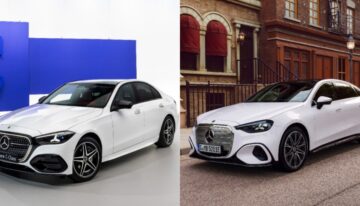
The third-generation Audi Q7 takes on the fifth-generation BMW X5 and the facelifted Mercedes GLE. Since the new Audi Q7 is currently available only with diesel engines, this first static comparison focuses exclusively on the diesel-powered versions.
Two weeks ago, we published our first static comparison between the new BMW X5 and the facelifted Mercedes GLE. However, many readers wrote to us on Facebook suggesting that we should also include the new Audi Q7. So here is our first assessment of the new Audi Q7 against the facelifted Mercedes GLE and the new BMW X5.
The new Audi Q7 is based on the new PPC (Premium Platform Combustion) architecture, which is derived from the PPE (Premium Platform Electric) platform adapted for combustion-engine vehicles. For example, the PPC platform adopts the electronic architecture from PPE, featuring a new operating system and three standard displays.
The fifth-generation BMW X5 continues to be based on the CLAR platform but adopts the new Panoramic iDrive operating system from the Neue Klasse architecture, featuring the Panoramic Vision display stretching across the entire width of the dashboard.
By comparison, the facelifted Mercedes GLE is built on the updated MRA II platform and features a revised engine lineup, including a diesel engine with an electrically heated catalytic converter and a new flat-plane-crank V8.
Engines and Versions
The new Audi Q7 launches with two 3.0-liter V6 diesel engines that employ a different technology from those used by BMW and Mercedes. The Audi Q7 features a first-generation mild-hybrid system with a belt-driven starter-generator producing 24 PS and 370 Nm. It is also optionally available with an electrically driven compressor that operates across the entire rev range. The electric compressor spins at up to 90,000 rpm in just 250 milliseconds and delivers a boost pressure of up to 3.4 bar. In addition, Audi’s new diesel engine can run on HVO (Hydrotreated Vegetable Oil) fuel, which reduces CO₂ emissions by up to 70–95%.
The two diesel versions are:
- Q7 V6 TDI – 3.0-liter V6, 245 PS, 500 Nm
- Q7 V6 TDI – 3.0-liter V6, 299 PS, 630 Nm
The facelifted Mercedes GLE is available with two diesel engines featuring a second-generation 48-volt mild-hybrid system with a 23 PS/205 Nm electric motor integrated into the nine-speed automatic transmission:
- GLE 350 d 4Matic – 3.0-liter inline-six turbodiesel, 286 PS, 650 Nm
- GLE 450 d 4Matic – 3.0-liter inline-six turbodiesel, 367 PS, 750 Nm
The BMW X5 is powered by the well-known 3.0-liter inline-six diesel, which also features a second-generation 48-volt mild-hybrid system with an 18 PS and 200 Nm electric motor integrated into the eight-speed automatic transmission.
- X5 40d xDrive – 3.0-liter inline-six turbodiesel, 286 PS, 650 Nm
Dimensions and Size
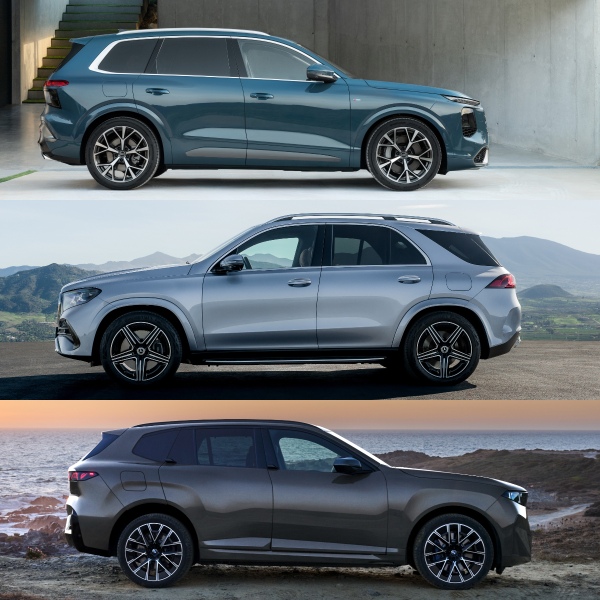
As with the previous generation, the Audi Q7 is the largest vehicle overall, although it does not have the longest wheelbase. At 5,056 mm in length, the Audi is 62 mm longer than the BMW and 132 mm longer than the Mercedes. Its width of 2,010 mm is identical to that of the Mercedes and 10 mm greater than that of the BMW. At 1,757 mm tall, it is 9 mm higher than the BMW but 40 mm lower than the Mercedes.
The BMW, however, has the longest wheelbase at 3,035 mm, compared with 2,998 mm for the Audi and 2,995 mm for the Mercedes.
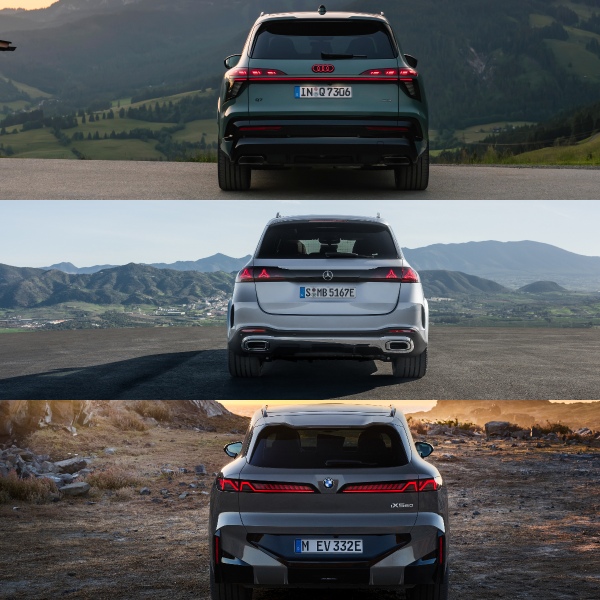
Thanks to its greater overall length, the Audi Q7 also offers the largest luggage compartment, ranging from 670 to 2,075 litres. Unlike the BMW and Mercedes, its rear bench is split in a 35:30:35 configuration.
The BMW X5’s luggage compartment capacity is virtually unchanged at 655 litres and expands to 1,850 litres thanks to the standard 40:20:40 split-folding rear seat. By comparison, the facelifted Mercedes GLE offers between 630 and 2,055 litres of cargo space, with its rear bench also featuring a 40:20:40 split-folding configuration.
The new-generation BMW X5 no longer offers a seven-seat configuration or the split tailgate that was available on previous generations. By contrast, both the Audi Q7 and the Mercedes GLE continue to offer an optional seven-seat layout.
Chassis and Suspension
The new Audi Q7 comes standard with a steel-spring suspension. As an option, customers can order the adaptive air suspension, which is paired with all-wheel steering, or the adaptive sport air suspension that lowers the ride height by 30 mm.
Like Mercedes, Audi also offers an intelligent suspension function. If the programmed route includes a railway crossing, the Audi Q7 automatically adjusts its suspension settings to ensure a smoother and more comfortable ride over the tracks.
The Audi Q7 comes standard with 20-inch alloy wheels, while three 21-inch wheel designs are available as options. Audi Sport GmbH also offers four 22-inch wheel designs and, for the first time, even 23-inch wheels.
Retaining the CLAR architecture from the previous generation, the BMW X5 features a double-wishbone front suspension and a five-link rear axle. However, all suspension components have been reinforced to cope with the increased vehicle weight, the tracks have been widened, staggered tyres are fitted as standard, and body rigidity has been further improved.
The new X5 comes standard with adaptive steel-spring suspension, helping to maintain BMW’s signature 50:50 weight distribution. As an option, buyers can specify Adaptive Chassis Control with two-axle air suspension and Integral Active Steering with a rear steering angle of up to 3.2 degrees, or Adaptive Chassis Control Professional (available exclusively on the plug-in hybrid models), which also adds active anti-roll bars powered by the vehicle’s 48-volt electrical system. This is possible because all petrol and diesel versions are equipped with at least a 48-volt mild-hybrid system.
The air suspension also includes an automatic self-levelling function that maintains constant ride height regardless of vehicle load. Drivers can select three ride-height settings via the Air Suspension menu. In Auto mode, the ride height is adjusted according to speed and the selected driving mode. The standard ride height is maintained up to 140 km/h, lowered by 10 mm between 140 and 200 km/h, and by 20 mm above 200 km/h. In Sport and Sport+ modes, the vehicle remains permanently lowered by 20 mm. In Off-road mode, ground clearance is increased by 20 mm, while a loading mode lowers the rear by 40 mm when stationary to facilitate loading luggage.
The optional M Sport package includes a firmer M adaptive suspension, M Sport brakes with dark blue brake calipers, 21-inch alloy wheels, an M interior and an M aerodynamic package. The M Sport Pro package adds 22-inch Jet Black Trigon alloy wheels, M Sport brakes with red metallic calipers, an M steering wheel and M seat belts. Eleven exterior colours are available, including five new shades, while 23-inch alloy wheels are offered as an option.
The facelifted Mercedes GLE uses a similar suspension layout, with double wishbones at the front and a multi-link rear axle. Standard equipment includes a conventional steel-spring suspension, but without adaptive damping.
Optionally, customers can specify the adaptive Airmatic air suspension with the intelligent Car-to-X function. Mercedes models equipped with this system share road-condition data via the cloud. When another Mercedes fitted with the same technology drives over the same section of road, the suspension automatically adjusts based on the previously collected information.
The facelifted Mercedes GLE is also better equipped for serious off-road driving. It can be fitted with the so-called Transparent Bonnet, which allows the driver to see the terrain directly underneath and immediately in front of the vehicle. It is also available with the sophisticated E-Active Body Control suspension, an expensive €7,735 option that enables the vehicle to “bounce” itself free from low-traction situations such as soft sand dunes.
At the same time, the E-Active Body Control system also significantly reduces both lateral body roll and longitudinal pitch movements.
Multimedia Systems
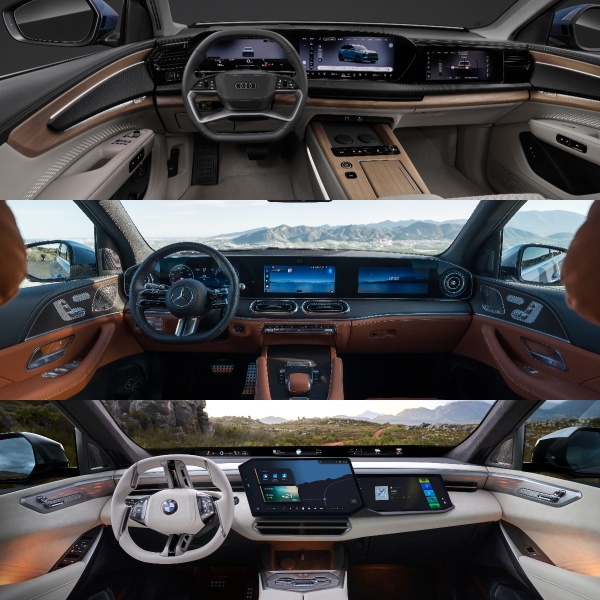
The Audi Q7 comes standard with three displays. The curved Audi MMI panoramic display integrates the two OLED screens for the digital instrument cluster and infotainment system, while the front passenger has a dedicated display.
The Audi Application Store provides access to a wide range of music, video, gaming, navigation, parking, charging, weather and news applications. The voice assistant can control various vehicle functions and, whenever it cannot answer a request on its own, it turns to ChatGPT for assistance.
Optionally, customers can choose a Bang & Olufsen 4D premium sound system with 22 speakers and up to 1,360 watts of output. The system also features speakers integrated into the front headrests and seat-mounted actuators that enhance the listening experience.
The new BMW X5 adopts the new ergonomic concept first introduced on the iX3 and i3, called Panoramic Drive. It features the Panoramic Vision display stretching across the entire width of the dashboard at the base of the windshield, a 17.9-inch hexagonal central display positioned close to the steering wheel, an optional head-up display, and a new steering wheel with two haptic control surfaces that will also be introduced on future BMW models.
BMW’s infotainment system runs on the new BMW X Operating System, using BMW Maps (based on HERE maps) and offering access to external apps such as Spotify, Disney+, YouTube, Zoom for video conferencing, and AirConsole games.
The dashboard of the Mercedes GLE facelift has been completely redesigned and adopts the layout first introduced in the CLA, featuring three 12.3-inch displays housed beneath a single glass panel stretching across the entire width of the dashboard. Unlike the CLA, all three displays come as standard on every version. Optionally, customers can choose a 3D instrument cluster and an augmented reality head-up display that projects information onto the windshield as a virtual 45.7 cm (18-inch) screen.
Mercedes has also abandoned the two small touch-sensitive pads on the steering wheel, replacing them with a rocker switch and a rotary controller that provide easier and more intuitive operation.
Mercedes uses its proprietary MB.OS operating system while integrating Google Maps for navigation and AI support from Google, ChatGPT, and Microsoft. Like BMW, it also offers access to more than 40 third-party apps, including Spotify and Disney+.
Production
Production of the new Audi Q7 takes place at Audi’s Bratislava plant in Slovakia, just like the first and second generations. The new Q7 can already be ordered in several European markets, with the first customer deliveries scheduled for September 2026.
Production of the new BMW X5 (G65) will begin in August 2026 at BMW’s Spartanburg, South Carolina, USA, plant and, according to current plans, will continue until July 2035. The new X5 is expected to reach customers by the end of 2026 or, at the latest, in early 2027.
Production of the facelifted Mercedes GLE (V167) began in June 2026 at Mercedes-Benz’s Tuscaloosa, Alabama, USA, plant, with customer deliveries scheduled to start in autumn 2026.
| Model | Audi Q7 V6 TDI 245 PS | Audi Q7 V6 TDI 299 PS | GLE 350 d 4Matic | GLE 450 d 4Matic | X5 40d xDrive |
|---|---|---|---|---|---|
| Engine/no. Of cylinders | V6, turbodiesel | V6, turbodiesel | L6, turbodiesel | L6, turbodiesel | L6, turbodiesel |
| Displacement | 2,967 | 2,967 | 2,989 | 2,989 | 2,993 |
| Max. Power/revs (PS/rpm) | 245/3,500-4,750 | 299/3,500-3,750 | 286/3,200-4,800 | 367/4,000 | 286/4,000 |
| Max. Torque/revs (Nm/rpm) | 500/1,500-3,250 | 630/1,750-3,000 | 650/1,200-3,000 | 750/1,350-2,800 | 650/1,500-2,500 |
| Electric motor | |||||
| Max. Power (PS) | 24 | 24 | 23 | 23 | 18 |
| Max. Torque (Nm) | 370 | 370 | 205 | 205 | 200 |
| L x w x h (mm) | 5,056 x 2,010 x 1,757 | 5,056 x 2,010 x 1,757 | 4,924 x 2,010 x 1,795 | 4,924 x 2,010 x 1,795 | 4,995 x 2,000 x 1,748 |
| Wheelbase (mm) | 2,998 | 2,998 | 2,995 | 2,995 | 3,035 |
| Boot volume (l) | 670-2,075 | 670-2,075 | 630-2,055 | 630-2,055 | 655-1,850 |
| Curb weight (kg) | 2,455 | 2,455 | na | na | 2,430 |
| Mixt consumption WLTP (l/100 km) | 7.1 | 7.2 | 7.4-8.2 | 7.4-8.2 | 7,0-7,7 l |
| CO2 emissions (g/km) | 186 | 188 | 195-215 | 195-215 | 187-200 |
| Acceleration 0-100 kph (s) | 7.2 | 6.0 | 6.2 | 5.5 | 5,3 |
| Top speed (kph) | 222 | 235 | 235 | 250 | 250/- |
| Prices (euro with VAT) | 87,900 | 90,500 | 92,064 | 98,282 | 95,750 |