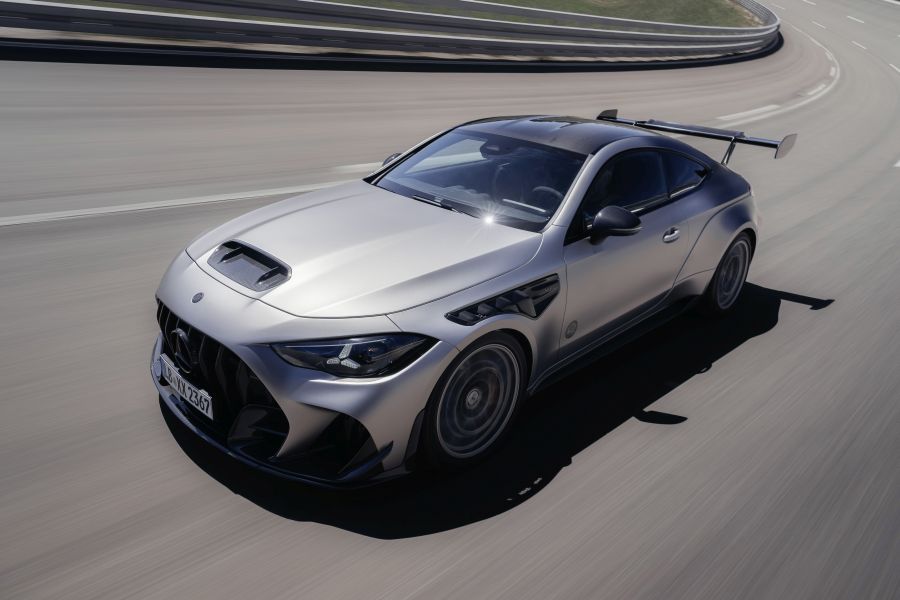
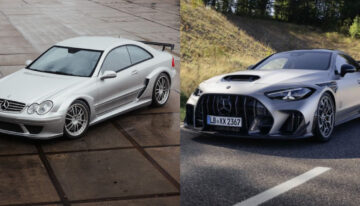
Mercedes has launched the second model in its Mythos series: the Mercedes-AMG CLE 646, powered by a 4.0-liter twin-turbo V8 producing 646 PS (637 hp). It is based on the AMG CLE 53 4Matic (C236) platform and is the successor to the legendary Mercedes CLK DTM AMG from 2004, which was also based on the mid-size coupe of its time, the CLK 55 AMG (C209).
Photo: Mercedes-Benz, Bonhams Auction House
Although more than 20 years have passed since then, an initial comparison of the figures makes for interesting reading.
Mercedes CLK DTM AMG is more than 150 kg lighter
The Mercedes CLK DTM AMG has a richer historical background, as the car was built to celebrate Bernd Schneider’s victory in the German Touring Car Championship. Schneider won five DTM titles (1985, 2000, 2001, 2003 and 2006).
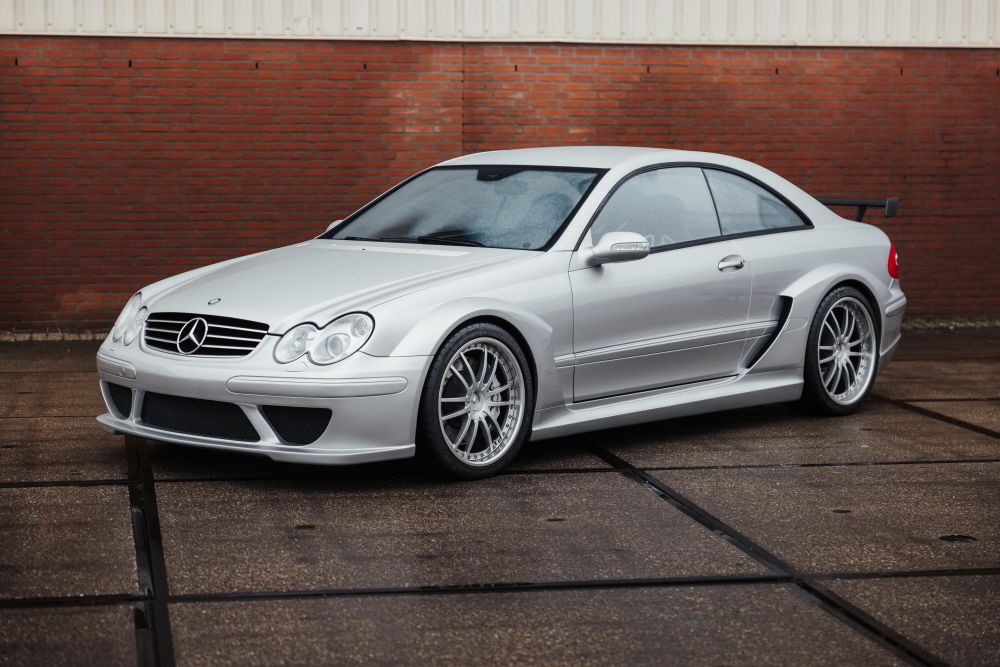
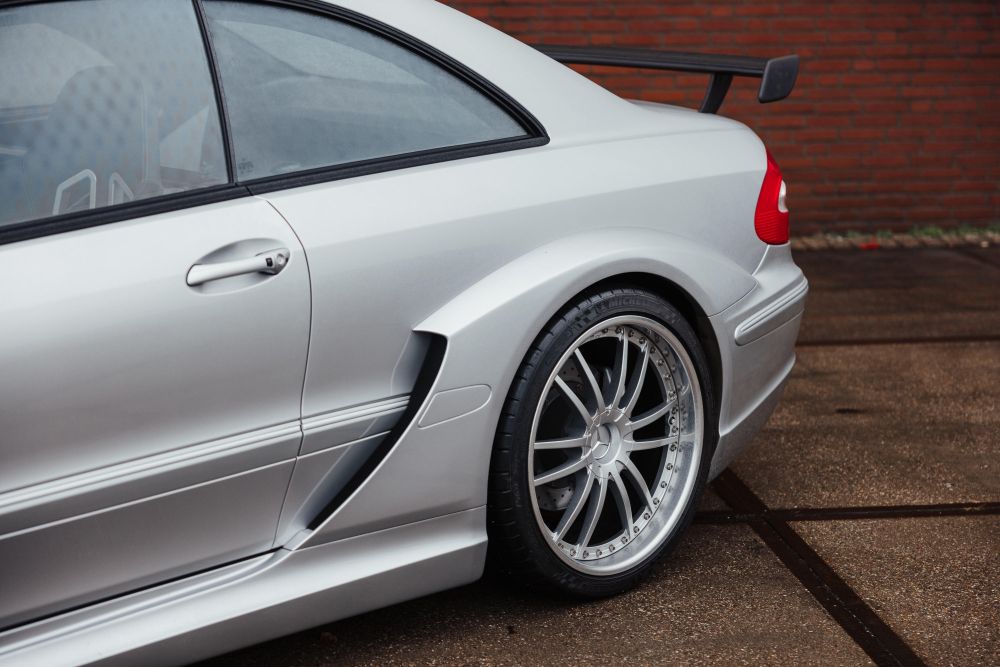
The design was inspired by Bernd Schneider’s race car, featuring larger front air intakes, flared fenders, an additional air intake ahead of the rear wheels, a massive rear wing and larger 19-inch front and 20-inch rear wheels fitted with 255/35 R19 tires at the front and 285/30 R20 tires at the rear.
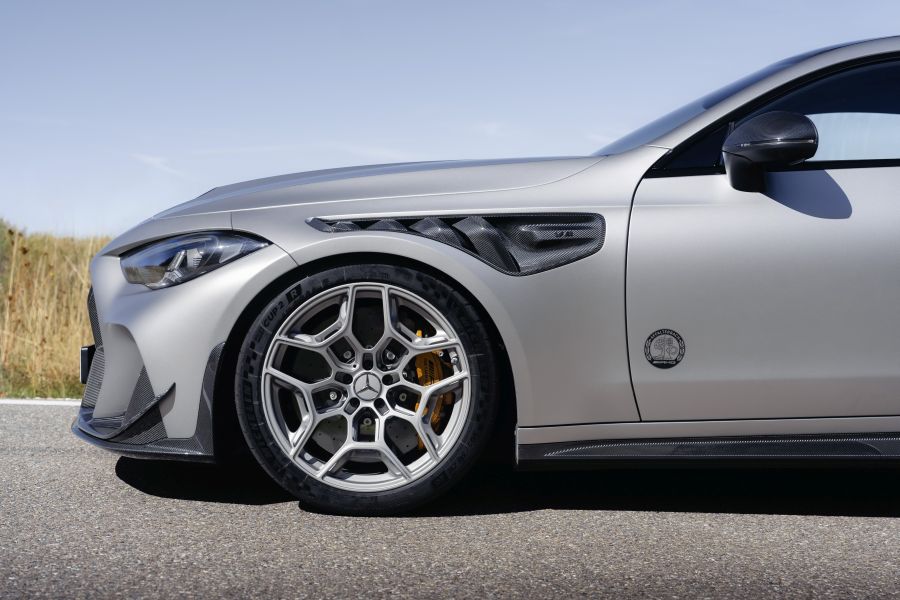
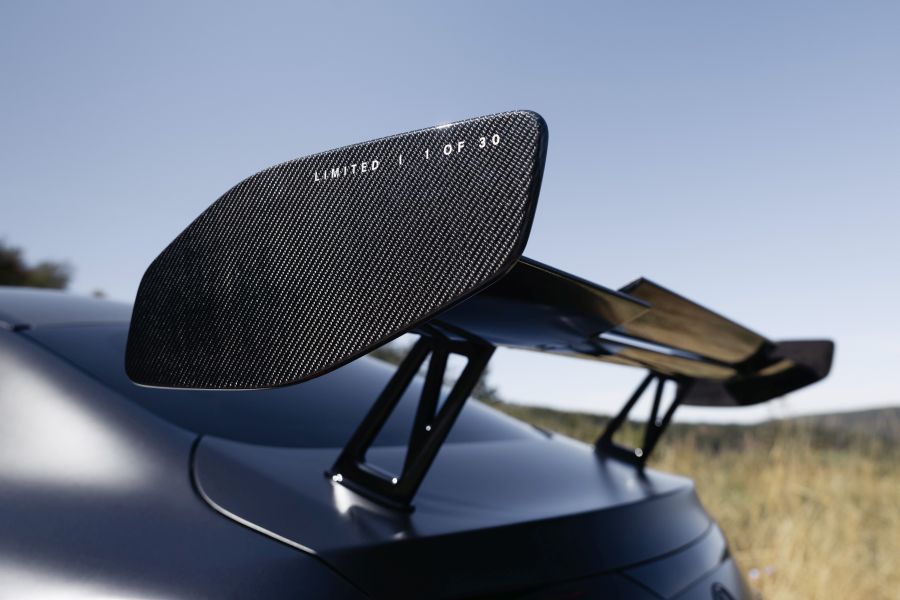
Its modern successor, the Mercedes-AMG CLE 646, also has a wider body than the standard model, with track widths that are 60 mm wider, as well as numerous carbon-fiber components, including the front spoiler, front-fender air intakes, rear spoiler with integrated diffuser, central hood air intake, roof and manually adjustable rear wing.
The car rides on 20-inch wheels front and rear, fitted with 305/30 ZR20 tires at the front and 335/30 ZR20 tires at the rear.
Similar interiors, focused on performance
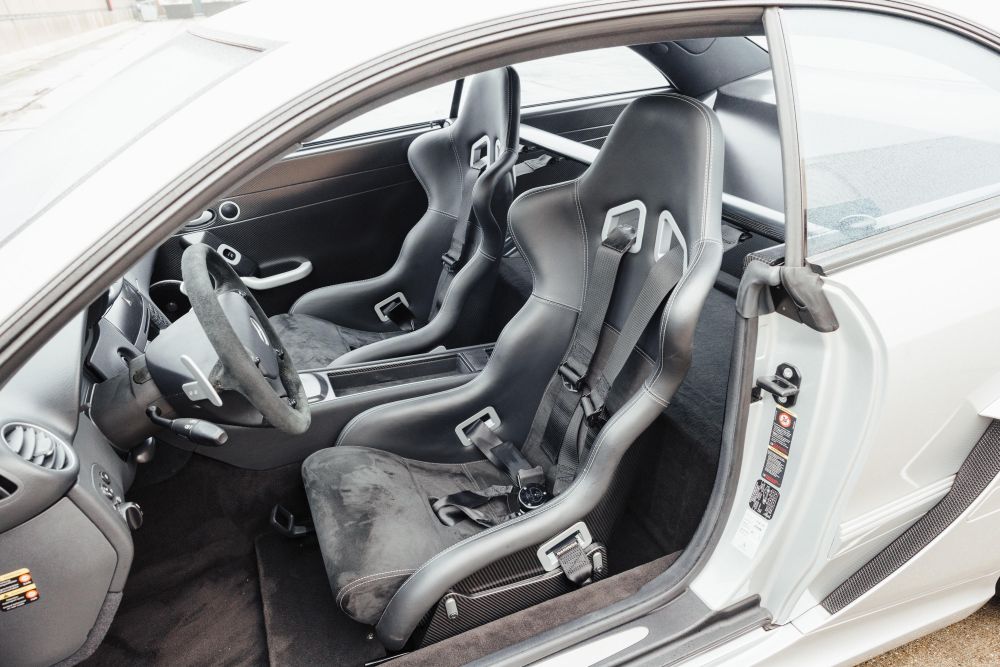
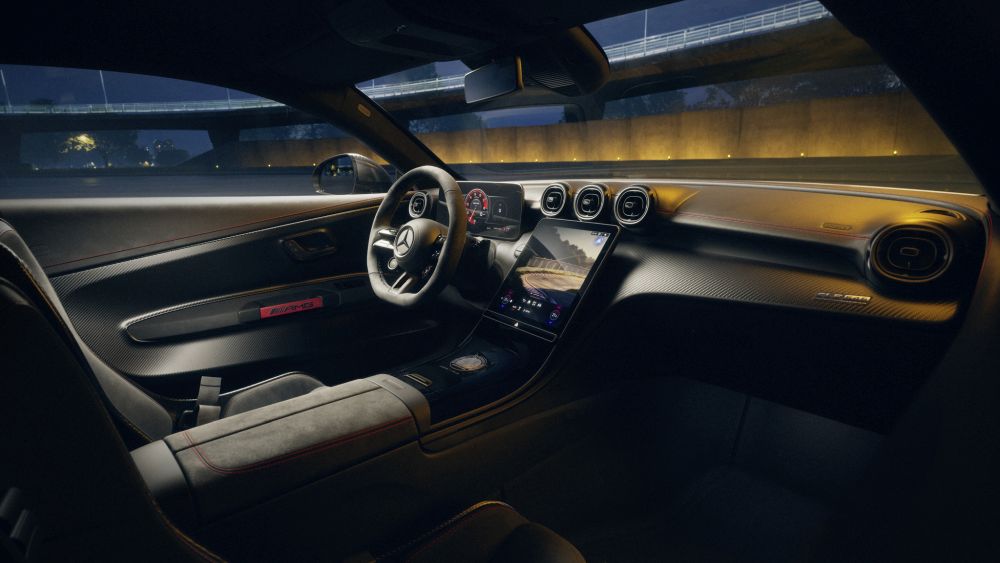
The interiors of the two models are similar, with both featuring just two seats and a roll cage for protection in the event of a rollover.
The Mercedes CLK DTM AMG has carbon-fiber door panels and racing bucket seats upholstered in leather and Alcantara, together with six-point racing harnesses.
The Mercedes-AMG CLE 646 offers a similar configuration, with two bucket seats featuring carbon-fiber structures, while the door panels and central section of the dashboard are also finished in carbon fiber. However, the six-point harnesses are available only as an option.
Despite the extensive use of carbon fiber and the fact that the Mercedes-AMG CLE 646 has a smaller-displacement V8, at 4.0 liters versus 5.4 liters in the CLK DTM AMG, the AMG CLE 646 is 150 kg heavier, weighing 1,895 kg at the curb compared with 1,742 kg for the CLK DTM AMG.
V8 engines, but different philosophies
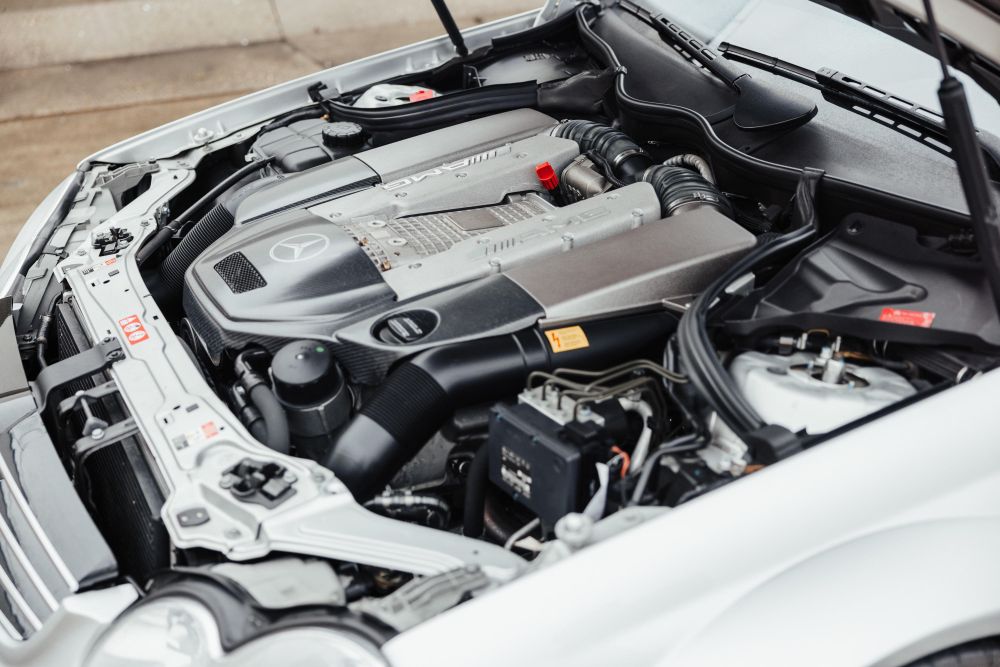
The Mercedes CLK DTM AMG is powered by a 5.4-liter supercharged V8 with a mechanical supercharger that produces a distinctive whine and eliminates any notion of turbo lag. The steering of this car, which I drove at the end of 2003, is absolutely fabulous, giving the car remarkable agility that would make even the people at BMW jealous.
The 5.4-liter V8 developed 582 PS (572 hp) and 800 Nm, accelerating the car from 0 to 100 km/h in just 3.9 seconds, while top speed was limited to 320 km/h. Fuel consumption according to the NEDC standards of the time was 13.7 l/100 km, corresponding to CO₂ emissions of 328 g/km.
By comparison, the Mercedes-AMG CLE 646 features the new 4.0-liter twin-turbo V8 with a flat-plane crankshaft and a 48V mild-hybrid system with a 23-PS/205-Nm electric motor. The system produces 646 PS (637 hp) and 850 Nm and accelerates the car from 0 to 100 km/h in the same 3.9 seconds, while top speed is limited to 310 km/h. Fuel consumption according to the stricter WLTP standard is higher, at 15.8 l/100 km, corresponding to CO₂ emissions of 369 g/km.
The power of these mighty V8 engines is sent exclusively to the rear wheels through a five-speed automatic transmission—with steering-wheel paddles for manual gear changes—and a mechanical limited-slip rear differential in the CLK DTM AMG, while the AMG CLE 646 uses a nine-speed automatic transmission and an electronically controlled rear differential.
Both models are equipped with ceramic-disc brakes: 420 x 40 mm discs and six-piston calipers at the front, and 360 x 32 mm discs with single-piston calipers at the rear for the AMG CLE 646 and 360 x 32 mm discs at the front and 330 x 26 mm at the rear for the CLK DTM AMG.
Their suspension systems are also different from those of the standard models on which they are based. The CLK DTM AMG featured a rear suspension whose ride height could be manually adjusted at the rear axle, while the AMG CLE 646 uses a steel coilover suspension with four-way adjustable dampers featuring independently adjustable low- and high-speed rebound and compression damping.
Price
The Mercedes CLK DTM AMG cost €240,000 when it was launched in 2004, but its value has since doubled, with good examples now changing hands for between €400,000 and €500,000. Only 100 were produced.
The Mercedes-AMG CLE 646 will be produced at one-third of that volume. Only 30 examples will be built, and its price will probably be higher than the current market value of the CLK DTM AMG.
Is it worth it? We will only find out after the first test drive. We already know how the CLK DTM AMG performs; now we have to wait and see what conclusions can be drawn after the first drive of the AMG CLE 646.
| Model | Mercedes-AMG CLE 646 Special Edition | Mercedes CLK DTM AMG |
|---|---|---|
| Engine type | V8, bi-turbo | V8, mechanical compressor |
| Displacement (cc) | 3,982 | 5,439 |
| Max.power/revs (PS/rpm) | 646/6,000-6,250 | 582/6,100 |
| Max. torque/revs (Nm/rpm) | 850/2,500-4,500 | 800/3,500 |
| Electric engine | ||
| Max. power (PS) | 23 | - |
| Max. torque (Nm) | 205 | - |
| Traction | rwd | rwd |
| Transmission | 9 speed, auto | 5 speed, auto |
| L x w x h (mm) | 4,949 x 1,987 x 1,420 | 4,650 x 1,800 x 1,360 |
| Wheelbase (mm) | 2,875 | 2,715 |
| Boot capacity (l) | 405 | 395 |
| Kerb weight/payload (kg) | 1,895/235 | 1,742/313 |
| Tires front - rear | 305/30 ZR20 - 335/30 ZR20 | 255/35 R19 - 285/30 R20 |
| Top speed (km/h) | 310 | 320 |
| Acceleration 0-100/200/300 kph (s) | 3.9/11.4/36.2 | 3.9/10.9/na |
| Combined fuel consumption (l/100 km) | 15.8 (WLTP) | 13.7 (NEDC) |
| Emission CO2 (g/km) | 359 (WLTP) | 328 (NEDC) |
| Price (euro with VAT) | na | 240,000 (2004) |