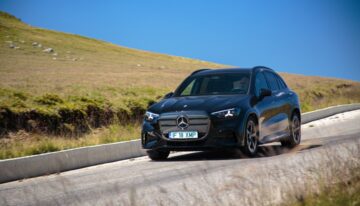
There is a certain ritual to driving a Mercedes-Benz. You settle into the seat, the door closes with that distinctive solidity, and the world outside immediately feels a little more distant. Whether it is a C-Class on a daily commute or an S-Class on a long motorway run, Mercedes owners tend to share a common priority: they care about the quality of the experience behind the wheel, and they care about doing things properly.
That same sensibility is behind a quiet but growing trend among Mercedes drivers — one that has little to do with performance upgrades or interior customisation. Increasingly, owners are mounting a compact camera behind their rear-view mirror and letting it run every time they drive. The device is unobtrusive, requires almost no maintenance, and most drivers who install one say it quickly becomes something they would not want to be without.
Many Mercedes drivers today are adding a dash cam to their vehicles as an additional layer of protection — not because they expect the worst, but because they understand that the road does not always reward good intentions alone.
Why Premium Car Owners Are Turning to Dash Cameras
It would be easy to assume that dash cameras belong in fleet vehicles and budget runarounds rather than prestige marques. That assumption has not aged well. Spend any time in a busy city centre car park or a motorway services and you will notice just how many higher-end vehicles now carry a discreet camera unit. There are practical reasons for this, and they are difficult to argue with.
The most obvious is value. A Mercedes represents a significant financial investment, and the cost of repairing one — whether it is a bumper on an A-Class or a door panel on a GLE — is considerably higher than on a mainstream vehicle. That raises the stakes in any incident, whether it involves another driver, a cyclist, or a stationary object in a car park. When the repair bill runs into thousands, having clear, timestamped video evidence of exactly what happened ceases to be a luxury and becomes a practical necessity.
Then there is the question of parking risk. A Mercedes left in a public space — particularly overnight or in an unfamiliar city — is a target. Not necessarily for theft, but for the mundane reality of other drivers who clip a wing mirror and drive away, or delivery vehicles that nudge a bumper while reversing. Without evidence, these incidents are almost impossible to pursue. With dashboard camera systems capable of monitoring a vehicle in parking mode for hours at a time, that dynamic has changed.
Insurance disputes are the third major factor. Anyone who has navigated a contested liability claim knows how quickly a straightforward situation can become complicated. Conflicting accounts, reluctant witnesses, and insurers inclined toward the path of least resistance can leave an entirely blameless driver out of pocket or carrying an undeserved fault marker on their record. Video footage does not negotiate or misremember. It simply shows what happened.
Real Situations Where Dash Cams Help Mercedes Drivers
The abstract case for a camera is compelling enough. But it is the specific, real-world scenarios that tend to convert sceptics.
Accident disputes. The most common application. Two drivers exit their vehicles after a collision, each certain the other was at fault. In the absence of independent witnesses, insurers are often left to split liability or make decisions based on the most plausible account. A camera that captured the fifteen seconds leading up to the impact resolves this immediately. It is not just useful in serious collisions — even minor scrapes at junctions or roundabouts become straightforward when the footage exists.
Parking lot incidents. You return to a car park to find a dent in your door and no note on the windscreen. Without parking mode footage, there is nothing to work with. Modern cameras with motion-triggered recording and continuous low-power monitoring can capture the offending vehicle, its plate, and the exact moment of impact. For owners parking in city centres regularly, this alone is often enough justification for installation.
Insurance claims. Beyond contested accidents, footage can support claims for pothole damage, road debris incidents, or situations where a third party denies involvement after the fact. Some insurers in the UK and Europe now actively factor camera ownership into their assessments, with certain providers offering reduced premiums for drivers who use cameras and agree to share footage when relevant.
Road incidents. Not every useful recording ends in a claim. Footage of dangerous driving by another party can be submitted to police or traffic authorities. In some jurisdictions this has led to direct action against offenders. It is also useful for documenting road conditions — unmarked hazards, aggressive drivers, or situations that may not result in a collision but warrant a report.
What to Look for When Choosing a Dash Cam for a Mercedes
Not every camera is worth fitting. Mercedes owners who have spent time researching the category quickly discover that quality varies enormously, and that the cheapest units often fall short in exactly the scenarios where good footage matters most. A few criteria are worth prioritising.
Video quality. Resolution alone is not sufficient. A camera recording in 4K with poor low-light performance is less useful than a well-tuned 2K unit that captures clear plates at night. Look for cameras with wide dynamic range (WDR) technology, which balances exposure across bright and shadowed areas. Most real incidents happen in conditions that are less than ideal.
Discreet installation. The interior of a Mercedes is a considered space. Bulky cameras mounted prominently on the windscreen work against that. Most quality units are now compact enough to sit neatly behind the rear-view mirror and become functionally invisible from outside the vehicle. Hardwired installation, routed through the headlining, eliminates visible cables entirely.
Wide field of view. A narrow lens misses the periphery where many incidents originate. A 140–160 degree field of view captures lane changes, vehicles approaching from angles, and the full width of most junctions. Dual-channel systems — covering both front and rear — extend this protection significantly.
Parking protection. Essential for owners who park in shared or public spaces. Look for units with dedicated parking modes, motion-triggered recording, and impact detection. Capacitor-based power storage (as opposed to a conventional battery) handles temperature extremes more reliably — relevant for a car that may sit in the sun or cold for extended periods.
Reliability. Drivers looking to add extra protection often explore modern dash cam options that can continuously record their driving and provide reliable video evidence when incidents occur. For example, many car owners today install a high-quality dashboard camera to monitor both driving activity and parking situations — with loop recording, automatic file protection for detected impacts, and GPS logging that timestamps footage with location data.
Do Modern Luxury Cars Still Need Dash Cameras?
It is a reasonable question. A current-generation Mercedes is loaded with technology designed explicitly to keep the driver safe: Pre-Safe collision preparation, Active Brake Assist, blind-spot monitoring, rear cross-traffic alert, and surround-view cameras that make parking easier than ever. Do all these systems not address the same problem?
They address a different problem. The safety and driver assistance technologies in a Mercedes are designed to prevent accidents from happening — or to mitigate their severity when they cannot be avoided. A dash cam does something entirely distinct: it documents events after they occur. The two systems are complementary, not redundant.
There is also a fundamental limitation to the built-in camera systems on most vehicles: their footage is typically not accessible in a format that can be easily submitted to insurers or presented in a dispute. The recordings, where they exist, are often overwritten and not designed with evidence in mind. A dedicated recording unit solves this directly, storing protected footage on a memory card that can be removed and reviewed immediately.
The broader point is that the sophistication of your own vehicle offers no protection against the behaviour of others. A perfectly driven Mercedes is still vulnerable to a distracted driver running a light, a cyclist swerving unexpectedly, or a reversing van in a car park. The camera does not care who is at fault — it simply records the truth, and that objectivity is its most valuable quality.
A Practical Addition to a Considered Vehicle
Dash cameras have moved a long way from the grainy devices that first appeared in police vehicles and long-haul lorries. Today’s better units are compact, reliable, and capable of capturing footage that holds up in insurance disputes and legal proceedings. For a driver who has invested in a vehicle that reflects their standards, matching that investment with the right supporting equipment is simply good sense.
For Mercedes owners who spend real time on the road — in cities, on motorways, in car parks that other people also use — a quality dash cam has become less of an optional extra and more of a quiet essential. The drivers who have one rarely consider removing it. The drivers who do not tend to wish they had one when it would have mattered most.