A quiet Mercedes cabin is not created by adding one thick layer of insulation. Noise enters through the glass, tyres, suspension mounts, door seals and airflow around the body. Removing one source can also expose a faint whistle or vibration previously hidden by it.
Mercedes therefore treats refinement as a chain of small engineering decisions. Some block sound at its source, others stop vibration travelling through the structure, and the most advanced systems counter selected frequencies through the audio system.
Silence Begins Outside the Passenger Compartment
Air becomes a major source of noise as speed rises. The body must guide it around the mirrors, pillars, handles and underbody without creating turbulent pockets. A low drag coefficient helps efficiency, but seals and individual edges still matter.
The doors use several barriers rather than one rubber strip. Primary and secondary seals interrupt air paths, while accurate window alignment limits high-frequency whistles. Frameless glass on models such as the CLA must lower slightly when the door opens and return firmly against the seal after closing.
Digital games use sound controls for a similar reason: presentation can be adjusted without changing the underlying result. Audio settings in payid pokies are worth checking, particularly the controls for music and sound effects. Leaving every channel active can recreate more of a busy casino atmosphere, while reducing music and keeping essential effects produces a calmer session. Full-screen mode can further limit visual distractions but does not affect the game mathematics.
Glass Has More Than One Job
Windscreens already use laminated construction for safety. Luxury models can extend acoustic laminated glass to the side windows, placing a sound-damping film between glass layers. This is especially useful against wind and traffic noise at higher frequencies.
Mercedes-Benz’s technical overview of the EQS explains that its acoustic glazing reduces wind noise as well as outside sounds, including tyre noise and passing traffic. That gives the glass a useful role beyond keeping the weather out.
Different materials can reduce a broader range of frequencies than one uniform panel. The intermediate layer may also improve thermal insulation and resistance to forced entry, so acoustic glazing sometimes forms part of a wider protection or comfort package.
The W140 S-Class introduced in 1991 used double insulating side glazing. Current luxury models apply newer laminated constructions without the visibly separated panes associated with that car.
Tyres Often Become the Loudest Component
An electric motor removes engine sound, but not contact between rubber and asphalt. The quiet drivetrain can make tyre noise and suspension impacts easier to hear. Larger wheels with lower-profile tyres may sharpen steering response, yet their stiffer sidewalls transmit more road texture.
Several details influence what reaches the seats:
- tread pattern and rubber compound;
- tyre width and inflation pressure;
- sidewall height;
- foam fitted inside certain tyres;
- wheel-arch liners and floor insulation;
- bushings separating suspension parts from the body.
Foam inside a tyre targets resonance in its air cavity rather than ordinary tread noise. It cannot compensate for coarse asphalt or an unsuitable tyre. Correct load and speed ratings therefore matter even when two products share the same dimensions.
Isolation Stops Vibration Becoming Sound
Noise is not always airborne when it begins. A motor, compressor or suspension arm can send vibration into the body, where a large panel behaves like a loudspeaker. Engineers interrupt that route with rubber mounts, bushings and isolated subframes.
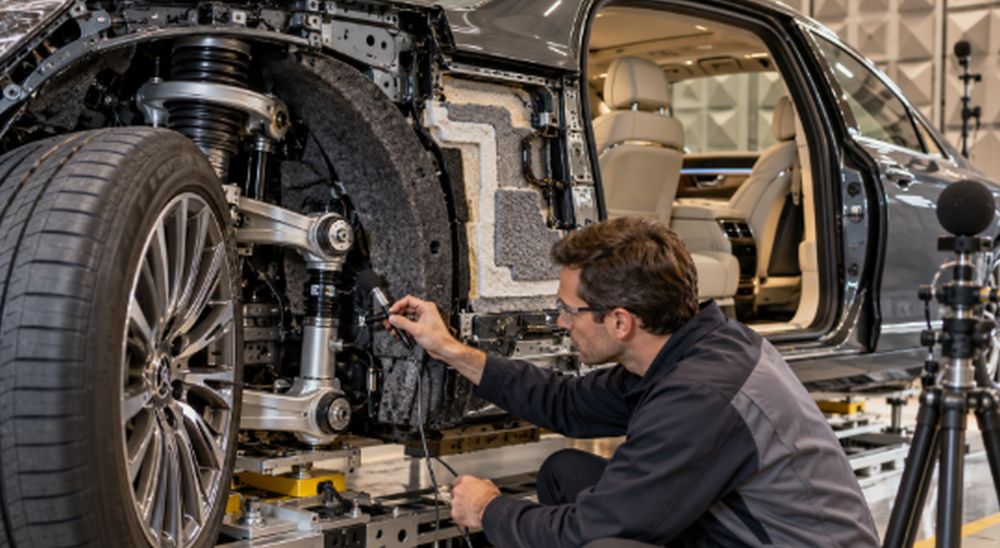
The EQS demonstrates this work. Its electric motors are encapsulated and mounted to limit vibration transmission. Underbody panels, wheel-arch treatment and interior absorbers then address the remaining road and wind noise.
Combustion models present another challenge. Their mounts must control movement under acceleration while preventing unpleasant frequencies reaching the cabin. Intake and exhaust systems are also tuned: an AMG retains a purposeful voice, whereas an S-Class keeps its engine distant during steady cruising.
Speakers Can Remove Selected Frequencies
Passive materials add weight and occupy space, so Mercedes-Maybach also uses active road-noise compensation on selected S-Class versions. Sensors detect vibrations associated with low-frequency tyre noise. The audio system generates an opposing signal through the speakers, reducing the sound perceived by occupants.
The process works best with predictable, low-frequency noise. It cannot erase every sharp impact, wind gust or loose item in a door pocket.
Active compensation complements rather than replaces physical measures. The cabin still needs:
- accurately fitted doors and windows;
- isolated suspension attachment points;
- suitable tyres and wheel sizes;
- absorbent material in cavities and floor sections;
- controlled airflow around the mirrors and pillars.
Treating these sources first leaves the electronic system with a narrower and more manageable task.
Quietness Must Still Provide Information
Complete silence would not always be desirable. Drivers need to notice emergency vehicles, tyre changes and unusual mechanical sounds. Electric cars must also produce an external warning sound at low speeds in many markets, even while engineers reduce noise inside.
Mercedes cabins are tuned rather than simply muted. An S-Class prioritises isolation, an AMG preserves more drivetrain character, and an electric model may offer artificial driving sounds as an optional layer. The target depends on the vehicle’s role.
The calm impression comes from coordination. Aerodynamics reduce wind disturbance, glazing filters higher frequencies, tyres and liners address the road, mounts interrupt vibration, and speakers counter persistent low tones. Their combined work makes conversation feel effortless even when the car is travelling quickly.