
Mercedes has launched the new Mercedes GLC EQ at a price similar to the conventional versions. We made the first comparison between the electric Mercedes GLC 400 4Matic and the GLC 400e 4Matic PHEV, which are offered at similar prices.
Price is no longer a problem because Mercedes offers the new electric GLC SUV at almost the same price as the PHEV-powered GLC.
Thus, the electric Mercedes GLC 400 4Matic starts at 71,281 euros, while the GLC 400e 4Matic PHEV version starts at 72,340 euros. The electric model is even cheaper by 1,000 euros than its PHEV sibling. And now some data.
If in the case of the Mercedes CLA EQ and CLA Hybrid we are talking about the same MMA platform (Mercedes Modular Architecture), in this case there is not the slightest connection between the Mercedes GLC 400 4Matic and its PHEV sibling.
Technical platform
The Mercedes GLC 400 4Matic is built on the new dedicated electric MB.EA platform with 800V technology, adaptive air suspension, and all-wheel steering borrowed from the S-Class. It comes standard with a classic steel-spring suspension, while the Airmatic air suspension and rear-axle steering with a steering angle of 4.5 degrees cost 2,844 euros (Agility & Comfort package).
It is powered by two electric motors delivering a combined 489 PS (Mercedes does not disclose the power of each motor individually), featuring electric all-wheel drive without a driveshaft between the axles. The rear motor is coupled to a two-speed automatic transmission.
On the other side, the Mercedes GLC 400e 4Matic is built on the conventional MRA II platform and also offers optional air suspension and rear-axle steering with a 4.5-degree angle. These cost an extra 3,320 euros (in the Technical package).
It is powered by a 2-liter turbo engine with 252 PS and 400 Nm and an electric motor with 136 PS and 440 Nm placed between the combustion engine and the 9-speed hybrid automatic transmission. The whole system delivers 381 PS and 650 Nm.


Acceleration and top speed: a draw
The electric Mercedes GLC 400 4Matic accelerates from 0 to 100 km/h in just 4.3 seconds and reaches a top speed of 210 km/h. By comparison, the PHEV model reaches 100 km/h in 5.6 seconds and tops out at 237 km/h.
Thus, the electric version accelerates 1.3 seconds faster to 100 km/h, but its top speed is 27 km/h lower.
Consumption and range: advantage GLC 400e 4Matic
The motors of the GLC 400 4Matic are powered by a 94-kWh net Li-ion battery, giving it a WLTP range of 673 km according to the latest homologation. It is not yet available for testing, and for now, we only know the official WLTP average consumption of 15.1 kWh/100 km. It can charge with a maximum power of 330 kW, needing 22 minutes to charge from 10 to 80%.
Realistically, we believe real-world consumption will be around a minimum of 20 kWh/100 km given the motor power and SUV shape, meaning a real range of 470 km. We estimated 20 kWh/100 km because with the Porsche Macan 4 electric, which has the exact same net battery capacity and slightly lower total power (408 PS), we obtained 19 kWh/100 km in a real test.
Mercedes GLC 400e 4Matic has a battery with a gross capacity of 31.2 kWh (25.3 kWh net), which provides a WLTP electric range of 120 km and can also charge at DC stations with up to 60 kW, requiring 29 minutes for the 10–80% charge.
We tested the GLC 400e 4Matic one year ago. With its 49-liter tank and a real average consumption of 9 l/100 km with the battery empty, the Mercedes GLC 400e 4Matic has a real range of 540 km, plus 100 km in electric mode in real driving, for a total of about 640 km.
Thus, the PHEV model could realistically have an advantage of about 170 km in terms of real range.
Interior space
We had the chance to get a first look at the Mercedes GLC 400 4Matic at the Munich Auto Show. At 4,845 mm long, 1,913 mm wide, and 1,644 mm high, it is 129 mm longer, 23 mm wider, and 6 mm taller than the PHEV model.
The 2,972 mm wheelbase is 84 mm longer. And this is felt in the rear legroom. Mercedes states that rear passengers have 47 mm more knee room than in the traditional GLC, and at first sitting—at the Munich Auto Show—the electric version felt more spacious. However, the 40/20/40 split rear bench has the same fairly short cushion as the combustion version, but it is comfortable with a well-shaped backrest.
The good news is that the boot floor is adjustable and can be raised by 8 cm. Under the adjustable floor there is a deep compartment which can also hold charging cables if the frunk is full. Yes, you can fit even two travel bags in the huge frunk, which has 128 liters (100 liters according to ISO 3832), and it opens in an original way by pressing the Mercedes logo on the hood.
The standard boot volume of 570 liters is 100 liters larger than in the GLC 400e 4Matic PHEV (the PHEV has a 130-liter smaller boot than the combustion GLC—470 liters compared to 600 liters—due to the battery being mounted partly under the rear bench and partly under the boot floor). With the rear backrest folded, the volume reaches 1,740 liters compared to 1,530 liters in the PHEV version.

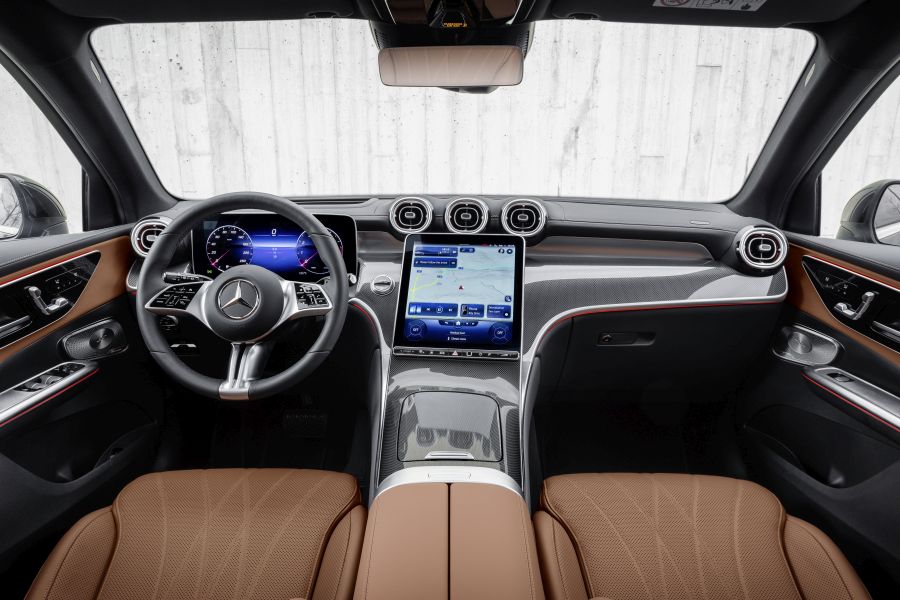
Interior and multimedia system
Here, it depends greatly on the chosen configuration.
The Mercedes GLC 400 4Matic comes with two configuration types, and the first is not very generous. The base one, Superscreen, has three displays—10.3 inches for the instrument cluster and 14 inches for the multimedia and passenger. However, these are three independent displays grouped under a glass panel. The top version, Hyperscreen (1,487.50 euros), is essentially a single continuous 99.3-cm display and looks spectacular. The head-up display costs an extra 1,249.50 euros, and augmented reality navigation 499.80 euros. The Burmester audio system with 3D sound and 15 speakers adds another 1,309 euros.
But the most important thing is the new in-house-developed MB.OS operating system, which uses technology and AI from Google, ChatGPT, and Microsoft, while navigation is based on Google Maps. More than 40 information and entertainment apps are available, including Disney+ and Spotify. A digital key is also included, which can be stored on a smartphone or smartwatch and shared, for example, with family members. As with other Mercedes models, the multimedia system features the improved Zero Layer interface, showing the most important information and most recently used apps.
On the other side, the Mercedes GLC 400e 4Matic comes standard with a 12.3-inch display for the instrument cluster and an 11.9-inch portrait display for the multimedia system, which looks very elegant. The head-up display costs an extra 1,178.10 euros, and augmented reality 499.80 euros. But it has a major disadvantage because navigation is based on outdated maps and not Google. And the touch controls on the steering wheel are annoying compared to the new physical scroll wheels in the electric version.
Equipment
In general, optional equipment is structured similarly and some even have the same or very close prices. Still, there are differences.
For example, the GLC 400 4Matic has a panoramic roof with top-class technology but cannot be opened. Made of laminated, thermally insulated glass, its opacity can be varied between transparent and opaque, with the surface divided into nine zones. 162 stars are integrated into the glass and can be lit in any of the 64 ambient light colors. Its price: 1,249.50 euros.
By comparison, the Mercedes GLC 400e 4Matic has a more traditional panoramic sunroof that costs an extra 1,689.90 euros.
Both models offer standard electric adjustments and heated front seats, but for now only the PHEV version allows you to order ventilated seats (928.20 euros). You can also opt for multicontour seats (1,011.50 euros) in the PHEV.
The electric version can be ordered with two AMG packages:
-
AMG Line 3,451 euros with 20-inch alloy wheels, AMG design package, and Comfort seats
-
AMG Line Plus 7,556.50 euros with 21-inch alloy wheels, AMG Line, sport seats, and red seatbelts
The PHEV version can be ordered with a single AMG package—AMG Edition, costing 5,360.95 euros.
Conclusion
The Mercedes GLC 400 4Matic electric is the more modern model, with a far better multimedia system and improved ergonomics, plus more generous interior space and high-tech options not available on the PHEV model. In addition, with the new illuminated grille, it looks more elegant and modern than the PHEV version. In the end, the electric version is even slightly cheaper than the PHEV version. Mercedes is playing aggressively and wants to push electric propulsion forward. And it has enough arguments for that, not just the price.


