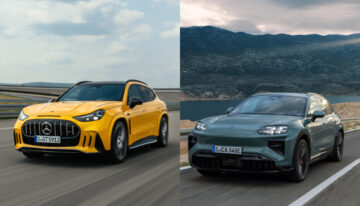
Launched just a few months ago, the Cayenne Electric is available in three versions: Electric (442 PS), S Electric (666 PS) and Turbo Electric (1,156 PS). All three use two permanent-magnet synchronous motors. It now faces a worthy rival in the Mercedes-AMG GT SUV, which is also available in three versions: the AMG GT 53 SUV, with two permanent-magnet synchronous motors producing 544 PS; the AMG GT 55 SUV, with 816 PS; and the AMG GT 63 SUV, with 1,169 PS. The latter two feature three Yasa axial-flux motors. The rivalry therefore extends across the entire range, not just the flagship versions. Let’s examine the two models in detail.
Range, batteries and charging
Regardless of version, the Porsche Cayenne Electric uses the same NMC battery with pouch cells, offering a gross capacity of 113 kWh. The battery is cooled from both above and below. Thanks to its 800-volt technology, the PPE platform supports charging at up to 390 kW, and Porsche claims a 10–80% charging time of 16 minutes.
We tested the entry-level Cayenne Electric and charged it from 44% to 75% in just seven minutes, at a peak charging power of 379 kW. This suggests that Porsche’s claimed 16-minute charging time from 10% to 80% is achievable.
Interestingly, unlike many other luxury electric vehicles, the Porsche Cayenne Electric has a separate AC charging port on the right-hand side and a DC charging port on the left.
At AC charging stations, the Porsche Cayenne Electric supports 11 kW as standard, with an optional 22 kW onboard charger costing €1,666. Unlike the AMG GT SUV, it can also be charged wirelessly at up to 11 kW. The wireless charging system requires pre-installation costing €226 and a charging plate priced at €1,844.50.
By comparison, the Mercedes-AMG GT SUV is also built on an 800-volt architecture, the AMG.EA platform. It is available with two NMC batteries featuring cylindrical cells measuring 26 mm in diameter and 105 mm in height, with net capacities of 106 kWh and 128 kWh. The cells are arranged in 18 modules in the 106 kWh battery and 22 modules in the 128 kWh version. Thanks to a special NMCA cathode and a silicon-containing anode, the cells achieve an energy density of more than 298 Wh/kg.
Both batteries support impressive charging power: up to 600 kW for the 106 kWh battery and up to 710 kW for the 128 kWh version. Since CCS chargers cannot support charging power above 600 kW, Mercedes has not specified whether charging at 710 kW requires MCS charging stations equipped with water-cooled connectors.
However, there is an important caveat: charging at 600 kW or 710 kW will very likely not be standard equipment. On the AMG GT 4-door Coupé, standard charging power is 350 kW, while the optional 600 kW capability is available through the AMG Performance Charging package, which costs €2,380.
Mercedes states that charging from 10% to 80% takes 11 minutes at 600 kW and 12 minutes for the larger battery at 710 kW, making the process slightly faster than in the Porsche.
Both batteries can also be charged at AC stations, although Mercedes specifies only an 11 kW charging capacity. However, the AMG GT 4-door Coupé offers an optional 22 kW onboard charger for €785.40, so this option will probably also be available for the AMG GT SUV.
Both batteries are integrated into the vehicle structure and feature protective housings.
In terms of range, Mercedes claims up to 668 km for the AMG GT 53 SUV, which is available only with the 106 kWh battery and has a consumption figure of 18.8 kWh/100 km. The AMG GT 55 SUV and GT 63 SUV are available with either the 106 kWh or 128 kWh battery, with claimed ranges of 585 km (20.9 kWh/100 km) and 700 km (21.2 kWh/100 km), respectively.
By comparison, the Porsche Cayenne, which has only one battery option with a gross capacity of 113 kWh, offers a claimed range of 617 km for the Cayenne Turbo Electric (20.6 kWh/100 km), 651 km for the Cayenne S Electric (19.5 kWh/100 km) and 642 km for the entry-level Cayenne Electric (19.7 kWh/100 km).
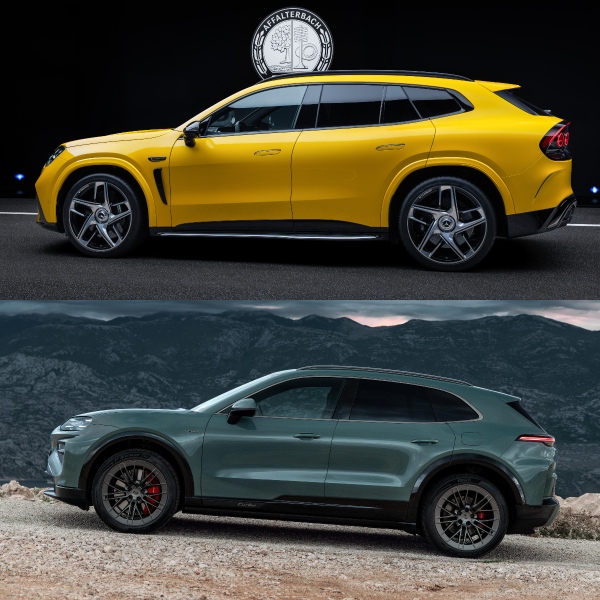
Motors and performance
In all versions, the Mercedes-AMG GT SUV offers more power and slightly lower weight, resulting in somewhat quicker acceleration, with one exception.
The Mercedes-AMG GT 53 SUV, with 544 PS and a kerb weight of 2,525 kg, accelerates from 0 to 100 km/h in 4.2 seconds. By comparison, the entry-level Porsche Cayenne Electric, with 442 PS and a weight of 2,600 kg, takes 4.8 seconds.
With 816 PS and a weight of 2,605 kg, the Mercedes-AMG GT 55 SUV equipped with the 106 kWh battery reaches 100 km/h in 3.1 seconds. The Porsche Cayenne S Electric, with 666 PS and a weight of 2,630 kg, takes 3.8 seconds. Even with the larger 128 kWh battery, the AMG GT 55 SUV completes the 0–100 km/h sprint in the same 3.1 seconds.
Surprisingly, the Porsche Cayenne Turbo Electric, with 1,156 PS and a weight of 2,720 kg, accelerates to 100 km/h in just 2.5 seconds. The Mercedes-AMG GT 63 SUV, despite producing 1,169 PS from its three axial-flux motors, takes 2.7 seconds, regardless of whether it is equipped with the 106 kWh or 128 kWh battery.
Both models also offer some emotional appeal. If you order Electric Sound on the Porsche (€499.80), your ears are treated to a sound that mimics that of a Porsche V8 engine in Sport and Sport Plus modes, although you can also activate it manually.
In the Mercedes-AMG GT SUV, the emotional experience is even more intense. In AMG Force Sport+ mode, the system reproduces the sound of an AMG V8 engine in the AMG GT 63 and AMG GT 55 SUVs, and that of an AMG inline-six engine in the AMG GT 53 SUV. The driving programmes also simulate gear changes similar to those of the AMG Speedshift nine-speed transmission, while vibrations are also transmitted through the seat.
Chassis and suspension
The Mercedes-AMG GT SUV features a sophisticated AMG Active Ride Control+ air suspension system with three-stage adjustment. It is standard on the AMG GT 63 SUV and optional on the AMG GT 55 SUV. Conventional anti-roll bars have been replaced by active hydraulic elements that control both body roll and pitch. As a result, the nose no longer rises sharply under hard acceleration or dips under heavy braking.
The suspension is combined with rear-axle steering. At speeds of up to 80 km/h, the rear wheels turn by up to 6 degrees in the opposite direction to the front wheels. Above 80 km/h, they turn in the same direction as the front wheels, by up to 1 degree.
The AMG GT 63 SUV comes with ceramic brake discs as standard, while the AMG GT 55 SUV is equipped with steel discs.
The Porsche Cayenne Electric features adaptive air suspension with four ride-height settings. An optional Porsche Active Ride system, similar in concept to the Mercedes setup, eliminates conventional active anti-roll bars in favour of dampers controlled individually by an electrohydraulic pump. This option costs €8,324. All-wheel steering is also available for €1,701.70.
Porsche also offers ceramic brake discs, priced at €9,293.90 with yellow brake callipers or €10,116.19 with callipers painted in gloss black.
We cannot comment yet on how the Mercedes-AMG GT SUV drives, but the entry-level Cayenne Electric impressed us with its fabulous steering, which offers superb feedback for an electric power steering system. It is linear yet responsive at the same time, and you always know exactly how much the wheels are turned.
The Cayenne also impresses with the wide range of suspension settings between Normal mode, where it is very compliant, and Sport Plus, where body roll is reduced to a minimum. It is worth noting that our test car was fitted with 21-inch wheels and wide tyres measuring 275 mm at the front and 315 mm at the rear.
During our test, which took us along motorways as well as high-altitude mountain roads, we also noted the enormous regenerative braking power of up to 600 kW. Average consumption during the test was 23.6 kWh/100 km, despite the sporty driving style.
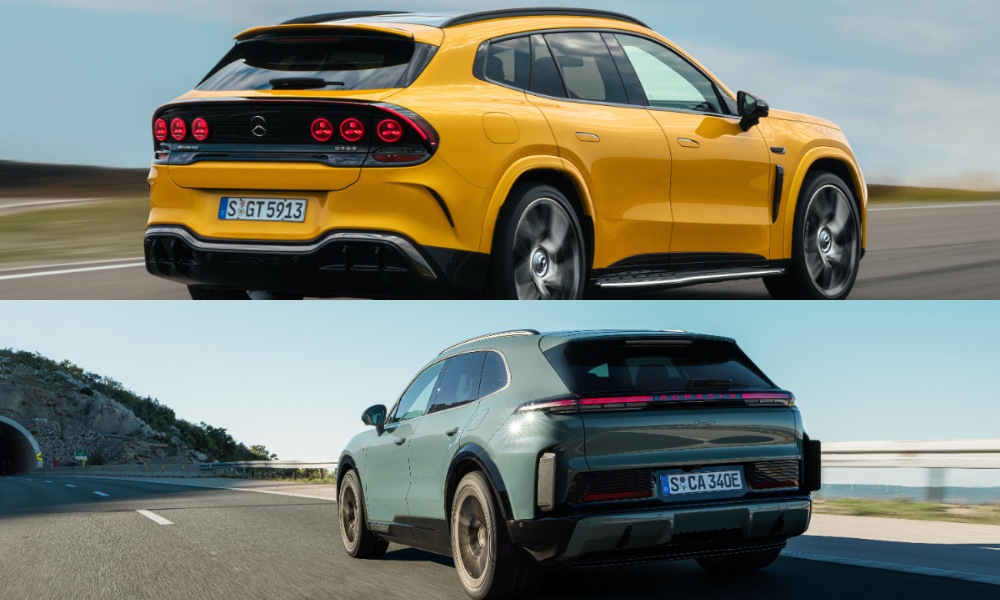
Interiors
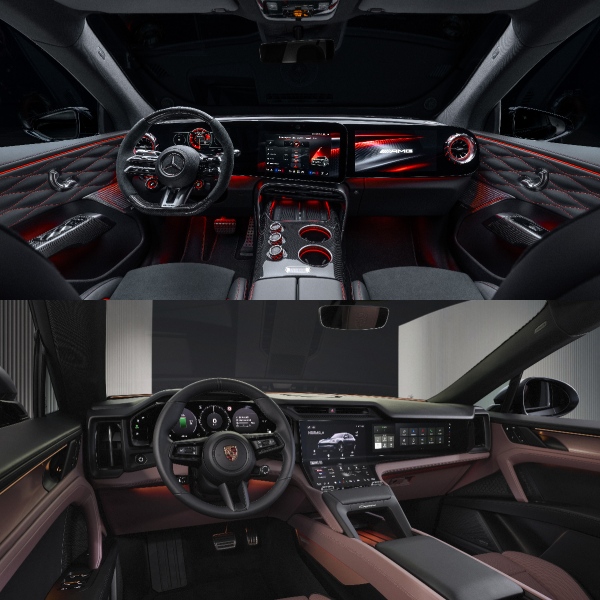
Both models feature entirely new interiors for their respective brands.
In the Mercedes-AMG GT SUV, the distinctly sporty interior is carried over from the AMG GT 4-door Coupé. It features a 10.2-inch digital instrument display, a 14-inch central infotainment screen angled towards the driver, and a 14-inch display for the front passenger. The AMG Performance steering wheel incorporates rotary controls for selecting driving modes. The centre console houses three rotary controls that allow the driver to adjust the car’s responses, cornering behaviour and slip characteristics individually.
The Porsche has an interior more reminiscent of a grand tourer. Its centrepiece is the so-called Flow Display, a vertically curved screen divided into two display areas. The upper section is dedicated to navigation and driving modes, while the lower section controls the climate system and ambient lighting settings, a new feature for Porsche.
In front of this curved display is an excellent palm rest that provides ergonomic access to the physical temperature controls, which produce a satisfying click when operated.
The instruments are displayed on a 14.25-inch curved screen similar to the one in the Taycan. On the right-hand side, several shortcuts provide direct touchscreen access to suspension firmness, ride height and ESP settings.
An optional 14.9-inch passenger display costs €1,951.50. A head-up display is also available for €2,391.90, projecting information onto a virtual screen that appears to be positioned 8.7 inches diagonally, 10 metres ahead of the car.
Despite its high price, the AMG Performance seats with integrated headrests are optional on the AMG GT SUV, as is the Burmester 4D sound system.
In the entry-level Porsche Cayenne Electric and Cayenne S Electric, Comfort seats with 14-way electric adjustment cost €1,243.55, while Sport seats with 18-way electric adjustment are priced at €1,624.35. The range-topping Cayenne Turbo Electric comes with the 18-way electrically adjustable Sport seats as standard.
Porsche has a major advantage in terms of interior versatility, as its rear bench slides electrically in a 40:60 split, allowing the luggage compartment capacity or rear legroom to be adjusted. With the rear bench in its standard position, the Porsche has a smaller boot than the Mercedes-AMG GT SUV, offering 553 or 519 litres, depending on the version, compared with 607 litres in the Mercedes. However, sliding the rear bench forward increases the Porsche’s boot capacity to an impressive 781 litres, compared with 607 litres in the Mercedes.
Both models have a front luggage compartment (frunk), but the Porsche’s is slightly larger, at 90 litres compared with 78 litres in the Mercedes.
Prices
Mercedes has not yet announced prices for the Mercedes-AMG GT SUV. However, we can estimate them by adding approximately €5,000 to the prices of the corresponding coupé versions. The larger battery could add a further €7,000–8,000 compared with the 106 kWh version.
The AMG GT 53 4-door Coupé costs €115,430, the AMG GT 55 is priced at €154,700, and the AMG GT 63 starts at €196,350. Based on these figures, the AMG GT 53 SUV will probably start at around €120,000, the AMG GT 55 SUV at approximately €160,000, and the flagship AMG GT 63 SUV at more than €200,000.
Versions equipped with the larger battery could start at approximately €127,000, €167,000 and €210,000, respectively.
By comparison, the Porsche Cayenne Electric starts at €105,200, the Cayenne S Electric at €126,400, and the Cayenne Turbo Electric at €165,500.
However, Porsche’s standard equipment is slightly less generous than Mercedes’ offering, and there are more options to choose from. For example, the entry-level Cayenne Electric we tested, which starts at €105,200, had a final price of €150,000 with its numerous optional extras.
| Model | Mercedes-AMG GT 53 SUV | Mercedes-AMG GT 55 SUV | Mercedes-AMG GT 63 SUV | Porsche Cayenne Electric | Porsche Cayenne S Electric | Porsche Cayenne Turbo Electric |
|---|---|---|---|---|---|---|
| Engine | 2, electric | 3, electric | 3, electric | 2, electric | 2, electric | 2, electric |
| Max. output PS(kW) | 400 (544) | 600 (816) | 860 (1,169) | 325 (442) | 490 (666) | 850 (1,156) |
| Continuous power PS (kW) | 270 (367) | 530 (721) | 530 (721) | na | na | na |
| Max. torque (Nm) | 800 | 1,860 | 2,000 | 835 | 1,080 | 1,500 |
| L x w x h (mm) | 5,084 x 2,001 x 1,656 | 5,084 x 2,001 x 1,656 | 5,084 x 2,001 x 1,656 | 4,985 x 1,980 x 1,674 | 4,991 x 1,980 x 1,674 | 4,985 x 1,980 x 1,674 |
| Wheelbase (mm) | 3,040 | 3,040 | 3,040 | 3,023 | 3,023 | 3,023 |
| Kerbweight (kg) | 2,525 | 2,605/2,715 | 2,585/2,695 | 2,600 | 2,630 | 2,720 |
| Boot volume front/rear (l) | 78/607-1,740 | 78/607-1,740 | 78/607-1,740 | 90/553/781-1,588 | 90/553/781-1,588 | 90/519/747-1,554 |
| Battery capacity net (kWh) | 106 | 106/128 | 106/128 | 108 | 108 | 108 |
| Charge power DC (kW) | 600 | 600/710 | 600/710 | 390 | 390 | 390 |
| DC Charging time 10-80% (min) | 11 | 11/12 | 11/12 | 16 | 16 | 16 |
| Charge power AC (kW) | 11 | 11 | 11 | 11/22 | 11/22 | 11/22 |
| Energy consumption (kWh/100 km) | 18.8 | 20.9/21.2 | 20.9/21.2 | 19.7 | 19.5 | 20.6 |
| WLTP range (km) | 668 | 585/700 | 585/700 | 642 | 651 | 617 |
| Acc 0-100/0-200 kphh (s) | 4.2/14.6 | 3.1/9.9 | 2.7/7.2 | 4.8 | 3.8 | 2.5 |
| Top speed (km/h) | 250 | 270 | 270 | 230 | 250 | 260 |
| Prices (euro with VAT) | est. 120,000 | est. 160,000/167,000 | est. 202,000/210,000 | 105,200 | 126,400 | 165,500 |