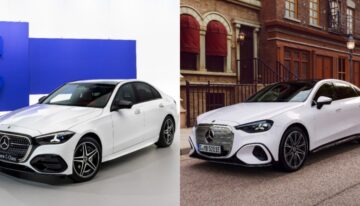
The Mercedes-Benz name turns 100 in 2026. One of the places marking the anniversary is half a world away from Stuttgart: the first floor of the Petersen Automotive Museum in Los Angeles. “World-Class: 100 Years of Mercedes-Benz” runs from May 23, 2026 to April 25, 2027, and the city is a fitting host.
“For over a century, Mercedes-Benz vehicles have set the industry benchmarks for luxury and performance,” says Terry L. Karges, the Petersen’s executive director. “We witness that every day on the streets of Los Angeles.”
Here are the cars a Mercedes fan should not miss, and the modern models that carry their ideas forward.
Why 2026 is the 100th year
The exhibit marks the centenary of the 1926 merger between Daimler and Benz, which created the Mercedes-Benz name. The Petersen’s own summary doesn’t hedge: “No other carmaker has been responsible for such a vast range of vehicles across so many categories.”
That is all the background a visitor needs. The rest of the exhibit is about the cars.
The 280 GE and the G-Class that followed
Of the cars on the Petersen’s list, the 1981 280 GE may feel the most familiar. Put it next to a new G-Class and the family resemblance is obvious: upright glass, flat body panels and a shape that still looks drawn with a ruler.
The G began as a working vehicle. According to Mercedes-Benz, development started in 1972 as a cooperation between Daimler-Benz and Austria’s Steyr-Daimler-Puch. The model series 460 arrived in 1979, built by hand at the Graz plant on a solid ladder-type frame with coil-sprung rigid axles. It came with two wheelbases and five body variants. Early customers included Germany’s riot police and Federal Border Guard, and in 1983 Jacky Ickx and Claude Brasseur won the passenger-car category of the Paris-Dakar Rally in a 280 GE.
The G has been reworked many times since then, and today’s car is a far more modern machine, but the 280 GE’s silhouette is still easy to spot in it.
In Los Angeles, the G has become part of the scenery. Spend an afternoon on Sunset Boulevard or Melrose Avenue and you’ll likely pass several. That makes the 280 GE an easy car to connect with: it is the ancestor of something you probably saw on the drive in.
From the 600 Pullman to the Maybach S-Class
The 1971 600 Pullman Landaulet is the grandest car in the room. Mercedes-Benz unveiled the 600 at the Frankfurt motor show in September 1963. Its archive describes the car as a new prestige car and the top-of-the-line model, offered as a standard sedan or as a seven- to eight-seat Pullman. The Landaulet goes one step further, with a folding top over the rear seats so the passengers can be seen. The Pullman stayed in production until 1981.
This was a flagship built around the people in the back, often with a chauffeur up front. Today that role belongs to Mercedes-Maybach, which Mercedes-Benz runs as its own sub-brand: the Mercedes-Maybach S-Class carries the chauffeur-car idea forward, and the GLS 600 brings it to an SUV.
Seeing the 600 in person makes the lineage easy to follow, from the chauffeur cars of the 1960s and 1970s to their modern successors.
AMG before it was a badge
Today AMG is a Mercedes-Benz brand, but it did not start as one. According to Mercedes-Benz, Hans-Werner Aufrecht and Erhard Melcher, both former Mercedes employees, founded AMG in 1967 in an old mill in Burgstall to develop racing engines. A 1990 cooperation agreement opened Mercedes’ sales network to AMG. Aufrecht sold a majority stake in 1999, and Mercedes-AMG has been wholly owned since 2005.
The exhibit shows both sides of that story. The independent years are represented by the 1984 500 SEC “5.4 Wide Body” by AMG and the 1987 300 TD Turbo “Hammer” by AMG, two cars that show how far the tuner would take a Mercedes before the 1990 agreement. The later years bring the 2005 CLK DTM AMG, the 2009 SLR McLaren Stirling Moss and the 2014 SLS AMG Black Series.
The motorsport and engineering cars run alongside them. The list includes the 1989 Sauber-Mercedes C 9, the 1991 C 112, the 2002 CLK-GTR Roadster and a 1990 190 E 2.5-16 Evolution II. There’s also a nice surprise: a 2006 Smart Roadster-Coupé Racing Edition. For anyone who drives a modern AMG, this part of the exhibit explains where the badge’s reputation came from.
Planning the visit, and driving the modern version afterwards
The Petersen is at 6060 Wilshire Boulevard, on the stretch of Wilshire known as Museum Row, roughly midway between Downtown Los Angeles and Santa Monica. “World-Class” is on the first floor until April 25, 2027. Check the museum’s exhibit page for tickets and admission before you go. Cars can rotate during a long exhibition. If there is one you have crossed an ocean to see, it’s worth confirming it’s still on display.
If you are flying in, a few details help. The museum’s visit page lists daily hours of 10 a.m. to 6 p.m., with check-in closing at 5:30 p.m., and the museum is closed on Thanksgiving Day, November 26, 2026. “World-Class” is included with museum admission, so the exhibit needs no separate ticket. The Vault is different: the museum lists ticket options with it included, and its last call is 5 p.m., so if you want both, see the Vault first and come back up to the Mercedes floor afterwards. Allow a good hour for “World-Class” alone, longer if the AMG and racing cars are your reason for the trip.
Visitors who walk out of the exhibit wanting to drive the modern descendants can arrange a Mercedes rental in Los Angeles; the Maybach S 580, the Maybach GLS 600 and the AMG G 63 all turn up in local rental fleets.
From Museum Row, the Pacific Coast Highway and the canyon roads above Malibu are within reach for an afternoon drive.
A century on one floor
A hundred years is a long time for any carmaker to keep a clear identity. Walk from the 280 GE to the 600 Pullman to the SLS Black Series and you see how Mercedes-Benz has managed it: each era’s best ideas survive into the next. For a Mercedes fan, that makes the Petersen worth the trip.