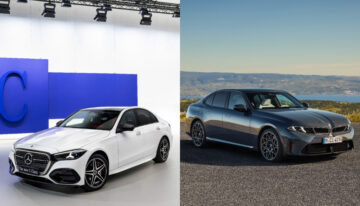
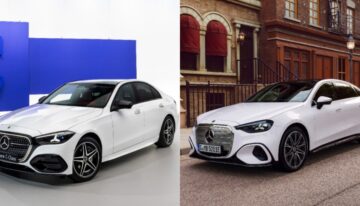
With the facelift of the Mercedes C-Class ICE, the exterior design has adopted some elements from the electric model, while still remaining distinctive. But which is the better choice? Mercedes C-Class ICE facelift or the Mercedes C-Class Electric?
Mercedes C-Class ICE and the electric C-Class share the same name, but they are very different cars, even after the facelift of the C-Class ICE, which has brought the designs of the two models closer together. So, which is the better choice?
Design with many similarities, but also many differences
After the facelift, the Mercedes C-Class adopted, like the electric C-Class, a radiator grille with a chrome frame and optional illuminated outline, while, depending on the market, the logo can also be illuminated. However, the grille texture is different from that of the electric C-Class, featuring a structure made up of hot-pressed three-pointed stars.
The Mercedes C-Class electric also has a grille with a chrome frame and optional illumination, but its structure is different, with a smoke-glass imitation at the bottom and three slats with two air vents between them, integrating 942 polycarbonate dots illuminated from behind. Again, depending on the market, the central logo can also be illuminated as an option.
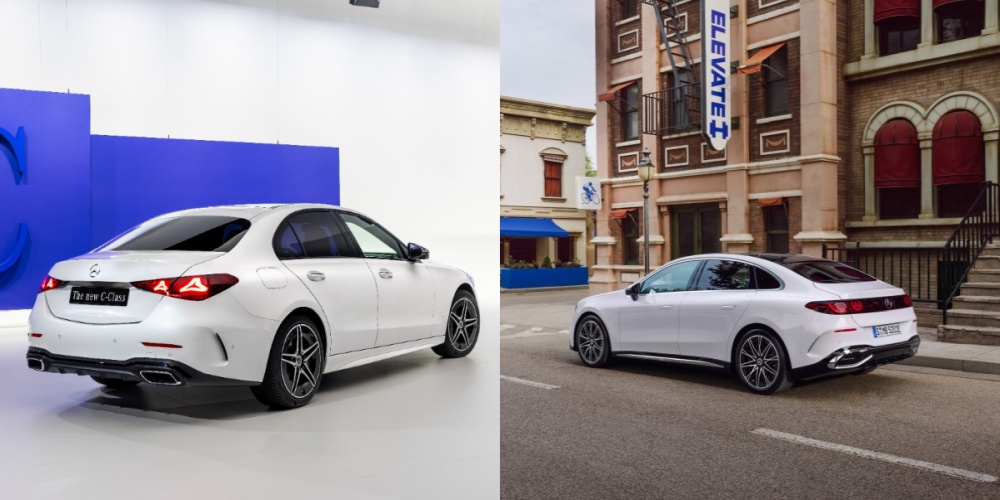
Interestingly, the light signature incorporating the brand’s logo in the headlights is similar on both models, while the rear light signatures are completely different. The ICE model adopts a light signature incorporating the brand’s logo, similar to that of the E-Class, while the electric version features a light signature with just two circles in each taillight, inspired by the AMG GT 4-Door Coupé.
Last but not least, the ICE model has conventional exterior door handles, while the electric C-Class can optionally be ordered with flush door handles integrated into the bodywork.
The Mercedes C-Class electric is larger and more spacious
The electric version is noticeably larger in every dimension. At 4,883 mm long, 1,892 mm wide and 1,503 mm high, it is 117 mm longer, 72 mm wider and 65 mm taller. Its 2,962 mm wheelbase is also 97 mm longer, providing more rear legroom.
The electric version also has a larger boot, with 470 litres compared with 455 litres in the ICE C-Class and just 315 litres in the plug-in hybrid versions. In addition, the electric version has a spacious 80-litre frunk.
Due to its very heavy 100 kWh gross battery, the Mercedes C 400 4Matic electric weighs 2,460 kg, which is 320 kg more than the most powerful C 400 e 4Matic plug-in hybrid and 610 kg more than the most powerful C 250 d 4Matic diesel version.
Completely different interiors
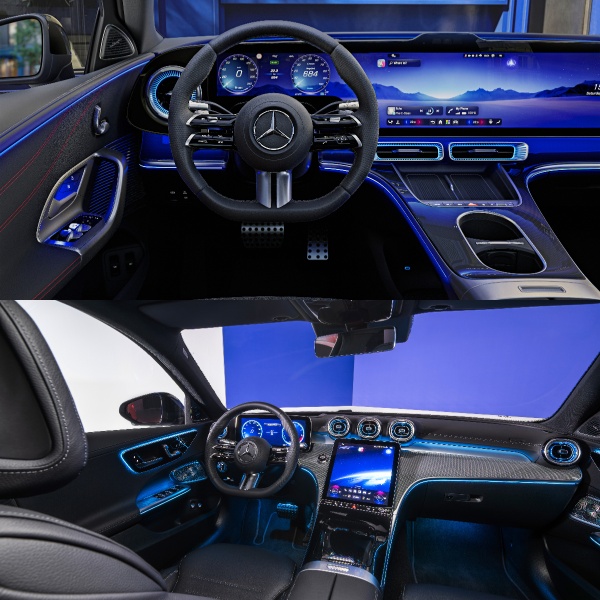
The facelifted Mercedes C-Class has retained the 11.9-inch portrait-oriented central display, which is completely different from the setup in the C-Class EQ, as well as from that of the E-Class and S-Class. Mercedes has chosen this approach in order to maintain a clear design distinction between the C-, E- and S-Class.
Although it has retained the same layout as before the facelift, the facelifted Mercedes C-Class has switched to Google Maps-based navigation and adopted Google services, as well as AI technology from Google, Microsoft and ChatGPT.
The 11.9-inch portrait display, tilted vertically towards the driver, is an elegant solution. It offers excellent visibility, while the menu icons are large and easy to access.
The Mercedes C-Class electric comes with three 12.3-inch displays. Only when opting for the Advanced Plus with Digital Extras package (€3,570) can the superb Hyperscreen be ordered. It stretches across the entire width of the dashboard and costs an additional €1,487.50.
Different platforms and suspension configurations
The Mercedes C-Class ICE is based on the MRA II platform, which is also used by the E-Class and S-Class, but it cannot be configured with adaptive air suspension like its larger siblings.
The car comes standard with conventional steel-spring suspension and can optionally be configured with:
- sports suspension (€404.60)
- adaptive suspension as part of the Agility & Comfort package (€2,802.45), together with rear-axle steering.
The Mercedes C-Class electric is based on the new dedicated MB.EA electric vehicle platform and comes standard with steel-spring suspension.
Airmatic air suspension can be ordered as an option as part of the Agility & Comfort package (€2,844.10), together with rear-axle steering with a steering angle of 4.5 degrees.
Engines and prices
For now, the Mercedes C-Class electric is available only in the range-topping C 400 4Matic version, featuring two electric motors producing 489 HP and 800 Nm, powered by a large 100 kWh gross battery (94 kWh net), which promises a WLTP range of 673 km (441 km in our test).
However, as with the electric GLC, other versions will become available in the near future: the C 250 with a single 354 HP motor on the rear axle and the C 300 4Matic with two motors producing a total of 421 HP. Both will feature the smaller 85 kWh net battery, offering ranges of 647 and 613 km, respectively.
On the other hand, the Mercedes C-Class ICE is available with three petrol versions (C 200/177 HP, C 250/C 250 4Matic with 218 HP and C 300/258 HP), two diesel versions (C 200 d/163 HP and C 250 d/C 250 d 4Matic with 200 HP) and two PHEV versions (C 300 e/C 300 e 4Matic with 218 HP + 136 HP electric motor, for a total of 354 HP, and C 400 e 4Matic with 258 HP + 136 HP electric motor, for a total of 394 HP).
All diesel and petrol versions feature a 48V mild-hybrid system with a 23 HP electric motor integrated into the nine-speed automatic transmission.
The same nine-speed automatic transmission is also used in the PHEV versions, which feature a much more powerful 136 HP electric motor compared with the 23 HP unit in the mild-hybrid models. This allows them to travel purely on electric power for around 100 km, thanks to the 19.53 kWh net battery mounted beneath the boot floor. The battery can be charged at AC stations at up to 11 kW or DC stations at up to 55 kW.
The Mercedes C 400 4Matic electric starts at €67,411, making it cheaper than the C 400 e 4Matic, which has almost 100 HP less — 394 HP versus 489 HP. Despite being much heavier, the Mercedes C 400 4Matic electric accelerates from 0 to 100 kph in just 4 seconds, compared with 5.3 seconds for the C 400 e 4Matic plug-in hybrid.
The most expensive diesel version, the C 250 d 4Matic, costs €59,821, while the most expensive petrol version, the C 300, starts at €60,279.
But below you can find the complete price list.
| Mild Hybrid petrol | Power | Price (euro with VAT) |
|---|---|---|
| Mercedes C 200 | 177 HP + 23 HP electric motor | 48,843.55 |
| Mercedes C 250 | 218 HP + 23 HP electric motor | 54,793.55 |
| Mercedes C 250 4Matic | 218 HP + 23 HP electric motor | 57,173.55 |
| Mercedes C 300 | 258 HP + 23 HP electric motor | 60,279.45 |
| Mild Hybrid diesel | ||
| Mercedes C 200 d | 163 HP + 23 HP electric motor | 53,335.80 |
| Mercedes C 250 d | 200 HP + 23 HP electric motor | 57,441.30 |
| Mercedes C 250 d 4Matic | 200 HP + 23 HP electric motor | 59,821.30 |
| Plug-in Hybrid | ||
| Mercedes C 300 e | 218 HP + 136 HP electric motor | 66,645.95 |
| Mercedes C 300 e 4Matic | 218 HP + 136 HP electric motor | 69,025.95 |
| Mercedes C 400 e 4Matic | 258 HP + 136 HP electric motor | 73,547.95 |
| Electric | ||
| Mercedes C 400 4Matic | 489 HP | 67,711 |