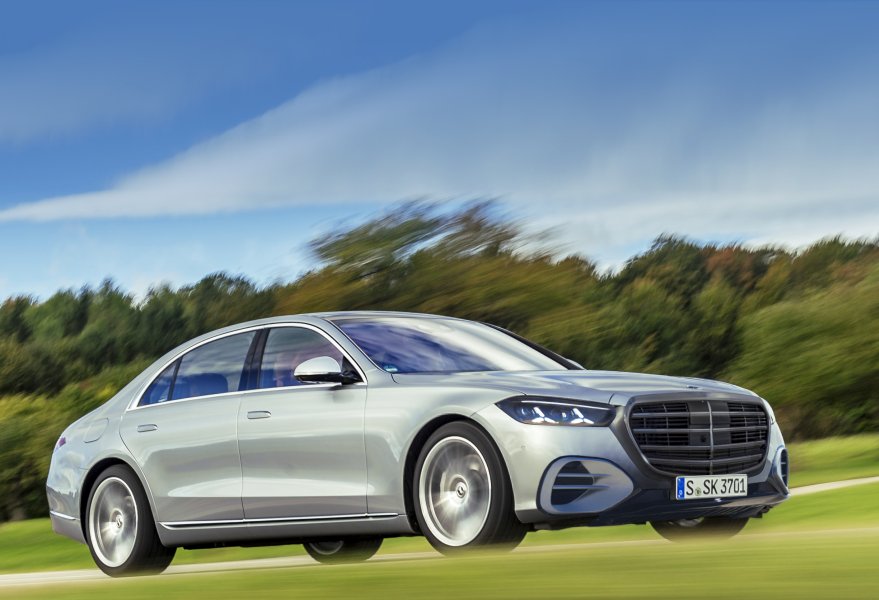
On January 29, 2026, the world premiere of the Mercedes S-Class facelift will take place at the Mercedes museum in Stuttgart. After previously presenting the first design details, we now return with information about technical modifications.
Photo: Mercedes-Benz, computer picture Marian Cilibeanu
Launched in September 2020, the Mercedes S-Class will undergo a major facelift at the beginning of this year. According to Mercedes, this facelift is “the most extensive update in the history of the S-Class.” In this regard, it is stated that around 2,700 components are new or revised, representing more than 50% of all components.
We have already written about all the design changes, and now we will focus on the technical details.
New V8 engine with flat-plane crankshaft
The major novelty is the M177 Evo V8 engine. “Evo” refers to the fact that the M177 abandons the cross-plane crankshaft in favor of a flat-plane crankshaft.
The M177 with a cross-plane crankshaft equips numerous Mercedes models, such as the AMG GLS 63, Maybach GLS 600, and AMG S 63 E Performance, as well as some Aston Martin models like the DB11 V8, DBX, and Vantage V8.
A flat-plane crankshaft has crank pins positioned at 180 degrees, while a cross-plane crankshaft has them positioned at 90 degrees. This results in a distinctly different sound. Cross-plane crankshaft engines have a firing order of 1-8-4-3-6-5-7-2 and, with two consecutive exhaust firings on one bank, they generate the typical muscle-car rumble.
On the other hand, flat-plane crankshaft engines, regardless of firing order, alternate between cylinder banks. In addition, they do not require counterweights and can therefore operate at higher engine speeds.
The Mercedes S 580 facelift will be the first Mercedes model to use the new M177 engine with a flat-plane crankshaft. It will produce 538 PS and 750 Nm, which is 35 PS and 50 Nm more than the current model. The power increase was achieved not only thanks to the new crankshaft layout, but also through optimization of the injection system, valve timing, intake, and exhaust ports. The M177 engine will also continue to use 48V mild-hybrid technology.
Revised six-cylinder engines
The S 450 and S 500 models will receive the revised M256 Evo inline six-cylinder engine. The 3.0-liter unit will deliver higher maximum torque of 600 Nm, up from 560 Nm previously, and will also offer a boost function that temporarily increases maximum torque to 640 Nm. Mercedes has not specified whether the 449 PS output of the S 500 will increase.
Plug-in hybrid with over 100 km electric range
The top PHEV model, the S 580 e, will feature a more powerful powertrain, delivering 585 PS—75 PS more than the current model. Mercedes also promises that the electric-only range of over 100 km will be maintained despite the increase in power.
Diesel remains in the lineup
As announced, the diesel engine remains part of the lineup, and Mercedes has adapted it to meet Euro 7 standards. In this context, the OM 656 Evo engine in the S 350 d and S 450 d models is the world’s first production diesel engine to feature an electrically heated catalyst, which significantly reduces cold-start emissions.
Modified AMG S 63 version
The new top AMG model will drop the “E Performance” designation from its name, as it will abandon the P3 Hybrid PHEV system with an electrified rear axle in favor of a 48V mild-hybrid system.
By eliminating the 190 PS rear electric motor and the 10.36 kWh battery, the enormous curb weight of 2.6 tons is expected to be significantly reduced.
Thus, the future AMG S 63 will use the new M177 V8 engine with a flat-plane crankshaft, capable of higher revs and therefore higher output than the 612 PS of some current AMG models. With 48V mild-hybrid technology, the new engine will deliver over 700 PS, and given the reduced weight, performance is expected to be at least on par with the current AMG S 63 E Performance.
Improved equipment
Rear-axle steering with a 4.5-degree angle will be standard, as on electric models, while rear-axle steering with a 10-degree steering angle will be optional. This allows the turning circle to be reduced by almost 2 meters on the long-wheelbase version. The air suspension will also use cloud-based damper control.
Mercedes has neither presented nor provided any details about the interior, but as previously reported, it appears the brand will abandon the portrait-style display in favor of a Superscreen layout from the new E-Class. The MBUX multimedia system will also use the new MB.OS software, which would mean navigation will use Google services.
On the occasion of presenting its 2025 sales results, Mercedes announced that later this year a facelift will also follow for the Mercedes-Maybach S-Class and the GLS SUV.